Tag Archives: Interview

How Your Local Church Can Engage Immigrants: Interview with Rev. Zach Szmara

Recently Wesleyan Accent Editor Elizabeth Glass Turner chatted with Rev. Zach Szmara, the founder of one of the first immigration legal clinics within a church building, about sanctuary, immigration law, and cross-cultural ministry at home. Rev. Szmara is the Lead Pastor of The Bridge in Logansport, Indiana, a congregation within The Wesleyan Church. He is the National Director of Immigrant Connection – a growing network of over 14 church-based legal sites  – and has provided immigration legal services experience to over 150 church leaders from a variety of denominations.


Wesleyan Accent: What are some of the most common questions you encounter from clergymembers who are uncertain about whether or how – or whether – to integrate immigration-related ministries in their congregation?

Zach Szmara: People wonder if it’s legal or not to serve immigrants.  The reality is that we’re providing immigration legal services – which means we’re using the immigration law as it is currently written to help people navigate through the process if there is a pathway for them.  Many times there is a pathway, but it is complex and confusing.  So in the same way many people utilize a professional tax preparer because tax law is complicated and they want to make sure they pay whatever taxes they are legally supposed to (not more, not less), we do the same thing for immigrants – we help them navigate a complicated legal pathway.

Furthermore, I remind people that some of the church’s best moments have been when we’ve advocated for, learned from, and stood with marginalized people who were caught up within unjust systems – so while it’s not illegal to serve immigrants, even if it were I believe we should still do it (think of the church and the Underground Railroad).

If starting a full legal office doesn’t make sense within the church’s context, some great first steps are to preach on immigrants and immigration, to lead a small group study (we have materials we recommend), or to start a citizenship class.

WA: You’re not a lawyer. How can you have a legal clinic?

ZS: The short answer is that the Department of Justice opened a pathway in the 1980’s so that through a nonprofit an individual can receive training (education) and shadowing (experience) in immigration law. Then she or he can apply to the Department of Justice, United States Citizenship and Immigration Services, and Department of Homeland Security/Immigration and Customs Enforcement and the legal site receives recognition while the individual receives accreditation to practice immigration legal services.

The training (education) part can be done two ways.  Most choose to attend a 40-hour training event, so it literally takes one week onsite.  Then the individual can do several other webinars on their own.  The second way is an online course which usually takes place over a few months.  I recommend the 40-hour training personally.  The shadowing (experience) part can be done by volunteering a number of hours at an existing site over several months or doing one of our Immigrant Connection Shadowing Experiences – which gain is one full week (40 hours) of intensive experiential learning.

So if someone does 40-hour training and 40-hour shadowing, they can be ready to go within weeks, and then it usually takes about a month to put together the application packet and they can apply for recognition and accreditation.  It usually takes about three months for all three governmental offices to review the application and approve it.

We’ve had local churches decide to launch a site and go through the process in as quick as five to six months from start to approval.

So we cannot do everything an attorney can do, but within the area of immigration law, we can legally provide legal services. I’m not a full-fledged attorney – I cannot do family law or criminal defense or any other area of law – just immigration.

WA: What are two or three facts that pastors should know about sanctuary, immigration law, and local engagement?

ZS: Many times pastors don’t realize that it’s illegal to practice law without a license, so they aren’t able to help immigrants with any paperwork or forms unless they take courses and get accredited by the Department of Justice.  It’s best for them to find and partner with a recognized site – you can find them here (https://www.immigrationadvocates.org/nonprofit/legaldirectory/ or download the Immigo app).

When it comes to sanctuary, there is no form to fill out to become a sanctuary site. ICE has said that they will refrain from engaging in enforcement operations at schools, medical and health care facilities, places of worship, and during public demonstrations such as marches and rallies.  In other words, all local churches are safe places and sanctuaries for immigrants.

The sanctuary movement is different and historically focused on garnering media and community attention for an individual or family who would be deported if a church didn’t step in to try to get the story of the individual or family heard, helping the community to rally behind them in the hopes an immigration judge may grant discretionary relief.

Finally, I remind all pastors that they don’t know what they don’t know; many people have ideas about immigrants and immigration that are unfounded. It’s important to realize that many of the key phrases utilized (“wait in line like my family did” or “illegal immigrants don’t pay taxes and steal our jobs”) are inaccurate.  The “line” is radically different than when many peoples’ families immigrated to the United States in the early 1900s. Even if there is a “line” (and many times there isn’t) the wait is over 10-20 years long.

WA: What’s the cost of starting an immigration law clinic in a church?

ZS: It depends on the network, denomination, and organization that the church partners with.  The Wesleyan Church is unique in that we launch Immigrant Connection sites for $5,000-$7,000 – but we are definitely at the lowest end of the spectrum.  We focus on churches doing this as a ministry and start by staffing sites with focused volunteers.  If a site needs to pay overhead costs and staff salaries – the starting cost raises substantially.

WA: What’s an example of some of the impact you’ve had?

ZS: There is no short example: our legal sites have impacted over 80 different countries. We reunite families, we help students have the ability to attend college, we help immigrants who were victims of crime find redemption of the very worst thing that occurred to them and receive a legal pathway forward, we help refugees become legal permanent residents, we help legal permanent residents become citizens, we help international pastors receive R visas to pastor churches and plant churches in the U.S., we have front-row seats to watch God transform lives and bring hope and a future into areas that are filled with animosity, confusion, and hopelessness.

WA: Many churches have separate worship services based on language. Why don’t you? Isn’t that awkward? How does it work logistically? What’s the benefit?

ZS: I’m glad in heaven there will only be one worship service even though it will be made up of people from different cultures, ethnicities, and languages.  While it may work to break up ethnicities, cultures, and languages in certain contexts, I feel my community has diversity in our schools, hospitals, banks, gyms, shopping centers – why not in church too?

When we segregate services based on languages, we break up immigrant and refugee families in which one generation leans into one language but the next generation leans into another language.  We also separate the majority population from learning from the minority population – and there is so much that white, English-speaking Christians need to learn from the immigrant, non-English speaking population.

It is awkward and it is hard and it is complicated and it is uncomfortable – but our goal is that it’s just as uncomfortable for a white English speaker as it is for a Spanish-speaking Latino. For too long we’ve had the wrong goal when it comes to multi-ethnic churches: what we’ve created is “multi-colored” white churches. In other words, these churches are very mono-cultural; it’s easy to attend as a white person because everything is still your worship style, your cultural way of doing things. You’re not uncomfortable in the least and you feel good because people of other ethnicities have assimilated to your way of doing things, so you can pat yourself on the back because there are different colors present in your worship.

But the goal for us is not assimilation but to be truly multi-cultural, which means everyone will be uncomfortable and confused at different times, everyone will have to give up a part of their preferences to be a part of our church.

The benefit for me is that I believe I’m called to build for Jesus’ kingdom – that I’m called to create signposts that point to Jesus, to his hope and his future – and I believe his kingdom coming means diversity. There will be multiple languages and cultural differences and multiple ethnicities in heaven (at least there were in John’s revelation of eternity) and so I don’t want to create some monocultural unity or sameness. I want to create a rich, diverse togetherness that is unity, but is not uniformity.

What I’ve Learned Working with Refugees and Immigrants: Interview with Josh White

A Note From The Editor: Recently Wesleyan Accent was able to chat with Youth Specialist Josh White about his role in caring for unaccompanied alien children who arrive in the United States. He also operates EQ Roasters, a small fair-trade coffee roasting enterprise aimed at encouraging economic stability in nations from which many unaccompanied minors come. An avid musician, his work can be found here.  He and his wife attend City Life Church, a multicultural Wesleyan church plant in Grand Rapids, Michigan.


Wesleyan Accent: You have a degree in music. How did you get involved with working with immigrants?

Josh White: I majored in music theory and composition at Indiana Wesleyan University, which I knew was more of a career/life-style degree than a “job” degree. For about two and a half years after graduating, I worked in the shipping department of a crafting goods warehouse, and was absolutely miserable. One of my close friends knew that I was looking for a new job, and put in a good word for me at a residential home that served UAC (unaccompanied alien children) teenagers. I interviewed, got the job, and started working.

That’s how I got into working with immigrants, but what kept me there was the fact that it allowed me to live out the values of Christ every day. I was able to feed the hungry, clothe the naked, care for the orphan, and welcome the stranger! What more could you ask for?

WA: What’s the general age range of the immigrants or refugees with whom you work? Where are some the places they’ve come from? What are some of the common reasons they’ve arrived in the United States?

JW: I mostly work with 16 to 18-year-old boys that come from all over the world. Our largest demographics are Central American and African teens. Most of the boys who we serve are fleeing gang violence or extreme poverty. Typically, the boys from the cities are fleeing violence, whereas the boys from the rural areas are fleeing extreme poverty and coming to the United States to work and send money home to their families who are struggling to survive.

WA: What’s a “typical” day like with someone who is really only a kid but who is living in a new country away from their family members, language, etc.?

JW: Most days it is easy to forget what most of these young men have been through in their short lives. They are teenagers and often act like teenagers, but rarely if ever show any behaviors that aren’t commonly exhibited by domestic teenagers. The language barrier is a universal theme within the home, but some boys handle it well and view it as motivation to learn and grow, and others can become discouraged because learning a new language is very difficult and takes a lot of work.

The family issue is one that really breaks my heart and that I wish more Americans could understand. Generally speaking, a lot of immigrants do not come to the United States because they just want to become rich or have a better life for themselves. People do not just leave everything they know and love for no reason. Immigration is not the problem. Global instability is the problem. These teens would never have left their families, their homes or their countries if they did not have to leave to survive or to provide.

This is why I have started a coffee company called EQ Roasters, and it is our mission to help stabilize communities around the world by paying them fair prices for their coffee and helping them become economically stable through their work, not through foreign aid. All coffees that we offer were purchased from the farmers or co-ops at at least 150% of Fair Trade prices.

WA: When unaccompanied minors age out of your care, where are they able to land, so to speak? Where do they go from there?

JW: Our program’s entire purpose is to teach our boys independent living skills so that they can survive on their own in the United States. Once a boy graduates our program, he is able to go to either independent living or semi-independent living which is somewhere between living on your own and living in foster care. Once they leave our program they stay within the larger program and still have a case manager who follows up with them on things like school, health, legal status, etc. The boys receive small stipends to help pay for housing and food as long as they continue to go to school or get a job in which they work full-time.

WA: What’s been one of the most surprising things about the work you do? What are the most common misconceptions? Have you ever received negative feedback about helping immigrants?

JW: The most surprising thing to me should not have been surprising at all, and that is that these boys are incredibly resilient. Oftentimes, they have lost everything, and yet they keep going. They keep fighting to make a new life. They are driven to make the most of the opportunities that they have been given.

I think that one of the most common misconceptions is that people who came over illegally are criminals. The sad truth is that emigrating to the U.S. legally is incredibly difficult for most, and simply impossible for others. When you have a gang that tells you, “Join us or die,” what do you expect them to do? Do you want them to be another teen forced into the gang life? Or should they just sacrifice their life for refusing to join the gangs?

I have never personally received negative feedback for working with this population, but I know that we have received some negative feedback from the community for the work that we do. I have had to have a lot of educational conversations with people, because most of us are just misinformed until we start working with the issues directly.

WA: What about young immigrants and refugees gives you hope?

JW: The characteristic of young immigrants that gives me the most hope for the future is their desire to give back. In a nation full of people who are concerned with getting their share, there is an entire group of young people that already has more than they could have ever hoped for, and now they want to use what they have been given to help others.

In Their Words: How Pastors Pray for Their Children (And Raise Them In The Church)

A Note From The Editor: Recently Wesleyan Accent posed a couple of questions to pastors and their spouses about how they pray for their children while in ministry, and how they choose to shape their kids’ experience of vocational ministry. Here are their responses.

Elizabeth Glass Turner


Wesleyan Accent: What are some ways you prayed for your children while they were growing up as you served in ministry?

Rev. Carolyn Moore, Founding Pastor of Mosaic UMC in Evans, Georgia: My husband and I have prayed together every night for most of our daughter’s life. When she was young, she’d crawl into our bed with us before going off to her own, and we would pray over her. We always prayed for God’s hand over her life, and we prayed for her future spouse. As she got older, she always knew we were there, praying for her, night after night. Of course, she prayed with us over our church and we prayed with her over things she was involved with at church. She grew up knowing the language of prayer, and feeling comfortable with prayer.

Rev. Andy Stoddard, Lead Pastor at St. Matthew’s UMC in Madison, Mississippi: We as a family gather together in one of our children’s rooms, we read a passage, talk about it for minute, and then we pray and go to bed.  I’ve often wondered if we should do more. But for us as a family, this little routine works for us.  We try to be real people who love Jesus, not spiritually perfect saints.  My daughter and I on the way to school listen to Christian music on K-Love, but we are just as likely to listen to Taylor Swift or some other Top 40 song.

Rev. Adam Lipscomb, Pastor at City Life Church in Grand Rapids, Michigan: Lately we’ve been praying that they just understand how deeply God loves them.

Rev. Kelli Ward, Connections Pastor at Forest Hills Wesleyan Church in Evansville, Indiana: We’ve discussed our prayers for our children and how we pray for our children to have a healthy understanding of the church. That they would have a healthy understanding of church as a family, complete with struggles and victories, grief and celebration.

Rev. John Gargis, Associate Pastor of Evangelism at Fountain City UMC in Knoxville, Tennessee: I pray they land in an area of life that they enjoy and fit their spiritual gifts. I pray they are a light.

Dr. Otis T. McMillan, Director of Evangelism in the A.M.E. Zion Church: Below is a sample of the prayer we prayed for our children and with our children. Barbara and I had weekly Bible study in our home:

Father God, although you have entrusted these children to us as a gift, we know they belong to you. Like Hannah offered Samuel, we dedicate our children to you, Lord. We recognize that they are always in your care. Help us as parents, Lord, with our weaknesses and imperfections. Give us strength and godly wisdom to raise these children after your Holy Word. Please, supply supernaturally what we lack. Keep our children walking on the path that leads to eternal life. Help them to overcome the temptations of this world and the sin that would so easily entangle them.

Dear God, send your Holy Spirit daily to lead, guide, and counsel them. Always assist them to grow in wisdom and stature, in grace and knowledge, in kindness, compassion and love. May our children serve you faithfully, with their whole heart devoted to you all the days of their lives. May they discover the joy of your presence through daily relationship with your Son, Jesus. May they become part of the solution in this world but never a part of the problems. Help us never to hold on too tightly to these children, nor neglect our responsibilities before you as parents.

Lord, let our commitment to raise these children be for the glory of your name. Cause their lives forever to be a testimony of your faithfulness. In the name of Jesus, I pray.

Wesleyan Accent: Did you deliberately shape their exposure to ministry and church life?

Dr. David Smith, Dean of Wesley Seminary in Marion, Indiana: Angie and I did not separate ministry into a compartment. We simply did “Kingdom life together” with our entire family. They were never excluded from the hard stuff and always were able to celebrate the high points. It seems to be a better reflection of what life is like; fully integrated in the walk of faith.

Rev. Adam Lipscomb: There have been times, especially early in the church plant, when we had people specifically assigned to them for Sunday mornings, one on one. We were both busy on Sunday mornings doing all the pastor/connect stuff.

I’ve made sure that I intentionally disciple the boys outside of church. For me, when we meet one on one, I took them through the story of the Bible and we had a little rhyme to keep the major stories in place in their heads. Our oldest son loves the Action Bible. When they were younger, we read through the Jesus storybook Bible.

Rev. Carolyn Moore: Not really, though we didn’t make her show up for every single thing. And we certainly never required that she act in a certain way around church people. We wanted her to have a genuine experience of community. She never questioned that she would be in church on Sunday mornings and at youth group on Sunday evenings. And she was always very comfortable with the people who came to our home for meals and groups. She would say that Mosaic helped raise her, and that the authenticity of that community shaped her understanding of “good church.”

Rev. John Gargis: My focus is Celebrate Recovery. They have seen people make it…not make it…and even go on to glory.

Rev. Kelli Ward: We have been deliberate in shaping their exposure. But in more ways, we have endeavored to be consistent in our own integrity. For instance, we don’t talk negatively about the parishioners in front of the children, not because we reserve those conversations for times when they are not around, but rather because we prayerfully look to God to transform our hearts in negative situations.

Rev. David Drury, Chief of Staff for the General Superintendent of the Wesleyan Church: I have used some ministry experiences to expose my kids to things others don’t get the opportunity to do. I see them as helpful windows into my ministry, so they understand what I do, and also just to help them be better Christians. So I have taken them with me on hospital visits, to pray with people, to funerals, etc.

Rev. Andy Stoddard: For our family in ministry, we try as best as we can to be authentic.  My wife and I try our very best not to be spiritually two-faced.  We try to act the same, live the same, talk the same, be the same at home as we are in church.  I will not act imperfect in my “real” life and then act perfect in my “preacher” life.  I try to own my brokenness and imperfection as a preacher.  we just try to be real in our faith, authentically Christian.  And my hope is that will lead my children to love the church as much as I do.

In Their Words: When Pastors Face Prejudice

A note about the following reflections from Black and Hispanic clergy: These accounts have been given by denominational leaders, academics and clergy from across Wesleyan Methodist denominations. As a white editor, I have been keenly conscious of the weight of holding these testimonies with care and respect. Content has been edited for length. As much as possible, editorial work has been extremely light in order to stay out of the way and allow the words and accounts to speak for themselves. Ministry is not easy and white pastors have many stories of difficult parishioners or hard seasons. These accounts illustrate the unique individual histories of minority pastors – and the unique challenges they continue to face on top of regular ministry demands.

Elizabeth Glass Turner


“It took me some time to share these reflections because in recalling these experiences, it was like pulling the Band-Aid off the wound. Some wounds never really heal because another one plops on top of it. They just become scar tissue that irritates us under the skin.” – a contributor

Wesleyan Accent: Have you ever been called a racial epithet? If so, what were the circumstances?

Rev. Dr. Joy Moore, UMC: I have often described my youth and young adulthood as living in a gap in history, a period of promise somewhere between my 5th and 12th birthdays as I experienced life under the protection of my parents. It would be the summer after my freshman year of high school when I would be confronted with my racial status. A friend and I had volunteered to work in a Catholic program for impoverished inner-city youth in Milwaukee.  One day, as we walked back to where we were staying, a few younger boys rode around us on their bikes shouting at us. My friend was visibly shaken by their taunts. I, with a newly attained teenage defiance, questioned the pre-teens as to whom they were referring. My friend stared with incredulity at my apparent unawareness that their characterization referenced us. But my simple question dispersed the bikers as quickly as their name-calling dispersed my innocence. It was the first time a white person had addressed me as “nigger”…

Rev. Yvette Blair-Lavallais, UMC: I was called a nigger while pulling out of the parking lot of a grocery store. Another motorist almost cut me off as I drove down the lot and I honked my horn. The passenger rolled his window down and hurled the slur at me, laughed and topped it off by flipping his middle finger at me. I was stunned and frozen for a few minutes, but I recovered and composed myself quickly and drove on away. The car was full of white boys and I wasn’t sure what else they might do.

Rev. Edgar Bazan, UMC: What is said with a simple scowl sometimes is even more powerful than words. There have been a few times when I experienced rejection because I am Hispanic and have an accent when I speak. Even though I am very confident of myself, it hurts to feel rejected because of who I am. What am I supposed to do, bleach my skin? Is my worth devalued because I moved to live in a different geographical area? Of course not, we know this if we are decent people. I know people that have been deeply hurt not just by looks but by actual hate-filled and ignorant racial slurs. It hurts me: things like, “wet-back, go back to your country, speak English, you are not American,” and so on.

Wesleyan Accent: Have you ever been physically or verbally harassed because of your race or ethnicity? If so, what were the circumstances?

Rev. Marlan Branch, AME: While living in Glencoe, IL, my dad was actually on the news because he worked in Evanston and would have to drive home late every day to Glencoe. He would get pulled over by the police at least twice a week once he reached the white neighborhood.

One time my friend and I were walking to his gymnastics practice on the North Shore. He was one year older than me and was black too. Here we were, two black boys – me in 7th grade and he in 8th grade. The police stopped us, searched his bag and our persons because we “fit the description.” Apparently there had been some robberies in the area.

Rev. Yvette Blair-Lavallais: I’ll speak from the point of being harassed in an academic setting and in a corporate setting. When I was an undergraduate, studying journalism, one of my professors said, “you dress so cute all the time. It’s like you’re white. You even wear your hair like a white girl. I don’t even wear nice clothes like that. And for the life of me I can’t figure out how you’re doing that because you’re not white. I’ve decided that I don’t like you.” Imagine my frustration, anger and disbelief that a professor, someone who is entrusted to present a fair and balanced environment in higher education, (instructing the class in balanced news coverage of all things) actually told me those words outright. She then used her white privilege to begin failing me in class. I ultimately passed the class but my work suffered because she intentionally always found fault with anything that I wrote.

During my career working as a communications director for a major national non-profit, I encountered harassment from a peer when I was promoted from a director position to a regional vice president position. The peer, who was in my same position (just in a different market) verbalized that the only reason that I was promoted is because I am black and that another team member, who had been at the company longer, should have been given that position. She said that I took that team member’s spot. Both team members were white. The working relationship became strained.

Rev. Dr. Joy Moore: Only by giving attention to history did I become aware that the announcement of the right to vote was not my achievement but a delayed right granted to United States citizens of my race. It would require a similar benefit of hindsight to learn that my father’s refusal to stop when we travelled was neither stinginess nor stubbornness in response to my naïve pleas for a bathroom. Rather, his concern was safeguarding his young family from humiliations levied as refusal of service. Because of this, I never heard the restaurant owner who told my parents if they came around to the back, he would make an exception to serve us since our family was fairer skinned. I didn’t yet comprehend the rest areas we frequented as we drove south were only for “colored.”

Later, when shopping alone back in Chicago, caught off-guard one afternoon, I stopped in a drug store to make an emergency purchase. Just as I picked up the package and turned toward the checkout counter, the Middle Eastern shop owner accosted me with an accusation of shoplifting.  Publicly, my person and purse was searched, displaying for all to see my wallet and the cash I was carrying while drawing attention to the lone item in my possession, a box of sanitary napkins. That afternoon I perceived the difference between humiliation and indignity, and the contrasting response each fuels in me. The former, shame; the latter, animosity.

The public elementary school education I received in segregated Chicago more than prepared me for private secondary education. So there would be no humiliation when I was again accused of wrongdoing during my freshman year of college. Upon reading my final paper for a sociology class, a male professor accused me of plagiarism, insisting, “no black student from Chicago could write like this.”

As the white sociology professor attempted to accuse my writing skills, the white English professor challenged the premise of my argument. Avoiding any stereotypes of African Americans, she enumerated the evidence of Asian mathematical acumen, the fiery tempers of redheads and simple-minded blondes. Knowing I had taken college-level English classes in high school, her dispute with my paper focused on its argument: nurture has more to do with development than nature.

Rev. Otis T. McMillan, AMEZ: I have been pulled over by two Moore county sheriffs, with their hands on their guns, with no explanation. They saw my sign on the back window and my clergy collar, they let me go.

Barbara and I were pulled over on NC 87 by a North Carolina Highway Patrolman, who said I was going a little fast. When I asked, “how fast was I traveling?” he said, “do you want the warning or do you want a ticket?”

Wesleyan Accent: For your personally, as an individual, what was the most painful experience you’ve had related to your race or ethnicity?

Rev. Yvette Blair Lavallais: The first time that I really began to understand that my race and skin color was considered “less than” is when I was in the first grade. My family had moved to a neighborhood that was slowly becoming diverse as more Black families began to call the area home. A little girl in my class named Ruthie, who played hopscotch with me and my other friends, was a little blonde-haired girl who spoke softly and wore her hair in a choppy pixie-cut. We had become fast friends and always played together at recess. I didn’t know it at the time, but Ruthie’s mother was disgusted that her daughter had made friends with a black girl. On a particular day that the mom rode her bicycle to pick up Ruthie, she instructed Ruthie to tell me that she was taking Ruthie out of our school and moving her somewhere else. When Ruthie related the news to me, these were the words that this little six-year-old girl struggled and stammered to say, being very careful to try not to tell me the exact words: “My mom says that I can’t play with you anymore because you’re black and we can’t be friends. I won’t be coming back to this school either.”

That very afternoon, my mother and I had a long talk about that quick yet painful moment. She explained to me that some people are just filled with hatred and that there will be people like that who exist in the world. To this day, I still remember that because it ultimately began to shape my experiences as a little black girl growing up in a society where parents didn’t bite their tongues to express how they felt about the way God had made me. And that I needed to know being in this black skin was a reason not to be friends with me.

The other defining moment is when I was in junior high school. It was open house night and I was helping my math teacher set up her room. Her daughter, who was about eight years old, walked up to me, stood up in a chair and came face to face with me. She looked me right in the eyes and said “I don’t like you because you’re black and I don’t like black people.” I was stunned but not so naïve to think that my teacher’s daughter uttering those words could possibly have just happened. Once more, my mom and I had a conversation about this occurrence.

Rev. Marlan Branch: I have had the fortunate opportunity to live and grow up in many different places. I’ve lived in the Deep South, the west side of Chicago, Glencoe (IL) where I and one other black girl were the only black kids in our grade from 6th to 8th grade, and Evanston (IL) which is a conglomerate of every demographic of people.

While in middle school I had to take a music class. I didn’t realize it then, but every class period the teacher would send me to a room by myself to “practice” and she would never come and teach me the music like the rest of the class.

I was the only little black kid in the class.

Wesleyan Accent: For you as an individual, what is the most common misconception you encounter about your race and identity?

Rev. Yvette Blair-Lavallais: The leading one is that we are all thieves and looking for an opportunity to steal something. I surmised that to be true on the day that I was stopped by a police officer. I was driving my brand-new SUV that I had saved up the down payment for and purchased. It was in my name. I was in downtown Dallas and had just pulled off from a “red to green light” when the patrol car came up behind me. The officer asked me whose car was this because it couldn’t possibly be mine. He told me that it was too expensive of a car for me to be driving. When I showed him my license, registration and papers, he was puzzled that the SUV actually belonged to me. I didn’t get a ticket, but I did get a reality check that once more being a black person driving a nice vehicle was “suspicious.”

Another misconception is that black women have the “black angry woman” syndrome. I was warned about this during one of my experiences in the ordination candidacy process in The United Methodist Church. I was told by a lay and a clergy person, “you’re very articulate for a black woman. You’d make a good associate pastor almost anywhere in this conference. Just make sure you don’t do like some of the other black clergy women we have and become known as the black angry woman.”

There is a misconception that black people don’t speak the King’s English, that we can’t make a complete sentence. When we shatter that perception, there is visible shock and surprise often accompanied by, “how did you learn to speak to eloquently?”

Wesleyan Accent: Do you estimate that the Church in general or local congregations specifically are more, less, or the same amount of welcoming than interactions in general society? Do you worship in a diverse congregation or one where you are a majority or a minority?

Rev. Edgar Bazan: In general, churches are places where one experiences hospitality and acceptance. As new guests or visitors we typically get a warm welcome. We are encouraged to join the church, which is great. But once we do and have spent time as insiders, we realize that to share power with someone that has a different heritage or race is not always as welcoming. I am troubled when I hear of a white church with a Hispanic ministry because typically they are “those people” or are the “Hispanic pastor congregation.”

Worshiping as a minority of non-white heritage means by default that we are not going to be in positions of power or influence unless we prove ourselves to be worthy. Yes, churches are typically healthier places than secular ones when it comes to race, but being welcoming is just a fraction of what it means to love our neighbor as we love ourselves.

Rev. Yvette Blair-Lavallais: I am serving in what the United Methodist Church calls a “cross-racial appointment,” meaning that I am a non-white pastor serving at a predominantly white congregation. My experiences so far have been positive. Both congregations have been welcoming and have shown love and hospitality toward me. An elderly man shared with me that when he heard I was coming to the church he was a bit apprehensive. He was already getting adjusted to having a woman pastor and now they were sending another woman, a black one this time. He followed it by telling me that this was a first for him in 50 years of being a member and after getting to know me, he was glad that I was here. On another occasion a woman in her 70’s walked up to me after the worship celebration, grasped my hands and told me “I am proud to call you my pastor.” That was a shocking yet beautiful moment for me.

I preached a difficult message the Sunday following the deaths of Alton Sterling, Philando Castile and the five Dallas law enforcement officers. A member told me about her experience of being 10 years old in Birmingham when the 16th Street Baptist Church was bombed in 1963 and four black girls lost their lives. She shared, “imagine in 2016 that the Holy Spirit would come in the form of a black woman pastor and preach to this congregation.” That too was a beautiful moment. I don’t know how this registers on the race barometer compared to society in general, but it is a refreshing start.

Rev. Dr. Joy Moore: The neighborhood congregation where I attended was affiliated with the predominately white National Council of Community Churches. Conferences and area collaborations afforded exposure to Christians who were of a variety of cultures other than my own. It seemed, from this limited experience, that the church was the best place to strive for and demonstrate unity across racial barriers.

But a decade into ministry, I was assigned a congregation where five women worked incessantly to remove me from ministry. Bold to place their fabrications and misrepresentations into writing, these women informed the bishop they would “not allow me a success.” Contrary to the affirmation of the majority of the 200-member congregation, these women drafted a letter in response to the cabinet’s inquiry whether my being the first woman of color to serve the congregation might have any bearing on their opinion. About 30 persons signed the letter – most who no longer attended the church or had even lived in the state during the entire span of my life. Their response: “How dare you call us racist!” A member of the cabinet informed me that had I not had a reputation born of a decade of service in that conference, my ministry indeed would have ended on the strength of their accusations. 

Wesleyan Accent: What experience do you most wish someone different than yourself could experience for themselves in order to better understand the reality of your life?

Rev. Yvette Blair-Lavallais: To walk into a store and have a white sales associate follow you around, point you in the direction of the clearance rack and ask you what are you looking to steal. To be the only black person having lunch with a group of white colleagues and having your order taken last and your food brought out last. To go on your third interview for a public relations position and be told “you are so impressive, you would do well in this role but you don’t look the part because these jobs are usually reserved for blonde-haired girls.” To step into an elevator and watch as a white woman clutches her purse because she believes you might be a pick-pocketer. To be told in a work setting that it’s highly unusual to be black and to be this smart.

Wesleyan Accent: How does it feel to be the only person of color in a predominantly Caucasian conference room, congregation, school, or meeting?

Rev. Edgar Bazan: A good friend mine that was an associate pastor many years in a predominantly white church shared with me one occasion: while in the church office a member of the church came in to visit and greeted everyone else except him. Without addressing him in any way, this individual said to the secretary, “when did we get a new custodian?” My good friend was Hispanic and this individual was white. I have had similar experiences in which I needed to do more in order to prove my position or credentials because I am Hispanic. 

Wesleyan Accent: What gestures, actions or attitudes from others have you found to be most meaningful and healing?

Rev. Yvette Blair-Lavallais: I have colleagues in the North Texas Conference, Central Conference and Texas Conference who are intentional when it comes to creating environments of diversity. They are very much aware of the imbalance of black and brown representation in the pulpit and in leadership roles within the Conferences, inviting us to be participants in programs and to serve in other areas that have historically been unopen to us.

Beyond the church setting, I have white friends and colleagues whom I interact with regularly and catch up with over coffee. Some of these friends are the same ones who have responded right away in my seasons of joy and sorrow. Their presence, willingness to listen, their empathetic ear and rise to action are all helpful and meaningful.

Closing reflections:

“I wish I had known back then what I know now.”

“The victories of the Civil Rights Movement seemed to make possible a bridge across the gap such that persons might comprehend that human capacity for intelligence, morality, and character were not divinely meted out during creation to certain continents of the globe. The gap in history seems to be again widening. The brief period of promise somewhere between my 5th and 12th birthdays closed around history repeating itself as I experience what my parents tried to protect me from.

I’m old enough that my first experience of racism is not nearly as defining as my current experiences. Then, I was taught to expect what I am experiencing. But I had role models who were respected, if only by our community. Today, with instant access to every random opinion or public accusation, the volume of the disrespect is as visual as the bodies hanging from trees when my parents were young. It will be more difficult to call forth a beloved community with 21st century claims for recovering the America of the 1950s, especially if black and brown bodies experience that recovery with 19th century violence.

The caution to “mind the gap” on London’s Underground is not to fall into it. It serves as a reminder of the gap’s presence and a summons to avoid it. Those who claim their identity by race, gender, nation, political party, economic or marital status are reminded to be aware of the gap created by these associations. Avoid excluding others as they exclude you. Instead, be mindful of the little things still sought to be achieved by each generation: human dignity, respect, and recognition that the world for which Christ died includes the descendants of persons not born in Europe. Those who claim to be followers of Jesus are summoned to practice the community someone dared ask God to create.”

“What is behind our words, what is deep in our hearts, that which makes us assume that just because an individual is of a certain race means that he or she can only aspire to limited options for personal development is in fact what is at the core of our race challenges. And this has to do with our lack of love for ourselves. If we could love ourselves with compassion and have self-awareness of our needs and suffering, we would be able to relate to others and treat them in the way we would like to be treated. But this is a rare sight. We are prevalently narcissistic in so many ways, that we don’t have a heart to go a mile in someone’s else’s shoes, let alone a second mile. Because I am the minority, I have learned to relate to those that are usually marginalized. So, when I am in meeting where I am minority, for example, I am more sensitive to welcome and include those that are not noticed by the predominant group. I have suffered exclusion, and I don’t want anyone to be relegated to such experiences.”

A Social Worker Goes To Haiti: Interview with Sarah Jane Bearss

A Note From The Editor: With the Wesleyan mantra, “the world is our parish,” it’s not only pastors and long-term career missionaries who engage in missions in the 21st century, when international travel is available and common. Recently Wesleyan Accent spoke with Sarah Jane Bearss, a case manager and special needs childcare worker who chose to live and work in Haiti for six months two years ago, on her experiences then and since.


Wesleyan Accent: What’s your overall career/area of study? With what church are you involved?

Sarah Jane Bearss: My Bachelor’s degrees are in Social Work and Sociology.  I have worked with children on the autism spectrum for several years.  I acted as a case manager coordinating the team that worked with the children and their families through an intensive in-home program.

I was raised in The Wesleyan Church, went to a Wesleyan university and attended Wesleyan churches.

WA: How did you hear about the opportunity to live out your faith in another country for a while?

SJB: My sister knew a couple that had been involved with an orphanage in Dessalines, Haiti.  The couple moved there with their two children to help run the orphanage.  When the community knew the orphanage was accepting babies again, they were overwhelmed.  They were brought four new babies in three months.  One of the little girls had numerous medical and developmental issues and they needed additional Haitian staff.  I received a text from my sister about the situation and as soon as I read it I knew I was going to Haiti.

WA: You spent six months in the country of Haiti. How does one pick up and arrange life to go and do something like that? Did you self-fund? What were peoples’ responses to your news that you’d be living overseas for a while?

SJB: I think the answer is more simple than people would imagine – I simply said yes to God.

God was already clearing a path before I had even heard of the need in Haiti.  The family I was a nanny for told me they were going to have to move. I was part of a church plant that had been struggling for some time and the district made the painful decision to close the church.  It was one more indicator for me that I no longer needed to be in Wisconsin.

People were constantly asking me what was next and had I found someone to sublet my apartment yet.  My answer continued to be, “I don’t know” and, “no.”  The day I moved out, God provided someone to rent my apartment and saved me three months of rent and utilities.  The life I had with “safety and security” with a church family and support network of friends was gone, but it made it so easy to say yes.

There were of course many details to work out, but I was so sure I went to get all of my vaccines before I even interviewed with the American board of the orphanage.  I had no “sending church” and the organization was independent so I did have to self-fund.  I went to several churches to raise support and God provided.  I didn’t have all of the money needed before I left but enough to get there and stay for a few months.  I didn’t have extra and spent all of my savings, but I knew it was the right decision.

For the most part Christian family and friends were supportive, with concerns primarily about my safety.  It was mostly people without faith of any kind who thought I was crazy.  “Wait, they aren’t going to pay you?  You mean you have to pay to get yourself there and you’re just volunteering?  What about retirement and your future, this will set you back.” It was actually a great way to share how doing short term missions doesn’t make me a good person, the only good I do is through God’s grace.

WA: How do you see yourself as a disciple? What do you wish more church members understood about missions involvement?

SJB: I’m a disciple just like any other follower of Jesus.  He doesn’t ask everyone to do the same things but we all need to be willing to say yes to him. I don’t feel called to full-time missions but plan to go back to Haiti. No matter where I live, I’ll be involved with children and music ministries.  Those are the areas where I’m gifted and love serving.

I wish more church members realized we are all missionaries. My geographic location while serving Jesus is not important, it’s my level of obedience where he has called me to serve. There were a few awkward moments when people would imply I was special for doing short-term missions. It was unexpected, and I would honestly respond that I was still the same person and we all work together as the body, whether locally or globally.

I also wish more church members realized what a key role they play in global missions even if they never step foot overseas. Financial support is of course important but prayer is vital.  I wouldn’t have been able to go and help without the support and encouragement from so many people.

WA: What are some of the strongest memories of your time there?

SJB: Communion. Despite the stale crackers, flat pop and vague understanding of the service due to my toddler level vocabulary of Creole it was one of the most Spirit-filled moments of my life. Knowing friends in the states were taking communion on the same Sunday, that thousands of believers worldwide were doing the same – it was overwhelming in the best possible way. Every time I took communion in Haiti I felt more connected to the Church worldwide, past and present, than I had ever felt before.

Sarafina.  I became “mama Sarafina” in Haiti. When she came to us the extended family shared she was eight months old, her mother was dead and they could no longer care for her.  She obviously was globally developmentally delayed, had vision issues and weighed under ten pounds. We found out from members of the community and hospital she was thirteen months old and her mother was most likely mentally ill.  Sarafina had numerous medical issues.She stayed with me because she frequently stopped breathing and had daily medication I had to give her.  One of my favorite memories is her holding my finger in church while I rocked her to sleep.

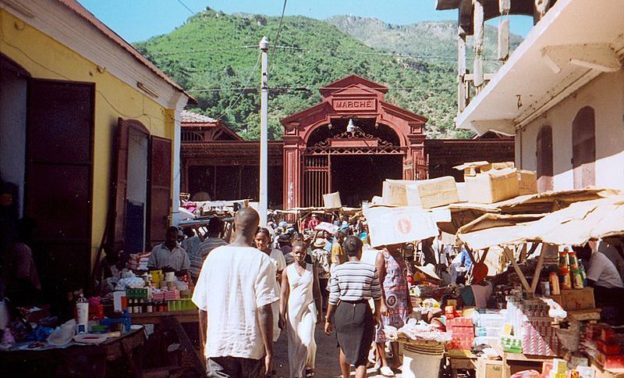
Other great memories include taking a trip to the ocean with the elementary age kids, visiting Sugar Cane Park in Port au Prince with the older children and going to the market. There were Methodist missionaries from Canada that helped run the hospital in Dessalines and the weekly Bible study we had was so encouraging, and we celebrated Canadian thanksgiving together.

WA: Did you have some reverse culture shock when you returned? How has your time in another country affected your experience of the average weekly church service?

SJB: Yes to the reverse culture shock!  Every time someone complained I wanted to tell them to zip it. I was in Haiti for six months and I’ve been back for two and a half years but in some ways I still feel I’m adjusting.  When the power goes out I feel nostalgic and I like much warmer temperatures than I used to enjoy.  The pace of life was much slower and there seemed to be a stronger sense of community at the orphanage, and I miss that in our independent and driven society.

Coming back, church seemed a bit anemic.  Church in Haiti was two and a half to three hours long. I think being there helped provide perspective and showed balance is a positive thing.

WA: What do you think keeps most people from doing this kind of thing?

SJB: 1.Fear of the unknown. Change is hard and it wasn’t easy but I would do it all over again.

2.Debt.

WA: In your experience, what’s the main misconception people have about a country like Haiti or about a short-term missions commitment like this?

SJB: Whether or not they say the words, many people assume the whole country is poor and needs to be saved.  It’s easy for outsiders and North Americans to look at Haiti and only see the negatives such as poverty and unemployment.  In the rural areas there is often no electricity, clean drinking water or access to medical care.  However, Haiti is a beautiful country and the people are survivors.  God was at work in Haiti before I ever went and he will continue to work in that country long after I’m gone.  I wasn’t needed to save anyone, but I was blessed to be a part of the work God is doing in Haiti.

I appreciate the orphanage I went to because there is also a church, clinic and school for the community.  Many churches in the U.S. have an ongoing relationship with the people of Dessalines through the orphanage.  While a trip to “love on orphans” or do a VBS feels good, how helpful is it to the community or the children who already may have attachment issues?

Instead, an ongoing relationship with a local organization makes sure to help guide resources in the right direction and fill the biggest needs.  Many people in Haiti support themselves by selling items at market or owning a small business of some sort.  When people flood the country with rice, clothes or other goods it hurts the Haitian business people trying to make a living. A short-term missions trip should be about service and what will empower the people of Haiti to address the needs and issues in their own community.

WA: What reflections would you offer someone who’s always wished they could travel and make a difference?

SJB: I don’t think I would have changed anything I did. Looking back I wish I could have adapted to situations in general without as much emotional turmoil. However, that’s just my human inclination to crave comfort instead of the uncertainty that often produces growth.

I would say go for it. It’s a life-changing experience to see the world from a different perspective and it’s hard to explain it to those who have not yet experienced it.

Being in Haiti pushed me to depend on God and pray in ways I hadn’t before.  Coming home was difficult because in my mind I had planned to stay an additional six months. I was having health issues; as much as I wanted to stay I knew it wasn’t the right decision. I returned in December and at the end of January my baby Sarafina died. We couldn’t get a heart surgery in Haiti because she had too many health issues and we couldn’t bring her back to the states for the same reason. I lost the daughter of my heart. When people ask if I have children I don’t know what to say and it often still makes me want to cry.

His strength is made perfect in my weakness, so if I don’t share what God has brought me through, how can others know how good God has been to me? I don’t want people to hear the negatives and focus on that, but on how God has been with me through it all. And despite my failures he can continue to use me no matter where I am.

A Conversation About “Breaking The Color Barrier”: Interview with Kevin Murriel

Recently Wesleyan Accent had the pleasure of chatting with Dr. Kevin Murriel about his new – and timely – book, “Breaking the Color Barrier: A Vision for Church Growth through Racial Reconciliation.”

*What motivated and inspired this book, now? 

During my doctoral studies at Duke University, I wanted to research something that intersected the church and society–something that as a finished product would make a difference. I chose to research and write on racial reconciliation in American Christian life.  My mentor, Bishop Woodie W. White, during my time at Candler School of Theology spoke about the Mississippi Church Visit Campaign of 1964 during Freedom Summer. This initiative, led by Bishop White’s roommate at Boston University School of Theology, Rev. Edwin King, sought to desegregate white churches in Jackson, Mississippi. I am a native of Mississippi. So, I decided to use the methods Ed King and other leaders deployed as a model for racial reconciliation in the 21st century.

Also, this topic seemed fitting given the media coverage that the killings of unarmed black men and women in America has received since the Trayvon Martin case in 2012. America is in volatile condition regarding race relations and now, in 2015, the nation seems more willing (or more forced) to wrestle with race and its social, economic, and religious implications in our democratic society.

*I think the phrase “racial reconciliation” can be parsed out many ways depending on who is hearing it. What does it look like to you? (There’s a big difference to me, for instance, between merely coexisting vs sharing life together.)

Dr. Benjamin E. Mays, former President of Morehouse College and mentor to Dr. Martin Luther King Jr., said that 11:00am on Sunday morning is the most segregated hour of the week for Americans. Yet, we work together, eat at the same restaurants, and attend recitals and plays together. This, I believe, describes what you mean by coexisting. In other words, as long as we can be around each other without impacting our individual quality of life then we are content. That, however, is not how I view racial reconciliation. That’s desegregation.

Racial reconciliation as I describe in the book is about intentional community with an end goal in mind. That goal can be different depending on what one is seeking to accomplish. I argue that for Christians, our end goal should be more multicultural congregations due to the changing demographics of our country. In the next 25 years, America will look drastically different and our communities will be more diverse. Therefore, the Church must begin to mirror the diversity of our communities or suffer in the reality of decline. To move towards this goal, we must name what really keeps us divided–race.

We cannot argue that theological differences overwhelmingly divide us because Blacks disagree with Blacks on certain theological issues just like Whites, Latinos, and Asians do. The truth is that we enjoy and feel more comfortable worshiping with people who look like us. To break this trend for greater Kingdom growth requires engaging in difficult conversations about the racially divisive history that is the thesis of the American narrative and then we must work towards forgiving what has been. There then must be an intentional effort, primarily on behalf of Blacks and Whites, to move beyond the past and reconcile so that the institutional church in America can have a future.

*I love that you’ve approached this in synthesis with the desire for church growth. What has your research revealed about the relationship between racial reconciliation and church growth? On a more personal, intuitive level, what is your sense of church health and vitality when people come together to worship and “do life” together?

Based on my research, the churches that are growing and thriving are those who are intentional in their message, mission, and function about welcoming all people (and actually doing it). I visited a thriving church near Atlanta, Georgia a few weeks ago and what I witnessed shocked me and gave me hope at the same time. It was a truly multi-cultural/racial congregation. And they were thriving. Their pastoral team was multi-cultural/racial, their greeters, ushers, choir and band.  The congregational makeup was about 55% White, 40% Black, and 5% Hispanic. Everyone was friendly and you could feel the unity in the atmosphere. It was the closest I’ve seen to how I believe heaven will be.

I contend that when people come together without anger and with love and “life together” as the end goal, churches will be healthier and people will find that they have more in common. But again, this must be intentional. Society has changed from the 1960’s. There are more interracial dating and married couples than ever and our children are being educated in schools that are more diverse. Most people’s social media outlets are multi-cultural/racial. We are surrounded by diversity and have accepted it in our normal daily activity. Now is the time to do make it a reality in our churches.

*Sometimes I mourn that North American life seems to be so privatized rather than communal and shared, even in this age of social networking: we “network” from our private residences or vehicles. What does genuine, Spirit-filled community look like to you?

In short, genuine, Spirit-filled community, I believe, is the ability to love and accept everyone for the content of their character rather than the color of their skin.

*Have you served in primarily single race-predominate congregations? What are practical steps an average Wesleyan-Methodist tradition church could take to break the color barrier?

I have served in three predominately white congregations and three predominately Black congregations and each has the same issue–we want to worship with whom we feel comfortable and each has a way of stigmatizing the other. The interesting thing about each of the churches I’ve served is that they were each in communities that in the past five years became more diverse. From my experience in these contexts and my research, some practical steps for local churches and conferences to break the color barrier are:

1. The congregation must decide missionally who it wants to be. In other words, they must decide whether they want to be a church that welcomes people of all races or remain a homogenized church community.

2. Pastors of race-predominate congregations should host intentional ministry sessions to consider ways of being in ministry together in their local community. This is in line with our Wesleyan theology of connectionalism.

3. Conferences should mandate that clergy have diversity training and push programs that equip clergy and laity to have conversations about race.

4. Appointments in our Methodist system should truly be made without regard to race. And when pastor is appointed to a congregation where they are the minority, the congregation should go through a time of preparation to help with the transition to minimize potential cultural and racial insensitivity.

These are starting points. But the desire to be with people in intentional community is the foundation to breaking the color barrier.

*What do you wish White North American Christians better comprehended about being a Black North American Christian? Do you think there are any misconceptions about White Christians within the Black Christian community? 

I can only speak from my experience as a Black North American Christian and though there are many things I wish White North American Christians comprehended about being a Black North American Christian, the primary thing regarding racial reconciliation is that it will take White North American Christians leading in a significant way for reconciliation to occur. I think there are misconceptions from both groups. But with racial reconciliation, misconceptions must be corrected through honest dialogue. We often don’t worship together because we do not fully understand each other and how can we make a judgment on someone or a group that we do not know personally? All White people are not racist and all Black people are not lazy, unintelligible thugs. Unfortunately, society, in many ways, paints these distorted group pictures. In fact, Rev. Edwin King, the focus character of my book, is a White pastor leading and helping to organize black students to desegregate white churches. It is a beautiful story of how together we can bring about change and be the church that God envisions–a diverse Kingdom on earth as it is in heaven.

*Fill in this sentence: “we will have broken the color barrier in North American congregations when: “All of God’s people celebrate diversity and join hands together in unity.”