Tag Archives: Prayer

Leading like Ananias: Prominence vs Significance in Pastoral Ministry by James Petticrew

“Prominence does not equal significance in the Kingdom of God.” I am not sure who said that first, but whenever I hear it my mind always goes to the book of Acts and Ananias. No, not Ananias who with his wife Sapphira lied to the Apostles and tried to defraud God and met an unfortunate end, but the simple believer we only hear of in a couple of verses in Acts 9. My fellow Scottish minister William Barclay called him one of the great forgotten heroes of the Bible and I want to do a little bit to help us remember his significance for our leadership.  

You know the background; Saul has been on a violent crusade to stamp out the fledgling Church. He is now on his way to Damascus to carry out the next stage of this literally murderous campaign. Then he meets Jesus and everything changes.  Saul is told to go to Damascus. Luke tells us this is what happens next.

In Damascus there was a disciple named Ananias. The Lord called to him in a vision, ‘Ananias!’ ‘Yes, Lord,’ he answered. The Lord told him, ‘Go to the house of Judas on Straight Street and ask for a man from Tarsus named Saul, for he is praying. In a vision he has seen a man named Ananias come and place his hands on him to restore his sight.’

 ‘Lord,’ Ananias answered, ‘I have heard many reports about this man and all the harm he has done to your holy people in Jerusalem. And he has come here with authority from the chief priests to arrest all who call on your name.’ But the Lord said to Ananias, ‘Go! This man is my chosen instrument to proclaim my name to the Gentiles and their kings and to the people of Israel. I will show him how much he must suffer for my name.’

Then Ananias went to the house and entered it. Placing his hands on Saul, he said, ‘Brother Saul, the Lord – Jesus, who appeared to you on the road as you were coming here – has sent me so that you may see again and be filled with the Holy Spirit.’ Immediately, something like scales fell from Saul’s eyes, and he could see again. He got up and was baptised, and after taking some food, he regained his strength.” (Acts 9:10-19)

Tom Wright makes this comment about our unsung hero: “We know nothing about him except this passage, and it’s enough: that he was a believer, that he knew how to listen for the voice of Jesus, that he was prepared to obey it even though it seemed ridiculously dangerous.” (N.T. Wright, Acts For Everyone) Wright’s words capture why Ananias is my unsung hero. Although we have few recorded words from his lips, his life speaks loud and clear about what it means to follow Jesus. He reminds us that being a disciple is about openness and obedience to Jesus. Ananias was a simple believer who was open to hearing the voice of Jesus and then was prepared to obey it wherever it led and whatever it cost. His life is a reminder to us that openness and obedience to Jesus are the essence of following Jesus.

We see this willingness to hear and obey Jesus in his encounter with Saul. To understand the full significance of what happened on Straight Street, remember that Saul had been carrying out a terror campaign against Christians. There is every chance that Ananias knew people whose death Saul had been responsible for. In all likelihood, Ananias himself was on Saul’s hit list for Damascus. Jesus tells Ananias to go and meet the man responsible for the death and torture of some of his friends and fellow believers and who was out to harm him personally.

 I wonder what I would have done in that situation?

I wonder what my first words would have been to Saul?

The first thing Ananias did was to go to where Saul was. He obeyed Jesus. He obeyed despite the fact he seems to have had worries that it might be a suicide mission. Once he heard Jesus’ words, Ananias was willing to obey whatever the personal cost to himself. Now there is an example that the contemporary church could do with embracing.

I never fail to be deeply moved by what Ananias does and says when he finally encounters Saul. “Placing his hands on Saul, he said, ‘Brother Saul…’” I find that nothing short of incredible.  Ananias embraced Saul, the arch-enemy of believers. The first words that Saul heard from a fellow believer following his conversion was not “killer,” but “brother.”

The only explanation I have for what happened in Judas’ house is that at some point, Ananias had heard Jesus say that his disciples had to love their enemies, so that is what he did. No questions asked. Saul couldn’t see Ananias but, in his words and embrace, I suspect he felt the grace and acceptance of Jesus through his fellow believer’s hands.

As a leader, I wonder whether Ananias’ example suggests I have been guilty of making being a disciple way more complicated than it is? This last year I’ve been caught up in theologizing and strategizing about discipleship, as our church tries to get serious about being and making disciples. But Ananias reminds me that fundamentally, I need to challenge people (and myself) to simply make time to hear Jesus’ voice and then do what he says. (I said it was simple, not easy.)

We are a congregation of ex-pats here in Switzerland; many of our people have stressful jobs that consume time voraciously. It’s a familiar challenge – I think our enemy successfully pulls us into a cycle of busyness which leaves us with little room to be open to hearing Jesus. I have been contemplating whether or not we are obeying Jesus – not because of stubborn disobedience, but because we are not making the time to hear what he is saying. After the Covid restrictions are rolled back and church life goes back to “normal” will that “normal” have enough space built in to allow us time discerning the voice of Jesus?

Does your life? Have you regularly cut out a chunk of time to be open to Jesus? Recently, a powerful revival has broken out at Longhollow Baptist Church in Tennessee. Its pastor, Robbie Galatay, has spoken about how this revival can be traced back to him finally scheduling time to simply be with and be open to Jesus. There is a lesson there for all of us in leadership.

I am in the final phase of my ministry now. In all likelihood, I am never going to be a megachurch pastor whose sermons attract millions of views on YouTube.  Nothing I write will knock My Utmost for His Highest or The Purpose Driven Life off the Christian bestsellers list. A few years after my retirement, I doubt if many people will remember my second name. But as I contemplate that, I come back to my original thought: prominence doesn’t equal significance in the Kingdom of God.

Was Ananias prominent in the early Church? No. But did his ministry have significance? Of course it did! Ananias’ ministry of love and prayer to Saul unleashed into the world a spiritual tornado whose impact is still very much with us. I wonder if Ananias lived to see the impact that Saul-turned-Paul would have? I wonder how many other people Ananias loved, embraced, forgave, and prayed for in his ministry? I wonder what impact they made? His ministry reminds me that my ministry may not have prominence, but in the Kingdom of God it can have a significance I cannot even begin to imagine.

Can I remind you? That’s true for you too, wherever and whomever you minister to.

How Church Planting Relies On The Power Of Prayer by John Freed

After my wife and I planted and established a Wesleyan congregation in the Indianapolis area, we shifted gears toward a different mode of reaching people for Jesus. Church planting continued to be our heart, so as a ministry team, we accepted the opportunity to serve as Directors of Church Multiplication for the Great Lakes Region District of The Wesleyan Church. In both settings, we believe that the number one way to enter a community missionally is through prayer.

Prayer and church planting have always gone together. In our strategy, there is little room for action or “doing” without also engaging in the constant work of prayer. In fact, I sometimes say that while some whistle while they work, people in church planting pray while they work.  Before a planter enters a new community, we ask that she first prepare herself with an army of prayer warriors; we actually recommend 500-1000 people committed to regular prayer. Church planting and prayer always go hand in hand.

Part of the way we invest in church multiplication is by training church planters in what that prayer looks like as they prepare to enter a community, because it’s not necessarily obvious. We encourage planters to pray for discernment, wisdom, and humility. This will shape how they engage with their team and their community. Planters have coaches and mentors as well, but praying in this way shapes moments of engagement.

Here are some of the ways we have learned to pray in church planting:

Pray for discernment in sharing faith and vision.

Pray for discernment in spiritual conversations.

Pray for discernment for receptive people.

Pray for wisdom to contextualize ministry.

Pray for wisdom in discipleship that makes disciples who make more disciples.

Pray for humility to enter a community as a learner, servant, and witness.

We believe that when you enter a community through prayer, you enter in stride with the Holy Spirit.

When Flawed Humans Follow Jesus by Kim Reisman

The apostle Peter is one of my favorite people in the Bible. He reminds me of me. Following Jesus is not always easy for me; from the very beginning, Peter seems to have experienced a similar sense of struggling as he sought to follow. Peter was a searcher with a good heart. He stumbles but tries his very best to follow. He’s always open to growing in his relationship with Jesus, even if that growth involves some pain. Peter was full of emotion, giving himself completely to Jesus at one moment, but then fearfully retreating from Jesus the next.

In Matthew 16:13-16, we read, “When Jesus came to the region of Caesarea Philippi, he asked his disciples, ‘Who do people say the Son of Man is?’ They replied, ‘Some say John the Baptist; others say Elijah; and still others, Jeremiah or one of the prophets.’ ‘But what about you?’ he asked. ‘Who do you say I am?’ Simon Peter answered, ‘You are the Messiah, the Son of the living God.'” (NIV)

What did Peter proclaim about Jesus? But now in Matthew 16:21-22, we see, “From that time on Jesus began to explain to his disciples that he must go to Jerusalem and suffer many things at the hands of the elders, the chief priests and the teachers of the law, and that he must be killed and on the third day be raised to life. Peter took him aside and began to rebuke him. ‘Never, Lord!’ he said. ‘This shall never happen to you!'” How is Peter responding now?

Peter was genuine in all of his interactions with Jesus. He boldly declared his belief that Jesus was the Messiah (Matthew 16:16), and then immediately questioned and chastised Jesus for talking about the suffering that lay on the horizon (Matthew 16:22). That last bit may have been bumbling and inappropriate, but it was genuine. Peter genuinely offered Jesus his entire being – the good and the bad. 

We read about these contrasts between the good and bad sides of Peter throughout the gospels. He simply didn’t always know what it meant to follow Jesus. When Peter witnessed the astonishing event of Jesus talking with Moses and Elijah on the mountain, all he could think to do was to offer to build shrines, places for each of them to live. (Matthew 17:1-11, Mark 9:2-9, Luke 9:28-36). When he sees Jesus walking on the water, he boldly climbs out of the boat, seemingly full of confident faith, yet when the wind and waves appear too much, he flounders in fear. (Matthew 14:22-33)

Washing another person’s feet was a common way of expressing hospitality and servanthood in the first century. Jesus washed the disciples’ feet on the night he was arrested. (John 13:1-9) When it was Peter’s turn, he felt completely unworthy, so he declined. And yet, when Jesus responded that it was necessary in order for Peter to be a part of him, Peter’s love poured forth: “Lord, not my feet only but also my hands and my head!” (John 13:9, NRSV)

Peter genuinely desired to follow Jesus, even if he didn’t always know exactly what that meant; and he was willing to offer his entire self, even his shortcomings.

 The question for each of us is, how willing are we to offer our entire selves to God – including our shortcomings?

Peter was willing to offer Jesus his entire self – shortcomings and all – because intuitively he knew that Jesus had created safe space between them. His intuition was correct. Jesus had created safe space, because Jesus understood Peter. Jesus knew how truly human Peter was. He knew that deep down in his heart, Peter desired to follow him, even though Peter’s understanding and capabilities were dramatically limited.

Jesus knew Peter well enough to call him the rock upon which he would build his church (Matthew 16:17-19); yet also knew him well enough to predict accurately that before the rooster crowed twice, Peter would deny three times that he even knew him at all. (Mark 14:26-31)

We are all like Peter. We too are truly human, with all of the frailties and limitations that brings. Just as he understood Peter, Jesus also understands us. Jesus knows that there are times when we want to follow; there are other times when we choose to shy away. But Jesus’ call to Peter was to follow, not at a distance—not in the shadows, afraid of what might happen next—but to move into the light and follow boldly, whatever came his way.

This is Jesus’ call to us as well. Jesus knows how limited our resources are. He knows that life is full of choices, temptations, and complex situations where we become confused and frightened. Yet he desires our faith to be real and authentic, and so he calls us to follow him anyway, closely, not at a distance. 

We are in the midst of Lent, working our way toward the week of Jesus’ crucifixion and death. As you fast and pray, reflect on the idea of a “safe space” between you and God. Do you sense the safety of that space? If not, I pray you will use your time of prayer to bring that experience honestly before God, opening yourself to the movement of the Holy Spirit in response to your need.

Jesus would go on to say, “If any of you wants to be my follower, you must give up your own way, take up your cross, and follow me. If you try to hang on to your life, you will lose it. But if you give up your life for my sake, you will save it.”  (Matthew 16:24-25, NLT)

During this next month, use your time of prayer and fasting to become more aware of the ways in which Jesus may be calling you to step out of the boat. And then step out in courage, knowing that Jesus understands that you are fully human, with all the frailties and limitations (but also with all the creativity and boldness) that brings.

Lenten Love: Make Things Better by Edgar Bazan

The Lenten season has started. Lent is six weeks (excluding Sundays) dedicated to prayer, fasting, and reflection to prepare for the grand celebration of Christ conquering death and his resurrection.

When I think of Lent, I am reminded that Easter is coming. We will soon celebrate the victory of Jesus over death through his resurrection and the gifts of forgiveness of sins and eternal life to all those who believe in him. In light of this, this Lenten season invites us to a particular time of reflection about our relationship with God and how we practice what we say we believe. As we are reminded of the meaning and purpose of our faith, we are also confronted with the realization that we may not be living up to the expectations of Jesus’ teachings.

Are we living up to Jesus’ teachings? Are we there yet? If you are like me, then you are far from it. We are trying; we stumble now and then, but we are not in denial, and we are making progress, even if it is just a little bit every day. With this in mind, I invite you to a serious and responsible self-reflection about how you are living your faith, but most importantly, how your relationship is with God and with one another.

Henri Nouwen described Lent as a time to refocus, to reenter a place of truth, to find ourselves in God once again. This is precisely what I want us to do this Lenten season: to find our place in God and affirm our identity as disciples of Jesus Christ.

Let’s begin with a simple question: how are you observing Lent?

Are you fasting, reading Scripture, praying? Great! That’s what the church traditionally has done for many centuries. Lent is a time of faith renewal as much as it may be a time of reconciliation with God. Fasting, reading Scripture, and praying are means of grace that help us be strong in our faith and close to God. So if you are practicing this, that is wonderful; keep doing it!

Today’s challenge is to go beyond a personal renewal of our faith and reconciliation with God. What if we commit to practice our faith to make the world better: more loving, more kind, compassionate, truthful, and empty of hate and evil? What if we show our faith to others in ways that make life better for them? What if we are a tangible blessing to others?

One of the most prominent critiques I make is that often, we are primarily known for what we are against than for what we offer. Our faith is more about how we make things better for all people, just like Jesus did. With this in mind, here is an idea of how we can observe Lent this year. The reading from Romans 12:9-21 using The Message translation encourages us like this:

Don’t fake your love, be real. Run away from evil; cling to good. Be good friends who love deeply. If you see someone in need, do something about it. Don’t be a cause for others to trip over but bless those even when they disagree with you. Laugh with your friends when they’re happy; share tears when they’re down. Discover beauty in everyone. Don’t insist on getting even; that’s not for you to do, but be generous in your goodness to all people. And last, don’t let evil get the best of you; get the best of evil by doing good.

As you can see, in this Scripture, Paul describes how Christians are to love each other and how we are to engage in our relationships with others. Paul explains that Christian behavior is doing everything for all people’s common good.

Our text doesn’t just say, “Love others more,” but it describes specific behaviors for loving others that Jesus himself modeled. This helps us see that Christian love is not just being nice to people; Christian love has a moral orientation toward the good. When we show love toward someone, we are moving them toward God’s goodness, so they too may find themselves in God. That is what Christian witness is, both during the Lenten season and throughout the year.

Since our faith is less about what we don’t do and much more about how we make things better for all people – just like Jesus did – let’s make part of our Lent resolutions to bring people to Jesus by practicing genuine love and showing generous goodness.

The Snake Still Slithers by BJ Funk

While America watched the horrors at our United States Capitol building on January 6, 2021, hurting and crying over the awful scenes unfolding on our screens, tumultuous laughter could be heard from one who some of us deny even exists. One elected representative evacuated that day even described his experience with unusual words for a politician: “it was like looking at evil.”  If you don’t believe Satan is alive and well, believe it now. He is the prince of this world, and what a chance God took when he set that snake on the loose! He has already been defeated; Jesus took care of that on the cross. He has no power now, except the power we decide to give him. When Jesus cried from the cross, “It is finished,” did you think he meant his life? But Jesus was raised from the dead and sits at the right hand of the Father.

So what did Jesus mean? What was finished? Satan’s power. Jesus meant, “He lost. We won!” But Satan failed to get the memo; he moves ruthlessly through his days, a wimp of who he used to be, trying in vain to continue his deception. As far as our lives are concerned, he is only as successful as we allow. His mission is to wreak havoc any way he can. He does not care who is embarrassed, hurt, mistreated, or slandered as he sets about to fulfill his purposes on this earth: turning every last one of us away from God’s glorious kingdom of light and pulling us into the destruction and darkness he loves.

Someone has said, “The greatest trick the devil ever pulled was convincing the world he did not exist.” I bought into that when I was younger. I thought he was simply a wind of evil that floats among us all, influencing bad things to happen. A good friend of mine echoes my thoughts during those days. “I thought Satan wasn’t actually real – until I met him face to face during my divorce.”

Yes, Satan is real. He is alive and well, and if we know this, we need to get ourselves into God’s Word, where we can not only see him described, but  also recognize that he is a has-been. You and I have to stand against his spirit of self-destruction. Biblical teaching reminds us that, “Greater is He [Jesus] that is in you, than he [Satan] that is in the world.” (1 John 4:4)

Satan is clearly our enemy, our adversary. He was dancing while the Capitol was being damaged, lives taken, injuries and trauma inflicted. “Be watchful. Your adversary, the Devil, prowls around like a roaring lion, seeking someone to devour.” (1 Peter 5:8) Look at some of the horrific acts he has handled. You will not understand this unless you have made a decision that Satan is our real enemy. We can all point to names of those we consider to be the real problem, and we might be right, but look beyond those names and watch how Satan instigates every act of darkness. And remember that he is always a liar.

“Now the serpent was craftier that any other beast of the field that the Lord God had made. He said to the woman, ‘Did God actually say, “You shall not eat of any tree in the garden?”” (Genesis 3:1)

When Eve ate the fruit and offered some to Adam, they both willfully chose to listen to the liar instead of their Creator. Before that moment, they were happy. But on taking a bite, they lost the innocence with which they were born. Quickly, they made clothes of leaves to cover up. 

As glass was shattering, doors were smashing and anger was exploding at our Capitol building, Satan was propped contentedly on a tree near the Capitol, slithering from limb to limb and laughing hysterically as one by one, scuffling people broke doors and windows, feeling they had the right to do whatever they wanted. “It’s our building,” some chanted, excusing themselves from the mayhem they caused.

And the snake slithered on.

Of course, Satan had long been after America. I am appalled at the divisions in our country. I can’t imagine how I would feel if one I loved had been mistreated or killed on our streets. In fact, for a while, the only redeemable picture from the brutalization of our Capitol was the realization that for a short period, members of both parties were on the same side, binding together, helping each other escape to safety, fearing for themselves and each other – and praying. If we could have gotten into the hearts of our elected officials, we would have heard many prayers being spoken silently. 

The night of January sixth, Inside Edition anchor Debra Norville ended the evening with, “God bless America.” The message is not a subtle one. America needs to return to the God we ask to bless us.

Had we been able to actually see a real snake crawling on a tree near the Capitol, we would have noticed one very real, very telling detail. The snake’s head is bashed in. He slithers with a wound. He circles with a crooked head, smashed at the victory over death by our strong Warrior, Jesus Christ. God’s words to Satan after the fall in the garden are telling. “And I will put enmity between you and the woman, and between your seed and her seed. He will crush your head, and you will strike his heel.” (Genesis 3:16)

Yes, the snake still slithers. But he is defeated. When he starts attacking you, repeat the name of Jesus, for, “At the name of Jesus, Satan has to flee.” (James 4:7) God is the ruler yet! Live in these uncertain days in the clear and certain authority of your Redeemer, Jesus Christ.

Surrendered Intercession by Shalom Liddick

“‘Oh, that Ishmael may live before you!’ Abraham cried to God.” (Genesis 17:18) This cry has always moved my heart. I have always felt a deep connection with Ishmael; we are him. That cry from the heart of a loving father is God’s cry for you and me. This is intercessory prayer. In My Utmost for His Highest, Oswald Chambers wrote, “You cannot truly intercede through prayer if you do not believe in the reality of redemption.” We must believe that God is mighty enough and lovely enough to make things right and that God desires to make it so. Intercession then is locating a person or a situation into the lap of dear God, confident that God will make things right.

I was 24 years old, a freshly minted American resident when my six-month-old baby went into anaphylactic reaction. Out of my belly came the cry, “God, what’s going on? He’s yours; please heal him!” I had given him peanut butter, and apparently, his body did not like it. I watched all the swelling go down within a few minutes as I cried to God in dance. I never considered calling 911, not because I have something against it! In the moment, I simply did not think of it; I knew prayer and God’s reliability.

Another time in a conversation with a friend, she said, “I get migraines,” welcoming my prayer. I prayed immediately. A few days later, she called to say that she had not had pain since our prayer together. Her migraines are still gone. I can go on and on sharing situations in which God has intervened because of intercession. I keep a journal of people and things I bring before God daily. God is reliable.

Intercession is becoming love; it is becoming the heart of God for humanity. It is asking God to redeem, to make right according to his perfect love. We do not tell God what to do, but we allow the heart of God to flow through us for our friends, families, society, and even enemies. Enemies don’t stay enemies in prayer.

It’s 2021; we see enemies everywhere – strange ideologies, racism, bigotry and such in the world and in the church. We are wary of each other and perhaps weary of God. God is not answering fast enough for you, or maybe he allowed things you did not want. There’s a sense in which we wonder, “why pray, when God will do whatever he wants anyway?”  But remember how Paul encouraged the Galatians: “Let us not became weary, [in interceding prayer] for at the proper time we will reap a harvest if we do not give up.” (Galatians 6:9) We must believe God is mighty enough to save and lovely enough to want to save.

Surrender is the key to intercession. Without it, love cannot and will not flow. We cannot avoid surrender. Revival will not happen without it. The transformation we desire in the lives of those we bring before God will not happen unless we raise our flags in surrender. Healing will only come to our earth – your flesh, mine, and the world – when we are free of our preconceived ideas of how reality should be, and we yield to God.

Did God say, “If my people who are called by my name will get smarter in their arguments, independence, possessions, and politics, I will hear from heaven and answer; I will forgive their sins and heal their land”? There is so much to make the heart weary. The earth and people groan for the return of God. We cry revival with our lips, but our hearts are not humbled; we have not repented of our arrogance. God appeared to Solomon when he consecrated the temple. He said, “When I shut up the heavens so that there is no rain or command locusts to devour the land or send a plague among my people,[you have to admit it has felt like this for the world] if my people, who are called by my name, will humble themselves and pray and seek my face and turn from their wicked ways, then I will hear from heaven, and I will forgive their sin and will heal their land.” (2 Chronicles 7:13-14, NIV)

Physical, emotional, spiritual, and societal healing all begins and ends in surrendered intercession. When you pray for me, and I pray for you, we manifest God’s love. We are family connected through the explosive love of God who created all things. Your healing is intertwined with mine and mine to yours. Let us pray for Ishmael. “Oh, that Ishmael may live before you!”

El Poder de la Oración by Karen Bates

Hace años, cuando me uní a Facebook, muchos cristianos no sabían qué pensar de la nueva plataforma de redes sociales. Uno de mis mentores renunció a Facebook y me explicó los peligros de conectarse con personas a través de Internet. Estaba tratando de convencerme de que la plataforma no tenía valor redentor.

 “Puedes ser amigo de gente que ni siquiera conoces.” “Eso no es seguro” advirtió.

Ella no fue la única que hizo sonar las alarmas, pero yo estaba en la escuela de posgrado y lo veía como una forma de conectarme con personas más allá del aula.

Después del “tsk, tsk, tsk,” mi objetivo era usar las redes sociales para algo más que mirar actualizaciones de estado e imágenes. Comencé a orar por las personas en sus cumpleaños, cuando aparecían al azar en mi “feed” o cuando actualizaban sus estados. No siempre les dije, pero oré.

Amo orar. No siempre comprendo el misterio de la oración, pero conozco su poder. Lo sé por mis propias experiencias y por lo que he leído en las Escrituras; hablar con Dios es fundamental para mí. Ayuda a activar mi fe, restaura mi esperanza cuando decae y me recuerda que Dios siempre está conmigo.

En algunos de los días más oscuros de mi vida, oré para que Dios iluminara mi situación. Puedo recordar haber escrito en mi diario esta sabiduría de Santiago 5: 13a: “¿Hay alguien entre ustedes, que esté afligido? Que ore a Dios.” Y luego del Salmo 27: 1,“El Señor es mi luz y mi salvación; ¿A quién temeré? El Señor es la fuerza de mi vida; ¿de quién tendré miedo?”

Algunos días, no siempre sé las palabras para orar. Cuando estaba angustiada en medio de una transición difícil, encontré consuelo en lo que el apóstol Pablo escribió en Romanos 8:26: “De la misma manera, el Espíritu nos ayuda en nuestra debilidad. No sabemos por qué debemos orar, pero el Espíritu mismo intercede por nosotros con gemidos sin palabras.”

Fue un gran consuelo para mí saber que el Espíritu estaba intercediendo por mí los días en que había orado todas las palabras que sabía orar.

Cuando la aplicación de fotos en mis dispositivos comenzó a proporcionar collages de eventos y Facebook comenzó a proporcionar recuerdos, me molestó. Algunas de las imágenes eran buenos recuerdos que quería revivir; pero algunos de los recuerdos incluían personas y situaciones que quería olvidar.

“¿De verdad Facebook, una foto de cuando jugaba voleibol en seminario hace 13 años? ¿No tienes nada más reciente o halagador?”

Sin embargo, miré a las personas en las fotos y me pregunté dónde estaban y qué estaban haciendo. No podía recordar todos sus nombres, pero recordaba cosas sobre ellos. A algunos los tuve que buscar para recordarlos. A algunos todavía los conocía porque éramos amigos de Facebook.

Entonces me pregunté: ¿qué pasaría si comenzara a orar por las personas que aparecían en collages y recuerdos? ¿Cuáles serían las oraciones, especialmente para los collages que muestran a personas con las que no había hablado en años?

Me di cuenta de que podía agradecer a Dios por las temporadas que estas personas estaban en mi vida.

Podía agradecer a Dios por lo que significaban para mí en ese momento y orar por la curación en situaciones en las que nuestras separaciones eran menos amigables. ¿Qué pasa si oro por ellos en sus circunstancias actuales o por lo que sea que estén haciendo ahora?

No tuve que decírselos. Podría simplemente orar. Así que lo hice y lo hago.

Soy de un linaje de personas que oran.

Muchas mañanas me despertaba con el sonido rítmico de mi madre orando, clamando a Dios por las personas, los lugares y las situaciones. Ella tiene una sala de oración y un muro de oración. Allí coloca fotografías de personas por las que está orando.

Cuando mi madre celebró un cumpleaños histórico el año pasado, oró por cada uno de sus nietos y bisnietos. Y cuando nació su primer tataranieto a mediados de junio, una de las primeras imágenes que surgieron fue la de ella orando por él. Es el comienzo de la quinta generación viva de nuestra familia.

Rev. Arlene Bates, Photo Credit: Tonyka Thomas

A menudo, mi madre nos llevaba a visitar a mi bisabuela materna, Lelia Mincy White. Mis cuatro hermanas y yo nos dispersábamos por la sala del apartamento de un dormitorio mientras mi madre y su abuela estudiaban las Escrituras y oraban. Recuerdo una visita en particular cuando mi bisabuela se levantó de la mesa y entró en la sala de estar. Ella puso sus manos sobre cada uno de nosotros y oró por nosotros.

Cuando murió mi bisabuela, la encontraron arrodillada junto a su cama, probablemente orando.

Después de la muerte de mi abuela materna, se compartieron cuadernos llenos de oraciones que había escrito. Oraba por muchas cosas por escrito, pero a menudo le recordaba a Dios quién es él y cuánto más poderoso es que un presidente—quien en el momento de una oración, estaba arruinando la economía.

No pretendo saber todo lo que necesito saber sobre la oración. No entiendo ni sé por qué se responden algunas oraciones y, aparentemente, otras no. No sé por qué algunas respuestas llegan rápido y otras lentamente.

Pero sé que Dios escucha y contesta las oraciones. Dios permite que la gente ore por ti incluso cuando no lo sabes. He llegado a comprender que incluso en mis momentos de duda y cuestionamiento, Dios todavía está escuchando, y todavía contesta las oraciones, y que el tiempo de Dios es perfecto.

Vicarious Faith In Community by Brian Yeich

A few years ago, I ran into a friend who was going through some tough family times. I asked him if there was anything I could do; his response caught me off-guard. He said, “I am struggling to have faith, and I just need other people to have faith for me.” I confess that before this, I didn’t really consider “having faith” for someone else. Of course I prayed for people and situations; but to have faith for someone – that seemed a bit strange to me. But I have come to believe that having faith for others – what you might call vicarious faith – is one of the most powerful, Christian things we can do as followers of Jesus.

How do you define faith? The writer of Hebrews defines it this way In Hebrews 11:1 – “Now faith is the assurance of things hoped for, the conviction of things not seen.” (ESV) So faith might be defined as “trust” or “belief.” One of my favorite definitions is that faith is “leaning our full weight upon” someone or something. I think many times we tend to think of faith as something we have (or dont have).

It wasn’t until I ran across a chapter in a book called Humanity and God by Samuel Chadwick that my thinking was challenged. He introduced the idea of vicarious faith.

Chadwick says that vicarious faith is a “faith that is exercised on behalf of another and is accepted for another,”* and he points to the Gospel of Mark for the prime example.

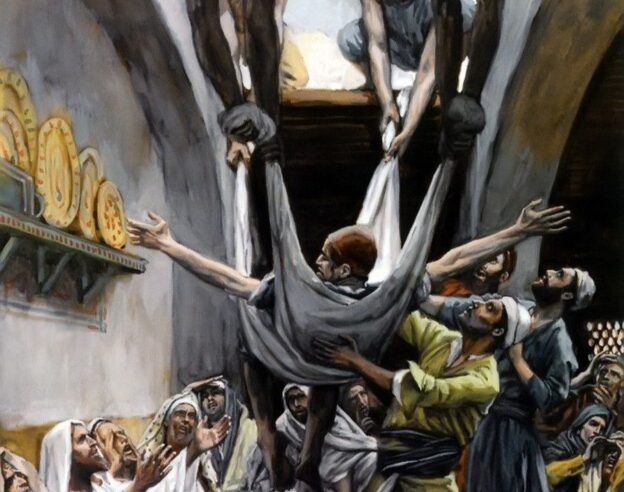
In the second chapter of Mark, we read a story in which Jesus has powerfully launched into his ministry and at the end of chapter one just healed a leper. He has now returned to the town of Capernaum, Jesus’ “home base” on the north shore of the Sea of Galilee. A crowd has gathered, as it often does around Jesus. And then something dramatic happens. Four friends, determined to get their friend into the presence of Jesus, lower a paralyzed man through a roof. Mark then reports something that may surprise us: “Jesus saw their faith.” In other words, he saw the faith of the mans friends – he then pronounces forgiveness to the paralyzed man. There is a very interesting interchange with the scribes about whether Jesus has the authority to forgive sins, which we don’t have time for today, but then Jesus goes further and heals the man’s body. Jesus sees the faith of the friends and then turns to the man and says, your sins are forgiven. And then he said, Rise, pick up your bed and go home.

Chadwick comments on this scene, “This man received both the forgiveness of his sins and the healing of his body, through the faith of the men who brought him.” It is very interesting that out of more than 20 miracles recorded in the Gospels, at least seven of those were healed through the faith of others.

In Matthew 8:5-13 we read about the Centurion with a sick servant.

“When he had entered Capernaum, a centurion came forward to him, appealing to him, ‘Lord, my servant is lying paralyzed at home, suffering terribly.’ And he said to him, ‘I will come and heal him.’ But the centurion replied, ‘Lord, I am not worthy to have you come under my roof, but only say the word, and my servant will be healed. For I too am a man under authority, with soldiers under me. And I say to one, “Go,” and he goes, and to another, “Come,” and he comes, and to my servant, “Do this,” and he does it.’ When Jesus heard this, he marveled and said to those who followed him, ‘Truly, I tell you, with no one in Israel have I found such faith. I tell you, many will come from east and west and recline at table with Abraham, Isaac, and Jacob in the kingdom of heaven, while the sons of the kingdom will be thrown into the outer darkness. In that place there will be weeping and gnashing of teeth.” And to the centurion Jesus said, ‘Go; let it be done for you as you have believed.’ And the servant was healed at that very moment.” (ESV)

Not a word is said about the faith of the man who was healed. It is attributed entirely to vicarious faith – faith exercised for him.

In John 4:46-54 we read about the healing of an official’s child:

“So he came again to Cana in Galilee, where he had made the water wine. And at Capernaum there was an official whose son was ill. When this man heard that Jesus had come from Judea to Galilee, he went to him and asked him to come down and heal his son, for he was at the point of death. So Jesus said to him, ‘Unless you see signs and wonders you will not believe.’ The official said to him, ‘Sir, come down before my child dies.’ Jesus said to him, ‘Go; your son will live.’ The man believed the word that Jesus spoke to him and went on his way. As he was going down, his servants met him and told him that his son was recovering. So he asked them the hour when he began to get better, and they said to him, ‘Yesterday at the seventh hour the fever left him.’ The father knew that was the hour when Jesus had said to him, ‘Your son will live.’ And he himself believed, and all his household. This was now the second sign that Jesus did when he had come from Judea to Galilee.” (ESV)

Whose faith had resulted in Jesus saving the official’s child? That son was healed entirely through the faith of the father vicariously exercised 25 miles away.

In Mark 9:14-29, we read about the healing of a boy with an unclean spirit. The disciples had not been able to heal the boy. Here the boy’s father is struggling with faith, but he says, “I believe; help my unbelief!” (ESV)

Whose faith moved Jesus to free the boy? Not the boy’s own faith, not the disciples’, but rather his father’s.

We find a final example in Matthew 15:21-28 where a Canaanite woman approaches Jesus and begs him to heal her daughter:

“And Jesus went away from there and withdrew to the district of Tyre and Sidon. And behold, a Canaanite woman from that region came out and was crying, ‘Have mercy on me, O Lord, Son of David; my daughter is severely oppressed by a demon.’ But he did not answer her a word. And his disciples came and begged him, saying, ‘Send her away, for she is crying out after us.’ He answered, ‘I was sent only to the lost sheep of the house of Israel.’ But she came and knelt before him, saying, ‘Lord, help me.’ And he answered, ‘It is not right to take the children’s bread and throw it to the dogs.’ She said, ‘Yes, Lord, yet even the dogs eat the crumbs that fall from their masters’ table.’ Then Jesus answered her, ‘O woman, great is your faith! Be it done for you as you desire.’ And her daughter was healed instantly.” (ESV)

Whose faith brought her healing through Jesus? It came, not through any faith of her own, but in response to the mighty faith of her mother.

This takes me back to my friend’s statement,  “I just need other people to have faith for me.” He was asking me to have vicarious faith for him and for his family, that Jesus might move in their lives in a powerful way. At the time, he didn’t have faith for himself or his family – he needed others.

Is there someone you know, for whom you might be called to have vicarious faith? Or maybe today you are the one who needs someone else to have faith for you.

Chadwick closes his chapter on vicarious faith with this: “Personal faith brings personal salvation, but vicarious faith brings salvation to others; and in this also it is more blessed to give than to receive. The supreme test of faith is not its personal benefit but its vicarious power.”

This is what the community of faith is about. It’s about having faith in Jesus, but it is also about having faith in Jesus for one another. Lord, may we have faith for one another and remember that it is Christ who saves and heals.


* Chadwick, S., 1904. Vicarious Faith. Humanity and God. London: Hodder and Stoughton, p. 295.

Strength in Ephesians: The Body, the Armor, the Power by Suzanne Nicholson

If you’ve been part of a marching band, you know how intricate the planning is for halftime. I spent the last 16 years in Ohio, where it’s impossible not to hear regularly about Ohio State University. Renowned for its sports teams, OSU is also known for its marching band and its creative halftime shows. One halftime show particularly caught my eye: a tribute to Michael Jackson, in which the band took his shape and proceeded to moonwalk across the field. It was amazing! In a marching band, one individual part may look like random steps, but when put together with all the other parts, the band works together to create an amazing picture. And as the apostle Paul finishes his letter to the Ephesians, he acts like a marching band director choreographing the halftime show. He gives instructions to the Church so that it can faithfully stand as a beacon of peace and righteousness. Today, we’re looking at three things that are necessary to remain standing after all is said and done: The body. The armor. The power.

Let’s read from Ephesians 6:10-20 (CEB):

“Finally, be strengthened by the Lord and his powerful strength. Put on God’s armor so that you can make a stand against the tricks of the devil. We aren’t fighting against human enemies but against rulers, authorities, forces of cosmic darkness, and spiritual powers of evil in the heavens. Therefore, pick up the full armor of God so that you can stand your ground on the evil day and after you have done everything possible to still stand. So stand with the belt of truth around your waist, justice as your breastplate, and put shoes on your feet so that you are ready to spread the good news of peace. Above all, carry the shield of faith so that you can extinguish the flaming arrows of the evil one. Take the helmet of salvation and the sword of the Spirit, which is God’s word.

Offer prayers and petitions in the Spirit all the time. Stay alert by hanging in there and praying for all believers. As for me, pray that when I open my mouth, I’ll get a message that confidently makes this secret plan of the gospel known. I’m an ambassador in chains for the sake of the gospel. Pray so that the Lord will give me the confidence to say what I have to say.”

Before we get into specifics, let’s look at the overall context of Paul’s letter: Paul writes this to remind the Ephesians of their identity in Christ, their unity as the body of believers—regardless of ethnic or other differences—and to encourage them to live in a way that honors God. The content of the book is split in half: the first three chapters explore the blessings of our life in Christ and how we have been saved by grace through faith; the last three chapters describe how we live as a result of our new life in Christ. After all, when something amazing happens in your life, you live differently.

Before jumping to Ephesians 6, let’s recognize an important aspect of this letter. We often read letters like this, hear the author say “you,” and assume it refers to me as an individual. While it’s true that as an individual believer, I need to follow Scripture, this is not Paul’s primary emphasis. Most of the time, Paul uses the plural form of “you” (“all y’all,” as we say in Kentucky) to address the Ephesians. In other words, these are commands for the church as a whole. God is calling the church to work together and help one another to live faithfully as believers.

As we venture into 6:10, Paul begins to wrap up. He urges the Ephesians to be strong in the Lord’s great strength. This is not a new theme in the book. Paul goes full circle—in 1:19, Paul told the Ephesians that he prays they may know “the immeasurable greatness of [God’s] power for us who believe, according to the working of his great power.” This is an important reminder—especially for the discussion about evil powers that comes next. We do not rely on our own strength.

Having the correct source of power is incredibly important: If you have a fancy sports car, you’re going to use the best gasoline available. You can’t just pour water in the tank.  And if we’re going to have strength for the battle ahead, we have to rely on the right source of power: God’s power, not our own. Paul is emphatic about this: he repeats the idea of strength three times in a single verse: literally, “strengthen yourselves in the power of his strength.” We need God’s power, not our own, because the battle ahead is a difficult one.

In verses 11-12, Paul calls believers to put on the armor of God, because it is the only way to withstand the evil day. He makes it very clear that we are not simply battling everyday circumstances and temptations; rather, powerful forces exist that in the world that make every effort to derail our walk with God.Paul describes them as rulers, authorities (not government authorities!), cosmic powers, and spiritual forces of evil in the heavenly places. There is a spiritual realm populated by hostile forces that are in opposition to the work of God. Paul’s point here is not to catalog the various kinds of demonic forces. Rather, he emphasizes the spiritual component to the struggles we face.

Yet Paul notes that these spiritual powers are in “the heavenly places.” The Ephesians who have read this letter will recall:

  • 1:3: We have been blessed in Christ “with every spiritual blessing in the heavenly places.”
  • 1:20-21: Christ sits at the right hand of God in the heavenly places “far above all rule and authority and power and dominion, and above every name that is named, not only in this age but also in the age to come.”
  • 2:6: We are seated with Christ in the heavenly places.
  • 3:10: The plan of the mystery of God has been revealed so that through the Church the wisdom of God will be made known to the authorities in the heavenly places.

Paul is urging us to be prepared to fight these forces but not to be afraid. Everything Paul has written to this point in the letter reminds us that Christ’s power is far greater than their power, and we who believe are seated with Christ, far above these lesser powers! Our transformed lives and unity in the body of Christ serve as testimonies to these spiritual beings, that God already has won the victory through Christ.

After digressing to point out who we are fighting (and the ultimate defeat of these spiritual forces), in verses 13-17 Paul returns to call the Ephesians to put on the whole armor of God. Traditionally, these next few verses are read as a call to the individual believer to put on the armor of God, but Paul already told us earlier in the letter who is the body that wears the armor: “And [God] put all things under [Christ’s] feet and gave him as head over all things to the church, which is his body, the fullness of him who fills all in all” (Ephesians 1:22-23).

This armor is effective when the whole body takes it up—there is a communal sense. We are not meant to be solitary individuals bearing the armor of God; rather, we are meant to help one another to bear the armor. Like the OSU marching band, in which individuals walk a path laid out for them and together make a unified whole, we who believe work together to provide a unified vision of the life in Christ.

What is this armor? Paul uses military imagery to illustrate preparing for battle, and yet the armor described is used mostly for defense. It is the devil who wages war on us, and our job is to stand our ground, stand firm, and remain standing. We’ve had a lot of hurricanes this season, and I’m always amazed at the weather reporters who stand out in the middle of the storm: they have a job to do and they find a way to stand firm in 70 mile an hour winds.

That’s our job as believers: we don’t go out looking for the battle; we know it will come to us. But New Testament scholar Andrew Lincoln reminds us: “The decisive victory has already been won by God in Christ, and the task of believers is not to win but to stand, that is, to preserve and maintain what has been won.”

Yet we won’t always face a hurricane. Scripture refers to the “schemes” of the devil. Sometimes attacks are powerful because they are subtle, taking us by surprise. Rather than a hurricane, we face a creeping mist that slowly blinds us, leaving us groping in the fog. Whether we face an onslaught of terrible life circumstances or creeping doubt, we have to be prepared to stand firm.

The first two pieces of armor that help us to stand firm are the belt of truth and the breastplate of justice (also translated righteousness). In terms of Roman armor, which is what Paul’s readers would picture, the belt is likely a reference to the leather aprons worn under the armor. This allowed freedom of movement while protecting the thighs. The metal breastplate protects a soldier’s vital organs, such as heart and lungs. When Paul refers to the belt of truth, “truth” has the sense of faithfulness and loyalty to God, and the breastplate of justice (or righteousness) has the nuance of doing what is just or right. We may think of being righteous, but the terminology refers to an action!

Paul does not pull this imagery out of thin air; these pieces of armor are mentioned by the prophet Isaiah. In one case, a messianic figure brings righteousness and faithfulness to those who suffer, particularly the poor (Isa. 11:4-5). In another case, God is offended at the lack of justice in the land, so God himself brings righteousness and justice to the people (Isa 59:15-17). Paul uses this imagery to describe how the church, the body of Christ (you and me!) must wear that same armor in order to fight its battles. The warrior God is a God who cares about righteousness in the land—justice for the poor and oppressed. When we wear God’s armor, we are to demonstrate God’s justice and righteousness.

Paul already said this in a different way in Ephesians 4:24 when he called them, “to clothe yourselves with the new self, created according to the likeness of God in true righteousness and holiness.” Here in our worship space we see the phrase “holiness to the Lord” displayed prominently. It reminds us that we are called to be people set apart for the Lord; we imitate Christ and offer every aspect of our lives to the Lord. We seek holiness in our own lives, and we work in the midst of culture to transform the injustices that we witness around us.

Connected to this righteousness is the imagery of shoes that prepare one to proclaim the Gospel of peace. Paul already wrote about the Gospel that brings peace, declaring in 2:14-16 that Christ is our peace, who destroyed the wall of hostility—the ethnic rivalry—between Jew and Gentile, making all believers one in Christ. And Isaiah connects righteousness with peace in 32:17:

“And the effect of righteousness will be peace, and the result of righteousness, quietness and trust forever.”

When Christians are faithful to God, when we live rightly—in a way that brings about justice to the community—this brings peace. It is common to hear protestors chanting, “No justice, no peace.” This was not an idea created in the 1960s; these protestors cite a biblical theme. It is only when justice pervades the land that peace will exist among us. We must work for justice for those who have been wronged—whether demanding justice for Breonna Taylor, providing aid to the poor in our community who have been overlooked, arguing for the rights of those with disabilities, or protecting others in society.

Next, Paul calls believers to take up the shield of faith to extinguish the flaming arrows of the evil one. Roman shields measured about 4’ x 2-1/2’ and were made from wood covered in leather. Paul identifies the shield for Christians as faith. When we trust the message of the Gospel, when we believe that Christ died for our sins, when we know that the Holy Spirit is transforming our lives, then these beliefs extinguish the lies of the devil, when he tries to tell us we’re not worthy, we’re irredeemable, we can never change.

But there’s more to this imagery than standing firm in our faith! Roman soldiers worked together in formation. They brought their shields together in battle so that they could protect one another from literal flaming arrows. This testudo formation (“tortoise” in Latin) created a shield wall—soldiers in the front line held their shields forward; those in the middle held the shields overhead, and those on the sides protected from the sides. Soldiers were far better protected when they worked together.

This underscores the “all y’all” language. Paul encourages us to work together as the body of Christ. It’s the body of Christ together that wears the armor. John Wesley proclaimed that he knew no holiness but social holiness—by which he meant that the body of Christ works together to strengthen each other.

We cannot stand alone in this battle to keep our faith alive and vital. If you help me to strengthen my faith, and I help you to strengthen your faith, then together we are better prepared to withstand the flaming arrows of the devil. We need each other. We are stronger when we are unified.

But our armor is not yet complete. Paul keeps telling us we need the whole armor of God, and armor is incomplete without a helmet and a sword. For the believer, this is the helmet of salvation. Protection comes from knowing that Christ has already won the battle on our behalf. The only offensive weapon for the soldier is the sword of the Spirit, the word of God. The term for sword refers to a short sword (about two feet long) that soldiers used for combat in close quarters, where fighting was particularly brutal. The Spirit is the power that makes the sword effective. The “word of God” refers to the gospel message of Christ, laid out for us in Scripture. This sword makes sense as a weapon: when the devil attacks, scheming and lying, the believer’s best counterattack is claiming the truths of the Gospel found in Scripture. Paul gives plenty of these throughout Ephesians:

  • God chose us in Christ (1:4)!
  • God destined us to become adopted as his children (1:5)!
  • We have redemption through the blood of Christ (1:7)!
  • God loves us (2:4)!
  • God saved us (2:5)!
  • God created us for good works (2:10)!
  • God has reconciled us to one another (2:16)!
  • We have access to the Father through the Spirit (2:18)!
  • We are being built into a dwelling place for God (2:22)!

And that’s just the first two chapters. We need to be immersed in the truth of the love of God so that we can stand firm. But Paul is not done yet. Although his armor language ends with the sword of the Spirit, he urges believers to cover the battle in prayer. He started with the command to be strong in the Lord and the strength of his might. But how do we find strength in the Lord? We connect to God, submitting ourselves to God’s will, through prayer.

Paul refers to the kind of prayer in which we talk to God and listen to God throughout the day. The way that we keep alert in battle is to be in prayer regularly. This is how we stand firm in the power of God’s mighty strength.

Just like our armor must be worn together, our prayers are offered for each other. Paul begins his letter by praying for the Ephesians, and he ends by asking the Ephesians to pray for all the saints, including Paul himself, who is under arrest for preaching the Gospel. The body that wears God’s armor finds its strength only when it is connected to God whose mighty strength has made the victory possible.

Paul concludes by urging the Ephesians to stand strong. He gives us three keys to remain standing: The body. The armor. The power.

Without the body working together to strengthen each other, gaps in the armor appear; flaming arrows slip through, wreaking havoc. This Christian walk was never meant to be solitary. We encourage each other, building each other up. When you join a church, you learn from small children, middle-aged parents, and elderly saints. You get to speak into their lives and encourage their walk with Christ. Becoming part of committed discipleship groups helps us grow in the faith. John Wesley’s vision of banded discipleship groups recognizes the importance of the body strengthening each other.

To stand strong, we need (say it with me!) the body, the armor, and the power. Without the armor of truth, justice, peace, faith, salvation, and the Spirit-empowered Gospel message, we are susceptible to the lies of the devil, who tells us we’re not loved, we have no value, we have no future. When we live faithfully in God’s truth, when we trust the love of Christ and devote our lives to him, we find that God’s armor holds fast. In wearing God’s armor, we pursue justice in an unjust world, we love and care for the humanity that God fought so hard to save, and we bring light to dark places.

To stand strong, we need the body, the armor, and the power. Without the power of God’s mighty strength, none of us will be able to stand in the evil day. It’s that simple. None of this happens on our own. Regular prayer, individually and together as the body of Christ, connects us to God, whose power is more than enough for the battle we face. Together as the body of Christ, we must seek God’s power to transform the world. To withstand the evil day and to remain standing, we need the body, the armor, and the power. This is Paul’s call to the Ephesians, and it’s God’s call to us today.

waiting

How to Pray in Active Waiting by Karen Bates

I am horrible at waiting. I don’t always hate waiting itself, but I have expectations. When something is not done in the timeframe I expect, I get an attitude — and keep waiting.

Right now, we are all waiting for the pandemic to pass. Social distancing, quarantining, and staying home are taking a toll on many of us. How do we endure the wait?

One of my best lessons about waiting came from learning how to grill a steak properly. For me, a perfect steak is medium well — just a hint of pink.

The first time I grilled steak, it was a disaster. It appeared to be just right — the juices were bubbling, the grill marks were there, and it smelled divine. Then I cut into it — it was blood-red and cold to the touch. Not one who is easily defeated, I talked to some seasoned grillers. They all suspected the same thing: the heat was too high.

“You have to wait for a steak to come to perfection. The high heat cooks it deceptively,” one of the grillers told me.

“It looks ready on the outside but is still raw on the inside. High heat cuts down the wait time, but it does not thoroughly cook the meat.”

I didn’t like hearing I was impatient.

Waiting isn’t bad; it can be a time of renewal. In Isaiah 40:31, Scripture tells us, “But they that wait upon the Lord shall renew their strength; they shall mount up with wings as eagles; they shall run, and not be weary; and they shall walk, and not faint.” Being renewed gives you strength for the journey. But sometimes, I find myself getting tired, because I am working to do what God said he would do, instead of waiting on God.

Earlier this year, I ran my first 5k race. I trained for the race, but halfway through, I found myself a little tired. However, when I saw the finish line, something happened to my weary body — I got a second wind. I didn’t even stop to take pictures with the signs of famous women along the route. I just kept running, going around people, staying focused on finishing. When I get tired of waiting, I imagine God renews my strength, just like my strength was renewed when I saw the finish line. Waiting is always part of the process.

Waiting is about preparing for what is to come. Get ready for what you request! Instead of watching my steak, pressing it down, or flipping it too soon, I left it alone. Instead, I set the table and put out the side dishes for the meal.

Invest in your waiting. I have petitions before God. While waiting, I fast and pray not just for my requests but also for others’ requests. On Fast for Your Future Tuesday, I fast and pray with people, believing God for answers.

Wait well. Learn how to praise God for what you are waiting for. Offering gratitude for what you cannot see may be a challenge. But praising God can change your attitude and perspective.

Are you praying for something? Do you have a request before God? Don’t get discouraged if you are tired of waiting. Just wait —the answer is on the way. Sometimes, waiting is easier said than done, but I am always encouraged by what David says about waiting in Psalms 27:13-14: “I remain confident of this: I will see the goodness of the Lord in the land of the living. Wait for the Lord; be strong and take heart and wait for the Lord.”

Don’t be impatient, like I was with the steak. Wait on the Lord. Because just like I waited for the steak to cook properly, you will be glad you waited for God to give you or send you the perfect answer.