Author Archives: Omar Al-Rikabi

Why Did the Women Disciple the Men? by Omar Rikabi

Back when it was “a different time” – in this case, just 1992 – the pastor warmed up our mens’ Bible study with, “Why did the woman cross the road…What’s she doing out of the kitchen in the first place?” Before the chuckling died down, he continued his opening act: “How do you fix a broken dishwasher…Kick her in the butt.” 

Twenty-five years later, my oldest of three daughters says, “Daddy, when I grow up, I want to be a boy.” She’s helping me set up the Communion table for worship in an hour, because the advantage of being a pastor with three daughters is every Sunday is “take your daughter to work day.” 

“Why?” I ask, unprepared for this conversation when my brain is tangled with mic cables and my upcoming sermon. 

“So I can be a pastor like you,” she says, pouring Welch’s grape juice into a chalice.

I wince. “Who says you can’t be a pastor when you grow up?” Answer her question with a question. Make her think about it, I tell myself.

“Because aren’t all the preachers in the Bible men?” she says.

It’s the season of Advent, so we talk about Mary, the mother of Jesus. About how she’s the first disciple, because she was the first to lay down her life for Jesus. And how before she delivered the baby, she delivered the first sermon in the New Testament:

“Oh, how my soul praises the Lord.

How my spirit rejoices in God my Savior!

For he took notice of his lowly servant girl,

      and from now on all generations will call me blessed.

For the Mighty One is holy,

    and he has done great things for me.” (Luke 1:46-49)

We don’t often look to Mary as disciple or preacher. We take our cues from Moses, David, Peter, Paul; we only look at Mary once a year at Christmas, and even then to reduce her and her womb to a utilitarian role. 

Opening Scripture, my daughters find a world where prophets and leaders from the home to the throne were determined by bloodline, gender, and birth-order (a.k.a. the firstborn male of the right tribe). All because of the dreaded word, patriarchy: when women were property of their fathers and dowry-ed off to be the property of their husbands, their children and legal rights belonged to him. He could divorce her with a word, so she kept her head covered and mouth shut. 

But – in those same Scriptures, my daughters read stories of women encountering God and leading God’s people. Like Hagar, the slave woman whose womb was also reduced to a utilitarian role. She is the only person in the Old Testament to directly give God a name, and she names him, “The God Who Sees Me.”

Or Deborah. When Israel was under oppression because of their corruption and dysfunction, they cried out to God for help. God gave them a woman. Before they had kings, Israel was led by judges known for either their legal or military leadership. Deborah was a prophet who happened to be a judge, and she had both – so much so that when Barak, the leader of the Israelite militia, was sent into battle, he said, “I will go, but only if you go with me.”

And Ruth, who is described by the Hebrew word meaning “warrior.” Oh, and she was an illegal immigrant who saved Bethlehem with integrity and courage. Or Esther, who did the unthinkable and went public before the king, saving her people not with looks, but devotion to God. 

How about Elizabeth, Mary’s cousin and the first human to prophecy the coming of Jesus while her husband doubted, and so an angel shut him up. Or the five-time divorced Samaritan Woman, who encountered Jesus at the well. She went back to testify and lead others to him, and a lot of folks in her village were saved. 

And my favorite, Mary and the other Mary. Just as two women were the first to preach about Jesus’ birth, these two women were the first to preach about his resurrection. They went to the tomb while the men were scattered. 

Daughter, look at these women who, like Moses, David, Peter, and Paul, are used by God to preach the good news and disciple your dad. And not just in the Bible.

My grandmother, who when I asked why some of the words in the Bible were in red, took that Bible and told me who Jesus was; Cindy, the pastor who led my confirmation class; Jeanine, a mother who called me out on some sin my freshman year of college and set some boundaries; Peg, who led me through inner healing and warned me numerous times of hang-ups in my life; Jo Anne, who’s preaching challenged me to not compromise the call on my life; Miriam, who’s preaching taught me what holiness really is and how to pursue it; Amanda, my co-pastor in college ministry who called out my weak points in ministry and stood up to fraternity boys dehumanizing women. 

Most importantly, there’s Jennifer, my wife and our kids’ mother. She’s in the garage using her tools and air compressor to repair a car engine or refinish furniture while I’m cooking dinner or cleaning the toilet. But she also leads our house, makes the rules, and assigns the tasks. We both do, and so in our mutuality I can be led and submit to her because we submit to each other.

Daughter, someday you can preach and disciple me too.. You already are.

So I stand my daughter in the pulpit, where she is pretending to preach like her dad, and tell her about Peter’s sermon on Pentecost when he drops the words of the prophet Joel: “‘In the last days,’ God says, ‘I will pour out my Spirit upon all people. Your sons and daughters will prophesy…’” (Acts 2:17)

Did you catch that, daughter? 

Prophets are the preachers who declare, “This is what the Lord says.” And now the prophets are your sons and daughters, no longer determined by bloodline, gender, and birth-order. There is only one manner of leadership in the church, and it isn’t gender or even credentials. The qualifications are to be called by God, anointed by Jesus, and filled with the power of the Holy Spirit

This is no joke, but the story of good news for women. And as Dr. Sandy Richter, the woman pastor-professor who taught me reminds us: we need to tell that story, and tell it well. 

Being a Waffle House Church in the Storm by Omar Al-Rikabi

“A terrible screaming began among the English,” John Wesley wrote in his journal, “But the Germans calmly sang on.”

Sailing aboard The Simmons from England to the American Colonies in 1736, John Wesley found his ship overtaken by storm after storm. Ironically, the ship sailed in October in an attempt to dodge hurricane season, but now here they were, with the wind and sea tearing the main sail in two and water flooding the boat.

Wesley, a minister starting what would be a failed missionary trip to Georgia, was scared of drowning and found himself in a crisis of faith, “ashamed of my unwillingness to die.” But also on board were 26 Moravian missionaries from Herrnhut, Germany, and as he worried they worshiped.

It’s fitting that the founder of our movement hoped to avoid hurricanes, because today the United Methodists are facing their own category 5 storm: General Conference 2020, which will make landfall in May and determine the future of our denomination (and for good measure, we’re also facing the other hurricane of General Election 2020) .

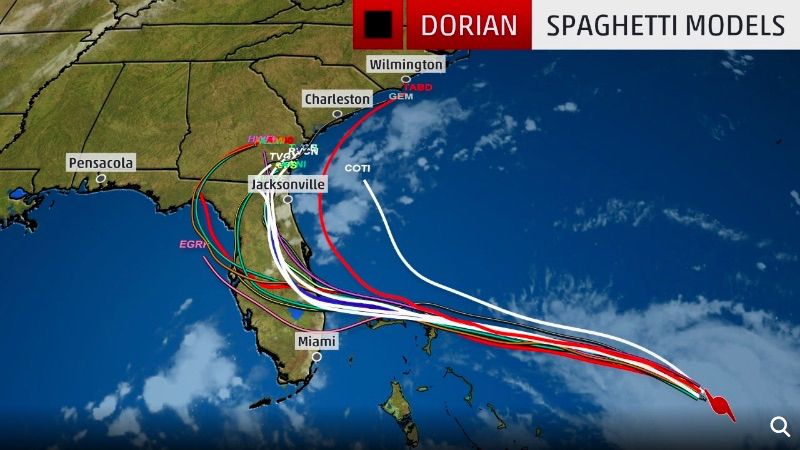
The thing about hurricanes is that we can see them forming out at sea a long way off, days away. The anxiety builds when the weather reports put all the different “spaghetti model” forecasts on the tv screen showing all possible trajectories, turns,  landfall locations, wind speeds, and flooding.

But no one really knows where a hurricane will hit and how bad the damage will be until it actually gets here. And if you’ve ever been through a hurricane, it doesn’t matter how much you prepare or even if you’ve been through one before, when they hit they’re still a shock and they do some kind of damage. The issue is how much, and what it will take to recover.

No matter what “side” you’re on in General Conference (or the General Election), we see it on the map, and anxiety is building. There will be shock and damage. But nobody knows what will actually happen until it gets here, and so we’re left with doomsday forecasts for months.

So what are churches to do while we wait, and who are we going to be in these storms?

What’s our plan? Breakfast. Our plan should be breakfast. Stick with me on this.

In Acts 27, the Apostle Paul sets sail for Rome, and along the way “the weather changed abruptly, and a wind of typhoon strength (called a ‘northeaster’) burst across the island and blew us out to sea.” (Acts 27:14, NLT) The crew panics and starts heaving cargo overboard to lighten the load. They lower the lifeboats, but Paul convinces them they’ll all drown if they jump ship, so they cut the boats loose. They can’t see the sun or the stars, so they can’t navigate. And in dramatic fashion, the Scripture says, “at last all hope was lost.”

All fear and no hope. Sound like anything some of us hear from the pulpit or the pundits?

Finally, after two weeks of fearfully trying to outlast the weather, Paul’s had enough and offers them…breakfast: “Just before dawn Paul urged them all to eat. “For the last fourteen days,” he said, “you have been in constant suspense and have gone without food—you haven’t eaten anything. Now I urge you to take some food. You need it to survive. Not one of you will lose a single hair from his head.” After he said this, he took some bread and gave thanks to God in front of them all. Then he broke it and began to eat. They were all encouraged and ate some food themselves. Altogether there were 276 of us on board.(Acts 27:33-37 NIV)

Did you catch it? It wasn’t that the sailors couldn’t eat because the storm left them with no food. They had plenty of food but were too afraid to eat because of the storm. And what did Paul serve first? The Eucharist. Holy Communion. The body of Jesus Christ: “[he] took some bread, gave thanks to God before them all, and broke off a piece and ate it. Then everyone was encouraged and began to eat.” That’s the Lord’s Breakfast he started with right there, and the crew had so many seconds and thirds that they were throwing food overboard!

As our hurricane approaches, how do we do the same? How can pastors and congregations learn from and lead like the Apostle Paul?

By looking at the “Waffle House Index.” The Waffle House Index is an informal metric FEMA has used to determine how bad a storm is and how long recovery will take. You see, the folks at Waffle House have a whole system for keeping restaurants open in a storm. They know how to do natural disasters. The index is three colors based on what they can offer: green means Waffle House is still serving the full menu; yellow means they’re serving a partial menu because there is no power or water; red means no menu and the restaurant is closed, so you know the damage is bad – really bad.

We need to be a “Waffle House church,” first offering people the body and blood of Jesus Christ, then offering a full menu of the faith even in the midst the storm.

How? Well first, we need to know our menu: the full story of Scripture and the robust depth of our theology, not just our favorite orders (the items we like to pick and choose). How do we learn (or re-learn) it? Maybe we need a congregation-wide confirmation class, a deep dive into the Apostle’s Creed, maybe a renewed form of class meetings and banded discipleship. Whatever a Holy Spirit imagination gives us for preaching and teaching, we can’t know our menu just for the sake of more information, but for the sake of transformation into being like Christ.

Second, we need to become better customers. Yes, there’s a lot of talk about how Christians shouldn’t be consumers, but that’s not what I’m talking about here. If you’ve ever waited tables, you know customers are most known for one thing: complaining. Maybe it’s because “the customer is always right” even when they’re wrong. I get it, because if you feel left out of the preparation process (not in the kitchen, so to speak), or your expectations haven’t been met (“This isn’t what I ordered!”) it’s easy to become disenfranchised. But we’ve got to move away from all the grumbling, criticizing, and fear-mongering. In other words, we’ve got to stop screaming.

Finally, we need to move from being customers to being waiters. Theologically speaking we’re supposed to be “servants,” because Jesus says things like, “For even the Son of Man came not to be served but to serve others and to give his life.” (Mark 10:45, NLT) And of course, one of our mandates is to have the same attitude of Jesus Christ who took the position of a servant. (Philippians 2:5-7)

Consider a story from last November of a Waffle House in Birmingham, Alabama. Because of a glitch in scheduling, just one cook was on duty after midnight to manage about 30 hungry and inebriated customers. He couldn’t keep up, but then one customer got up, put on an apron, and started washing dishes. Another started cleaning tables and serving coffee. With the two customers-turned-waiters at work, the lone employee could keep cooking.

To be this kind of servant in the storm evokes what Wesley wrote about later in his journal at sea: “There is something special about these Germans. They are always so happy! And, they do the menial jobs on this ship without protesting.”

Remember, we’re not a bunch of inebriated customers at one in the morning, we’re servant people filled with the Holy Spirit (Acts 2). This means our storm might give us the opportunity to creatively step up and serve the souls of some hungry and angry people (aka “hangry”). But like Paul, we’re serving them Jesus in the middle of the storm because Jesus is the one who created the very wind and waves (Colossians 1:16) and then later spoke to the storm and told it to calm down (Mark 4:35-41).

And isn’t it interesting that when he was in the storm at sea Wesley asked himself, “How is it that thou has no faith?” which is the same thing Jesus asked his disciples in their boat? Jesus is asking us the same question now. “You have one business on earth – to save souls,” Wesley said.

What does that business look like in our churches in this season of storms? It looks something like the way late chef Anthony Bourdain described a Waffle House: “Where everybody, regardless of race, creed, color or degree of inebriation, is welcomed. Its warm, yellow glow, a beacon of hope and salvation, inviting the hungry, the lost, the seriously hammered all across the south to come inside. A place of safety and nourishment. It never closes. It is always faithful, always there for you.”

Eventually, Jesus will return and there will be no more storms (literal or metaphorical). And when he does we know that, “The servants who are ready and waiting for his return will be rewarded. I tell you the truth, [Jesus] will seat them, put on an apron, and serve them as they sit and eat!” (Luke 12:37, NLT)

Until then, we might as well set the table.


Interview: The Advent Mission with Omar Al-Rikabi

Recently Wesleyan Accent spoke with Rev. Omar Al-Rikabi, an occasional Wesleyan Accent contributor and author of The Advent Mission, a new Christmastime devotional from Seedbed Publishing. 

Wesleyan Accent:Why the Advent “mission”? Is this about missions? Global missionaries? Do I have to give money? Hey, is this a sneaky way for churches to take an extra offering?

Omar Al-Rikabi: I think it helps to look at the meaning of the two words “Advent” and “mission.”

The meaning of the word “mission” is “a sending to go perform a specific duty.” In the creation story, humanity was given a specific mission: to walk with God and tend to creation. But we know what happened: mission failure.

Because of this God had a new mission, a rescue mission, summed up in the mission statement of our faith, John 3:16: “For God so loved the world that he gave his one and only Son.”

And the meaning of “advent” is “the arrival of a notable person or event.” So then, the Advent Mission is about preparing for and celebrating the the arrival of Jesus on that mission. But not just in the manger as a baby, but also his second arrival when he returns.

So yes, the arrival of Jesus’ mission should impact what we consider “missions,” which is ultimately sharing the good news of Jesus, and the book addresses that.

WA: Why are we talking about end times at Christmas? Is that like a zombie holiday movie mashup? When you mention the second coming of Christ, are you talking about Left Behind?

OAR: That’s the funny thing about the Christian Calendar: it begins at the ending, but once you see how it all fits, it makes sense. I describe it in the book like this:

Advent begins with the return of Jesus to the world in final victory, because of . . .
Christmas: the birth of Jesus into the world, which leads to . . .
Epiphany: the manifestation of Jesus to the world, which leads to . . .
Lent: Jesus’ journey to the cross for the world, which leads to . . .
Easter: the resurrection of Jesus in the world, which leads to . . .
Ascension: the enthronement of Jesus over the world, which leads to . . .
Pentecost: Jesus sending his Spirit into the world, which leads to . . .
Kingdomtide: proclaiming the good news of Jesus to the world, which leads to . . .
Advent: the return of Jesus to the world in final victory.

And as far as Left Behind, that’s something that I do address in a chapter called “Apocalyptic Anxiety.” Basically, as Wesleyans we don’t subscribe to “Left Behind” theology and all the fear it fires up. The larger goal of the book is to put together a better, and more hopeful, idea of the return of Jesus.

And to be clear, it’s not just about Jesus’ return. The last week of Advent makes the turn to the manger and gets us ready for Christmas, and so does the book. And what makes this Advent book unique is that it doesn’t end on December 25th. It goes all the way through the 12 Days of Christmas and ends on Epiphany, January 6th. I did this because I think we separate the two events, the two seasons. But that’s why the Church follows seasons and not days, because we need the time to prepare and embrace what Jesus is doing, and that takes time.

WA: What are some practical ways I can prepare for Advent besides taking advantage of Black Friday (or better yet Cyber Monday)?

OAR: Well obviously the first thing you can do is get the book! But in all seriousness, the goal of the book is to be a primer for Advent. So the first part of the book talks about what Advent is and what it isn’t, then makes a turn to how we participate through prayer, fasting, relationships, and acts of mercy and justice.

WA: Who is this book for? Grown ups? Families? Sunday morning discipleship groups? What are some of the most fruitful ways you envision it being used?

OAR: Yes and yes. Obviously we’re talking about Jesus coming back, and being born, to put an end to sin and sickness, so some of those sins and sicknesses are named in certain parts (i.e. pornography, slavery, etc.)

When I first wrote the material that eventually became this book, my context was campus ministry. And the thing about working with college students is they’re gone during most of Advent and Christmas. I imagined giving them something they could take with them to keep them connected in the season.

And when I got to the local church, I found that most folks don’t think about Advent the way I’ve described at all. And it’s hard to preach about it from the pulpit, because it takes more storytelling that you can do in a couple of sermons, especially if (as in my appointment) two of the Sundays of Advent are filled with children’s musicals and Christmas cantatas. Plus so many folks go out of town. None of these are bad things, but they do make it challenging to preach, teach, and prepare for what this season is really about. So I imagined what I could put in their hands that they can take with them that tells the story.

Prepare for the holiday season today by buying The Advent Mission today here.

My Muslim Problem by Omar Rikabi

I have a Muslim problem.

I am a Christian pastor in North Texas. I am also the proud son of a Muslim immigrant from the Middle East, and I have a very wonderful—and large—Muslim family.

This is a problem, because when I hear about San Bernardino, or Paris, or any other terror event, my first prayer is to hold my breath and hope the killers do not have names like mine.

This is a problem because down the highway from me some men with guns protested outside a mosque, then posted the names and home addresses of local Muslims online.

This is a problem because a brother in Christ, and president of a large Christian university, received thunderous applause when he told his student body to get guns and help end Muslims before they kill us.

This is a problem because a leading presidential candidate, along with the son of an iconic preacher, called for Muslims in our country to be tracked, databased, and banned from coming into the country, with both looking to the U.S. treatment of Japanese during WWII as inspiration.

These stories frighten me, but they do not cause shock and awe. I’ve heard this kind of rhetoric spoken beneath the public surface most of my life. Like the one time, somewhere between 9/11 and the invasion of Iraq, when I received an email from a friend in ministry. It was a joke that read something like this:

A cowboy, an Indian, and a Muslim walk into a bar. The Indian said, “My people used to be very great in number, but now are very small.” The Muslim replied, “My people used to be very small in number, but now are very big in number. Why do you think this is?” The cowboy responded, “Because we ain’t played cowboys and Muslims yet.”

I reminded him of my family’s background, and told him I found the joke theologically tasteless and unfunny. My friend said he understood, but “we’re at war,” and as a Christian I should be more concerned with being on “God’s winning side.”

This is a problem.

In seminary, after I gave a talk in chapel about this, another pastor came up to me and said, “I’ve always hated Muslims. I’ve never led my congregation to pray for them as humans.” So goes the trend in some churches and politics of creating Muslims as the other: A less than human without a face or a story… or only a story veiled in hate and violence.

But a trip through my family’s reunions, Skype calls, and Facebook feeds tells more common Muslim stories: my retired uncle who lives with his kids and grandkids near the beach; my cousin who just graduated college and started her first job; her mom who also went back to school and finished her degree; one has a new girlfriend; another can’t stop posting about his favorite football team tanking their season; many came together this fall from around the world to celebrate a wedding… some had not seen each other in years, while others met for the first time.

They are Muslims who are falling in love and having a first kiss; trying to get an education and looking for jobs; wanting to have families and buying homes; celebrating the birth of a child and suffering the loss of loved one; playing video games and going on vacations…

In other words: common human stories.

***

Christmas reminds us God is redeeming all our little human stories into his great divine story through Jesus Christ. This is the good news of the Gospel. The nature of Jesus’s incarnation—God becoming human to be in relationship with each of us—puts us face to face with real people with real stories. When we choose to distort, ignore, or not enter into another’s story, we deny the incarnation and change what is happening.

I get the fear of terrorism. Part of my family’s story includes those living as refugees in foreign countries, mourning the memory of a loved one shot to death because of religious and ethnic extremism.

And I have fears, too. I fear what the rhetoric of “track and ban” could lead to, because history’s darkest ethnic atrocities started with this kind of talk. And I’m afraid, because of our current climate, that someone will hurt my wife or my girls because our name sounds like those terrorist names.

Yes, there are Muslims who commit horrible acts of violence. But violence is not unique to Islam. It is common to all humanity. In our fallen depravity, all of us are radicalized by sin.

This is not a Muslim problem.

This is a human problem.

We need to get our stories straight, because  the Gospel of Christ does not discount anyone from grace and salvation… even terrorists. Take Paul, who started out as a religious militant, overseeing the execution of Christians he saw as infidels because he thought that put him on God’s winning side.

He went on to become the author of most of the New Testament.

If I believe in prevenient grace—that Jesus is pursuing every person—I can only know what he’s up to by entering into another’s story through His holy love. How can I join in if I am running in fear from, discounting, and demonizing those made in the image of God?

This is a problem for me, because it means I cannot dehumanize the politicians, preachers, and even friends who dehumanize my Muslim family.

I cannot become a monster to defeat a monster.

Because dehumanization may be a casualty of war, but it should never be a casualty of the Gospel.

He Had a Name by Omar Rikabi

I have an almost daily battle with my six-year-old daughter to get dressed for school.

This morning it was her sneakers. She calls them her happy shoes.  She can put them on herself, and even tie them. But she always wants “Daddy to do it.”

And I do. I always do.

***

She’s my firstborn. My princess… because that’s what we named her. The day we came home from the hospital, I called my dad on speakerphone so he could talk to her. He worked in Egypt and Syria, so this was how they would have to meet. Before I put the phone down by her head, he asked me, “What did you name her?”

“Sadie.”

“What does it mean, this Sadie?”

“Princess.”

“In what language does it mean princess?”

“Hebrew.”

There was a small pause, as his Iraqi culture of the father choosing an Arab name for his children tried to process this.

“Hebrew?…. Let me talk to her.”

***

After I got sneakers on her feet and her feet to school, I listened to NPR while eating breakfast and heard the story of a boy.

A small refugee boy who drowned fleeing Syria in a raft crossing the Mediterranean Sea.

He wasn’t the only one. Thousands have died like this… of the millions in Syria and Iraq driven from their homes by war.

But a photo of the boy went viral, and NPR interviewed Peter Boukhaert for Human Rights Watch:

“What really touched me in the photo was the little sneakers… One of my favorite moments each day is to dress my boys before they go to school. I saw those little sneakers and I realized that his parents had dressed him that morning for a very difficult journey.”

My wife and I have a policy of not listening to or watching stories of dead children. We can’t think about it.

But as I listened, I dared myself to look for the picture of this boy. And as I looked at him… facedown in the sand and surf, dressed in a red shirt, blue shorts, and his little velcro sneakers… Bouckhaert continued:

“Aylan was his name. He was age three.”

He had a name.

This was not a photo of a body. This was a photo of a boy.

And he had a name.

***

Against my wife’s better judgment, I’ve been looking at Aylan all day.

I can feel his parents putting on his shorts. His shirt. His shoes.

Did they fuss with him to stay still and get dressed, trying to stay calm for his sake, trying to hide the urgency in their voice?

Did he get all dressed up, only then needing to go potty?

Did they make up a story of an adventure so he wouldn’t be scared?

I can hear the mixture of love and frustration a parent has when dressing their child, calling his name over and over again to be still.

Because he had a name.

***

The first name given in creation was Adam. It means humanity.

The Scripture story tells us that God, through Jesus Christ, created all of humanity in his image and breathed into us the breath of life.

I thought of Adam when I saw the first hashtag given to Aylan’s story: Humanity Washed Ashore.

I’m a minister of the gospel that calls Jesus the new Adam: The Son of God who died and rose from the grave to rescue all of humanity. And though I’ve preached, written, and told countless stories about this gospel of peace for the Middle East, before this morning I’d grown numb: Why can I tell you more about the impact of Tom Brady’s reinstatement on my Dallas Cowboys in week 4 than I can about the backstory that led to Aylan’s death?

Later, NPR updated the piece and told the father’s story. I had to dare myself to read it:

“The Turk smuggler jumped into the sea, then a wave came and flipped us over. I grabbed my sons and wife and we held onto the boat,” Mr. Kurdi said, speaking slowly in Arabic and struggling at times for words.

“We stayed like that for an hour, then the first son died and I left him so I can help the other, then the second died, so I left him as well to help his mom and found her dead… What do I do… I spent three hours waiting for the coast guard to come. The life jackets we were wearing were all fake… I am choking, I cannot breathe. They died in my arms.” 

***

He had a name.

Why did his father choose Aylan? What does it mean, this Aylan?

His father’s name is Abdullah.

His big brother’s name was Ghalib.

His mother’s name was Rehan.

Abdullah was a barber. He cut hair. That was his honest day’s labor. But how did Abdullah and Rehan meet? When did they know they were in love? Where was their first kiss? What did they feel when she became pregnant for the first time? What happened when they brought their firstborn home?

Now we know their names. But what was their whole story?

Because they all have names.

They all have stories.

The same name and story as you and me.

Adam.

I dare you to get to know them.