Author Archives: Kim Reisman

Beauty and Brokenness by Kim Reisman

My mother and sister are artists. I am not. I have other gifts (lest anyone worry about my self-esteem), but art isn’t one of them. That’s why I love spending time with my mother and sister. There is something entirely different and inspiring about the creativity God has given them.

Years ago, my sister spent a week with me while her son attended a camp at a nearby university. One of the many reasons I looked forward to that week was because we were planning to undertake an outdoor art project while she was there – something I never would have done on my own.

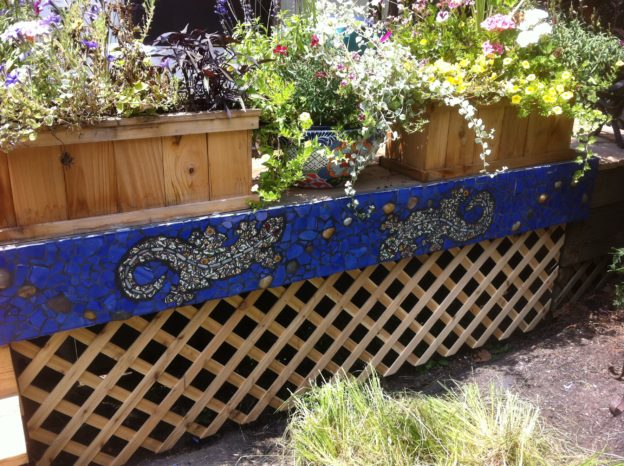
We had recently finished a kitchen remodel and I had a good deal of tile left over, so we decided to create a tile mural on the side of our deck. I was so excited! Of course, when I thought about a tile mural, I envisioned using the existing square tiles to create something nice, neat, and orderly. Not Kerry. She envisioned a mosaic. Why don’t we just break these tiles up and use the pieces to make something new?

A mosaic? (gulp) Ok….

It was hard work. And fun.

And we were quite pleased with the finished product. It brought beauty to my back yard and a smile to my face every time I looked at it, reminding of my sister, her joy in living, her unboundaried creativity, and willingness to risk doing big things. It was a source of encouragement to me as well. Kerry wasn’t the only bold one! I had stepped out of my neat, orderly box, dared to create a mosaic, and it worked!

But then winter came, one of the most bitter we had seen in years – record lows, snow, ice, more snow. A possible precursor to the record-breaking winter weather we’ve had in more recent years. It seemed that spring would never arrive. But it finally did and when we began to tend to the yard, we discovered that my beloved mosaic hadn’t survived the sub-zero (Fahrenheit, mind you) temperatures.

I was heartbroken. It hadn’t worked after all. My mosaic lay in a crumbled heap.

My husband, John, knew that I would have a hard time throwing any of it away so he swept it all up and put it in a big bucket. Spring gave way to summer and then to fall. The bucket stayed on the deck where John had left it. Winter came once more – another hard one. It lingered like the last one, but finally it was nice enough to get back into the yard. I began clearing beds and getting my pots ready to plant.

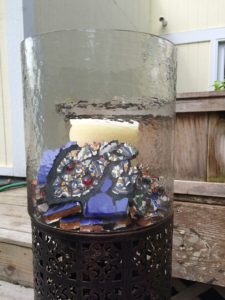
And there was the bucket, still sitting there filled with all the broken pieces. I decided I had to do something about the remnants so I sifted through them and came across a big chunk with the various smaller pieces still intact. You could even tell what it was – the head of one of the geckos in the mosaic. His red eyes shone and I realized he was still kind of pretty, even though he was broken. I had recently bought a big candle globe that I had planned to line with rocks, but decided that he would look nice nestled inside. As I began to arrange him in the candle globe, I realized that all those mosaic pieces – even though they were broken – if they were gathered together, all those pieces would look quite lovely inside the candle globe.

That big candle globe filled with the broken mosaic pieces of my beloved project has brought me great joy over these past years. Not in the same way as before, of course. But each time I see it, I’m reminded of my sister, who continues to challenge me with the freedom of her creativity. And I’m still encouraged to be bold and to take creative risks.

But there has always been something different about this new thing that emerged out of the old. Each time I light the candles and watch the light dance and the mosaic pieces glow and shimmer, I’m reminded of the mysterious intermingling of beauty and brokenness, brokenness and beauty.

As I have journeyed in faith, one of the most significant discoveries that has helped move me forward is the recognition that even though the Holy Spirit is always moving within us and around us, we seldom become aware of that presence until we are willing to be honest about the depth of both the beauty and the brokenness within each of us. But once we’re willing to be honest, the Holy Spirit moves within us in ways we could never have anticipated. And the integrity and authenticity of our witness grows in tandem with that honesty.

In this time of Lenten reflection and preparation, I pray you would be willing to open yourself to the presence of the Holy Spirit that comes when we are honest about the depth of both our beauty and our brokenness. And even more importantly, that you would be empowered to share honestly with others about both of those things, so that all can know that nothing is beyond the power of the Holy Spirit to heal, mend, and transform.

Trusting Our Instincts by Kim Reisman

Scripture focus:

When Jesus came to the region of Caesarea Philippi, he asked his disciples, “Who do people say that the Son of Man is?” “Well,” they replied, “some say John the Baptist, some say Elijah, and others say Jeremiah or one of the other prophets. ”Then he asked them, “Who do you say I am?” Simon Peter answered, “You are the Messiah, the Son of the Living God.” Jesus replied, “You are blessed, Simon son of John, because my Father in heaven has revealed this to you. You did not learn this from any human being. Now I say to you that you are Peter, and upon this rock I will build my church, and all the powers of hell with not conquer it. (Matthew 16:13-18, NLT)


Ever since he was a little boy, my nephew, Jacob, has been very in tune with his instincts. Frequently when playing with his friends, if things started to get out of hand in some way or move in a risky direction, you could hear him say cautiously, “I don’t know… I’ve got a bad feeling about this…” Throughout Scripture we see stories of persons who were able to trust their instincts as they followed God. They were aware of the ways and dangers of the world; and as they lived out their faith, they trusted their instincts not only as a source of protection but as a signal of how to follow God.

Much to the displeasure of his opponents, Nehemiah dedicated himself to rebuilding the wall. His enemies, Sanballat and Tobiah, made several attempts to get him to stop; but at each turn Nehemiah recognized that “they were just trying to intimidate us, imagining that they could break our resolved and stop the work. So I prayed for strength to continue the work.” (Nehemiah 6:9, NLT) Finally, under the guise of trying to keep Nehemiah safe, a friend urged him to stop working and go to the safety of the Temple; but Nehemiah’s instinct told him “that God had not spoken to him but that he had uttered this prophecy against me because Tobiah and Sanballat had hired him.” (Nehemiah 6:12, NLT)

Jesus had an innate sense of who was trustworthy and who was not. When the Pharisees were questioning in their hearts Jesus’ pronouncements of forgiveness, believing them to be blasphemous, Jesus “perceived in his spirit” their thoughts and confronted them (Mark 2:8, NRSV). When Peter declared him to be the Messiah, Jesus pronounced him the rock on which he would build the church, a profound sign of his trust that Peter would come through for him in the end.

Our inner instincts are a significant source of guidance as our lives unfold. While there remains much to learn about how instinct operates, I believe it is the prompting of God’s Holy Spirit within us. William Law was an 18th-century English clergyman whose writings have been very influential. He described this prompting well when he wrote:

The book of all books is in your own heart, in which are written and engraven the deepest lessons of divine instruction; learn therefore to be deeply attentive to the presence of God in your hearts, who is always speaking, always instructing, always illuminating that heart that is attentive to him.*

Our instincts are the natural means in which God communicates with us about truths we have no other way of comprehending. Learning to trust those instincts, being deeply attentive to the presence of God in our hearts, enables us to make strong connections between our faith and our daily lives. It is a way we become more in tune with our instincts, more attentive to the inner voice of God communicating with us. Prayer, along with other spiritual disciplines is the way we learn to trust the inner promptings we receive as we negotiate the challenges of life.

I find it interesting that our intestines are lined with the same type of tissue that surrounds our brains. In a strange way for me that similarity seems to account for the way our “gut” communicates with us. We must be open to that communication. We must be attentive so that we can hear God speaking to us, instructing us, and illuminating us as we make the connections between our faith and the activity of our lives. In this way we will better hear when God guides us saying, “This is the way, walk in it.” (Isaiah 30:21, NRSV)

As you pray and fast this month, reflect on the ways you have trusted your instincts. Recall situations in which trusting your instincts led you in the right direction. As you do this, I pray you will deepen your awareness of what your instincts are telling you and that you will remember that God communicates with us through our “gut,” revealing truths we have no other way of knowing.


*Joy of the Saints, Templegate, 1988, p90.

A Sweet Gentleness by Kim Reisman

Today is Ash Wednesday, the day Christians all over the world mark the beginning of Lent, many with ashes and prayer and fasting. This is not a day when we usually read the resurrection portion of the gospels, but considering the powerful and visible ways the Holy Spirit has been moving these past few weeks, this may be a good year to do just that.

In the last chapter of Luke’s gospel we are given both a promise and a commission. Jesus promises to send his Holy Spirit and instructs us to take the “message of repentance to all the nations” because “there is forgiveness of sins for all who turn to me.” (Luke 24:47, NLT)

Repentance. Forgiveness. These are the themes of Lent, and, it seems, the focus of the Holy Spirit’s work in these days – a work that is clearly spreading far beyond its beginnings at Asbury University.

I’ve been moved by what I’ve read about students publicly confessing addictions to pornography, anger at God, bitterness of heart, despair as the result of difficult family situations. It is clear there is pervasive anxiety, depression and deep woundedness. And yet these same students are proclaiming healing, joy, and a deep love of God like they have never before experienced.*

I’ve been amazed at the consistency of the descriptions of what the Holy Spirit is doing. Joy and peace are pervasive. This is clearly a tender and beautiful outpouring of the Spirit, marked by sweet gentleness.*

What a contrast to our world. We are in a thrashing time. A time marked by our breathtaking ability to do violence to each other. We hurt those we love most with our words and our deeds. We let others down by the things we do and the things we don’t do. Our world is filled with greed and indifference, lust and envy, gluttony, anger, and pride. Our lives are marked by anxiety and depression, broken relationships, and damaged hearts.

And amidst all this thrashing, the Holy Spirit is moving with a sweet gentleness. In an age of anxiety and violence, God is reaching out to us with peace.

As we begin this season of Lent, my prayer is that each of us would remember that we are witnesses to an amazing truth: there is forgiveness for all who turn to Jesus Christ. God is searching for each of us, offering us forgiveness, joy, and peace. And God’s goodness and kindness and holiness and grace and presence and creating power and salvation are here now. They are all available to us now. I pray you would experience that reality. That the sweet gentleness of the Holy Spirit would wash over you in a way that heals, redeems, and restores. And that you, in turn, would channel that same Holy Spirit gentleness to those who so badly need a word of peace and joy.


*Suzanne Nicholson – When Streams of Living Water Become a Flood: Revival at Asbury University.

The Answering Place by Kim Reisman

Scripture focus:

The Lord is righteous in everything he does; he is filled with kindness. The Lord is close to all who call on him sincerely. He fulfills the desires of those wo fear him; he hears their cries for help and rescues them. The Lord protects all those who love him, but he destroys the wicked. (Psalm 145:17-20, NLT)


In Jesus in Blue Jeans: A Practical Guide to Everyday Spirituality, Laurie Beth Jones tells of serving as the executive director of a YWCA Girl’s camp. There was a girl, Carol, at the camp who had been a tremendous challenge to her. One day Carol invited Laurie Beth to walk with her up the mountain. About two-thirds of the way up, Carol stepped off the trail and asked Laurie Beth to look down. When she did, she saw a small area a few yards off the path, which had been cleared of all the weeds and brush and was surrounded by a carefully constructed circle of rocks. “I cleared away everything but the wildflowers,” Carol said self-consciously as Laurie Beth looked around. “From here you can see all of us down below,” she said as she pointed out the recreation field and each of the cabins. “That is why I picked this spot.” Carol continued tentatively, “I know I’ve been a lot of trouble for you…and I thought this might be a good place for you to come and get some answers.” Laurie Beth responded, “That is beautiful, Carol, I will call this ‘The Answering Place.’” (Laurie Beth Jones, Jesus in Blue Jeans: A Practical Guide to Everyday Spirituality, Hyperion, 1997, p 151-152)

As we move through our lives, it seems at every turn we’re confronted by questions. Questions about how we should behave, what we should believe, questions about our commitments, our priorities, our decision-making. Yet many of us forget that there is a place where we can go for answers. We lose sight of the fact that God is close by and available, ready to meet us wherever we are in order to hear us and respond. It is easy to become distracted and even overwhelmed by the demands of our lives so that the sense of God’s closeness begins to fade.

Moses often went up the mountain to the place where he would meet God and receive direction. When Elijah was fleeing from Jezebel’s soldiers, he went into the wilderness, encountered God in a still small voice, and discovered what he was to do next. As the time for Jesus’ crucifixion drew near, he went to the Mount of Olives to pray. It was his “answering place.” He knew God would be there to meet him, to listen, to answer all the questions he may have had and to guide him into his future.

In all the times of our lives, but especially as we approach the season of Lent, we need to be deliberate about creating answering places where we can meet God. Too often we act in haste, obtaining information but never taking enough time to carefully contemplate what we’ve learned. We’re faced with decisions and challenges but work to address them without tapping any of our faith resources. We need to step away, find a place and time where we can meet God, open ourselves to God’s movement within us, and seek God’s guidance and creative power in our lives. Laurie Beth Jones writes, “I need a viewpoint that allows me to look down on the everyday happenings of my life and see them as God sees them, placed in their proper perspective.” (p152) That is a viewpoint we all need; that is a viewpoint that strengthens the connection between faith and daily life. But we will be unable to gain such a viewpoint without deliberately seeking answering places, places where we can go to meet God, to come to know God better, and to allow God to inhabit the center of our lives.

Do you have an answering place? I hope so, and I pray that you are deliberate about going there. If not, I pray that you might find an answering place. A place where you can meet God and reconnect to the power God offers to direct and sustain you. And I pray that you would gain a God’s-eye view of the everyday happenings of your life so that you might receive answers to your questions and be guided into your future.


Harnessed by Kim Reisman

Scripture focus:

I lift my eyes to you, O God, enthroned in heaven. We look to the Lord our God for his mercy, just as servants keep their eyes on their master, as a slave girl watches her mistress for the slightest signal. (Psalm 123:1-2, NLT)


As we begin the new year, our Scripture focus comes from Psalm 123. Psalm 123 is a psalm of ascent – a song people sang as they went up the hill to worship in the Temple in Jerusalem. It describes a posture of looking up – I lift my eyes to you. This posture of looking up is important for our spiritual journey. It’s the type of posture we need to grow in our life of faith.

The problem is this posture of looking up doesn’t come natural to us. Our more natural posture is a horizontal one. We want to explore our spirituality, but on our own, independent terms. The New Age guru Deepak Chopra once said that people were attracted to his teaching because he satisfied a spiritual yearning without making them think they needed to worry about God or punishment.

That’s our natural posture. We want to be spiritual, but we don’t want that spirituality to be encumbered by authority. We want to discover divinity within us or around us, but not above us. We want a God on our own level; a God we can argue with about the things that make us uncomfortable – marriage, divorce, sexuality, what we do with our money. We’re not looking up; we’re looking across.

But Psalm 123 describes a posture of looking up. I lift my eyes to you, O God, enthroned in heaven. When we read this psalm, it’s easy to avoid the issue of authority and get side-tracked by physical location; but our relationship with God isn’t about where God is located, in the heavens or anywhere else. Our relationship with God is about God’s position of authority in our life.

Verse two emphasizes God’s authority as well; we look to God in the same way that servants look to their masters, waiting for the slightest signal to direct them into action. This type of attitude is difficult for us not only because of our discomfort with the language of servitude, but because many of our cultures – especially American culture – emphasize independence. We grow up anticipating one day leaving home; we go to school anticipating graduation and a new job. Each milestone in life marks another step on our road toward independence. What we don’t realize is that independence doesn’t always mean freedom.

We’re all harnessed in one way or another. Each milestone of our life simply marks trading one harness for another. We may be excited about “adulting” until we realize we now have to pay for everything. I had the opportunity to stay home with my children when they were young. I was so excited – no more constraints of work! I wouldn’t have to answer to anyone! Ha! Anyone with children knows I simply removed the harness of employment and replaced it with the harness of parenthood!

Our wide and varying commitments harness us whether we realize it or not. School, jobs, children, parents, these and countless other responsibilities, all come with a yoke that we must wear. That’s why Jesus’ words in Matthew are so important. “Take my yoke upon you. Let me teach you, because I am humble and gentle, and you will find rest for your souls. For my yoke fits perfectly, and the burden I give you is light.” (Matthew 11:29-30, NLT)

Jesus says, “my yoke” because he knows we’re already harnessed; but he wants us to be yoked in a way that suits us. Life will harness you; but you can choose to what or to whom you will be yoked. Jesus says, fasten yourself to my harness, yoke yourself on God’s terms, not those of the world.

There’s a mythical story about a sea captain who was guiding his ship on a very dark night and saw faint lights in the distance. He told his signalman to send a message, “Alter your course 10 degrees south.” A prompt message returned, “Alter your course 10 degrees north.” The captain became angry because his command had been ignored, so he sent a second message, “Alter your course 10 degrees south – I am the captain!” Again, a message promptly returned, “Alter your course 10 degrees north – I am Seaman Third Class Jones.” Infuriated, the captain sent off a third message, knowing that it would evoke fear, “Alter your course 10 degrees south – I am a battleship!” Once again, a prompt replay came, “Alter your course 10 degrees north – I am a lighthouse.”

When we look straight ahead, often all we can see is darkness and fog. We can’t see the forces that have us harnessed and are telling us which direction we should go, how we should behave, what commitments we should or should not make. But when we look up, when we lift our eyes as the psalmist says, we can see the light. When we yoke ourselves to Christ, recognize his authority in our lives, we become connected to God’s hand and can follow God’s light. It’s God’s power and energy that pulls us and pushes us and leads us.

As you pray and fast this month, think about the things that have you harnessed. What would you have to change to more become more fully harnessed to Christ? My prayer is that you will take on a posture of looking up. And in doing so, you would able to see God’s light more clearly, and be guided by it as you seek to follow him.

The Peace of Christ by Kim Reisman

Scripture focus:

Don’t worry about anything; instead, pray about everything. Tell God what you need, and thank him for all he has done. If you do this, you will experience God’s peace, which is far more wonderful than the human mind can understand. His peace will guard your hearts and minds as you live in Christ Jesus. (Philippians 4:6-7, NLT)

Last month we asserted that it is entirely possible for us to live out our faith in visible, tangible ways – that there are things we can do that indicate to the world that God is at the center of our lives. We explored the idea that people can witness God’s place in our lives through our behavior – all the decisions and actions of our daily lives.

But it’s not just our actions that show how God fits into our lives, it’s the way we carry ourselves as well. When we have a strong connection between our faith and our daily lives, our lives will be marked by an inner sense of peace. This peace isn’t the same as a life without problems. Like the joy we discussed a few months ago, this inner peace depends not on our outer circumstances; but on an awareness of the reality of our salvation and the confidence that God will meet our needs.

The disciples are excellent examples of the inner nature of peace. As their experience with Jesus unfolded, through his ministry, his death, and his resurrection, the disciples were never exempted from the difficulties in life. Their peace was not an external experience. On the contrary, they endured prison, interrogations, beatings, and were even martyred as a result of their faith. Thus, the peace that marks a life of faith is an interior one, the gift Jesus promised his disciples when he said, “I am leaving you with a gift – peace of mind and heart. And the peace I give isn’t like the peace the world gives. So don’t be troubled or afraid.” (John 14:27 NLT)

The problem is that there is a huge gap between what we profess and how we live. Like keeping our joy hidden, we don’t live as people with an internal sense of peace. We may claim to have abundant life, but the way we live doesn’t provide much evidence. We may insist that we are confident that God will provide for us, but the reality of our panic at the first sign of trouble says otherwise. It’s one thing to talk about peace; it’s quite another to claim it in the face of tragedy. That’s why peace is such an important fruit to foster as we seek to follow Jesus. By cultivating the peace of Christ, we close the gap between what we profess and how we live.

In October, WME provided an evangelism seminar in Romania that was attended by Christians from several Eastern European countries, including Ukraine. The Ukrainians who joined us had found refuge in Romania when their cities were overtaken by Russian troops. Yet they didn’t consider themselves refugees. Instead, they saw themselves as missionaries, faithfully showing and sharing the love of Jesus in difficult days. They sang the words “I raise a hallelujah…in the presence of my enemies” with sincere courage and joy. Inner peace radiated from them, as that refrain was transformed from poetic words of praise into genuine words of truth and power.

These Ukrainian Christians closed the gap between the claim of peace and an actual experience of it by focusing on Jesus. That’s our task as well. We remember his example, his words, his life and ministry. We remember the gift of his sacrifice on our behalf and the gift of new, abundant, and eternal life that sacrifice affords us. As Paul said, “Since we have been made right in God’s sight by faith, we have peace with God because of what Jesus Christ our Lord has done for us.” (Romans 5:1, NLT)

We close the gap between our claims of peace and our actual experience of it by doing God’s will as well. Jesus said, “If you love me, obey my commandments. And I will ask the Father, and he will give you another Counselor, who will never leave you. He is the Holy Spirit, who leads into all truth.” (John 14:15-17, NLT)

Faithful obedience is crucial to the nurture of peace. God desires us to live out our faith in the real world, not retreat from it or practice our faith in a vacuum. Therefore, God needs room to move in our lives, to act and direct us in ways that only God can know. No matter how deeply we believe we know God, we will never know God well enough to predict how God will act or what God is going to demand of us. Obedience is our necessary response. Through our obedient response and our determination to keep our mind stayed on Jesus, we will foster Christ’s peace, and others will be able to see that peace reflected in our lives.

As you pray and fast this month, reflect on whether there might be something missing from your life. Is something robbing you of peace? In a few weeks we will welcome the Prince of Peace as we celebrate Christmas. Moving ever closer to that celebration, I pray you will keep your hearts and minds stayed on Jesus, doing all that you can to keep your relationship with Christ alive and vibrant. In that way we will be able to raise our hallelujahs with truth and power.


Useful Knowledge by Kim Reisman

Scripture focus:

As we know Jesus better, his divine power gives us everything we need for living a godly life. He has called us to receive his own glory and goodness! And by that same mighty power, he has given us all of his rich and wonderful promises. He has promised that you will escape the decadence all around you caused by evil desires and that you will share in his divine nature. So make every effort to apply the benefits of these promises to your life. Then your faith will produce a life of moral excellence. A life of moral excellence leads to knowing God better. Knowing God leads to self-control. Self-control leads to patient endurance, and patient endurance leads to godliness. Godliness leads to love for other Christians, and finally you will grow to have genuine love for everyone. The more you grow like this, the more you will become productive and useful in your knowledge of our Lord Jesus Christ. (2 Peter 1:3-8, NLT)


One of the core commitments at World Methodist Evangelism is the belief that we show and share the love of Jesus through the wholeness of our lives – through our words, through our deeds, and through the signs that the Holy Spirit manifests in us and around us. Flowing from that commitment is the belief that it is entirely possible for us to live out our faith in visible, tangible ways – that there are things we can do that indicate to the world that God is at the center of our lives and that we take the witness of Scripture seriously in the choices we make and the commitments we undertake. It is these visible and tangible ways of living that make up our moral life – the godly life as Peter refers to it.

Our behavior and our faith are intimately intertwined as is reflected in our Scripture for this month. Peter writes, “As we know Jesus better, his divine power gives us everything we need for living a godly life.” Clearly deepening our relationship with Christ is crucial if we are to live lives of moral significance. Conversely, living a “life of moral excellence leads to knowing God better.” There is an obvious interdependency here. But it’s not simply a neatly packaged set of “steps” that will instantly make us morally excellent or magically place God at the center of our lives. Instead, our faith experience is a process of deepening our relationship with God through prayer and spiritual discipline, through the study of Scripture, and through a commitment to the moral life. Each of these components in turn strengthens the others as the process continues for the entirety of our lives. As our faith grows, our knowledge about Christ, about Scripture, about the various tenets of the Christian faith becomes productive and useful; that experience then deepens our faith, and on it goes.

How then do we begin to be “more productive and useful in our knowledge of Jesus Christ”? How do we strengthen our moral lives? The foundation for such an undertaking is very simple. We begin with moral sincerity. We must truly want to live a moral life; we must earnestly desire to apply Scripture to our daily lives with integrity and power.

There may be some of us who need to start one step earlier. We may need to begin by asking God to help us want to live a moral life. A deliberate commitment to moral integrity that extends beyond simply wanting to “be a good person” may be something that has been externally placed upon us rather than springing from within ourselves. Thus, our first task is to ask God to help us desire that deeper commitment, to help us actually want it rather than feeling we ought to have it.

As we begin the process of strengthening our moral selves, we must start where we are – not where we think we should be. We must ask for and accept the forgiveness God offers in order to be free from the guilt of the past that so often constrains us. For some of us this is an ongoing part of our spiritual journey, but for others this may be a giant first step. Regardless of where you are on your journey, moral sincerity is a gift from God; for it is God whose divine power gives us everything we need to live a godly life.

A second foundation for a commitment to the moral life is the community of faith. Moral excellence is a “lived reality” that is strengthened by the community of believers. As social beings, we are constantly being shaped by the culture that surrounds us. Thus, if we are to succeed in our commitment to the moral life, we must surround ourselves with others who treasure virtue, who are dedicated to teaching and living the moral life. These monthly devotionals may be helpful on a personal level. They may launch you on your journey of knowing God more deeply and living in ways that reflect that relationship. However, our striving to apply Scripture to our daily lives with integrity and power – to live out our faith in visible and tangible ways – that striving will not be consistently rewarding without the support of a morally serious community committed to providing direction and encouragement.

Following Jesus involves action. We commit ourselves to Scripture, to prayer, and to living in ways that reflect our faith. In other words, we behave in ways that reflect God’s place at the center of our lives. This behavior is not confined to specific activities such as church attendance; but it extends to our daily lives and all the decisions and actions that take place there. As we commit ourselves to following in this way, Peter’s word will become more and more true in our lives, we “will grow to have genuine love for everyone” – something desperately needed in our world.

As you pray and fast this month, I challenge you to think seriously about the ways in which you want to strengthen the moral fabric of your life and then find a community that can support you in your effort. As you do this, I pray that you will remember that through the Holy Spirit, Jesus has given us “everything we need for living a godly life. He has called us to receive his own glory and goodness! And by that same mighty power, he has given us all of his rich and wonderful promises.”

Outstretched Hands, Inches Apart by Kim Reisman

Scripture focus:

It is actually best for you that I go away, because if I don’t, the Counselor won’t come. If I do go away, he will come because I will send him to you. (John 16:7, NLT)


When my youngest daughter, Hannah, was 11 years old she mastered the skill of throwing an M&M into the air and catching it in her mouth. She was quite proud of her accomplishment and wanted me to see it. As you might expect each time she tried in my presence, she missed; but as soon as I would leave the room, she would be successful once again.

Hannah’s experience illustrates a basic human truth: Only on rare occasions are we able to perform at our best in the presence of those who are most important to us. Our young children throw tantrums when we drop them off at preschool; yet they are fine the minute we leave the room. Even the disciples were not spared this unpleasant reality – none of the miracles they were able to perform in their ministries took place in Jesus’ presence. It was only when he sent them out, and then again after he had left, that they were able to rise to the occasion. Our dilemma is that God has, in a very mysterious sense, “gone away,” while we remain to rise to the occasion.

Certainly we have been blessed with the power of the Holy Spirit, our Counselor, the one whom Jesus promised to send to us when he went away. Yet in a very real way we can feel alone, disconnected. Michelangelo’s famous depiction of Creation on the ceiling of the Sistine Chapel is a magnificent illustration of this feeling. God’s hand stretches toward Adam, while Adam’s hand extends back toward God – outstretched hands, with only inches to separate the fingers. How like our relationship with God: so close and yet so far away.

Our commitments can seem overwhelming; the hectic pace of our lives can leave us feeling chaotic and frazzled. The few inches that separate our fingers from God’s fingers can seem more like a huge gulf. It can be easy to ask, “Why? Why would Jesus leave us if he cared for us so much? Why must we be left on our own like this?”

The disciples help us with this question. While Jesus remained in human form, it was possible for the disciples’ faith to be grounded not within their hearts but on the concrete confirmation of their senses. They could have faith because Jesus was tangible; they could see him and touch him; they could eat with him and hear him speak.

While Jesus was on this earth, the disciples were just that – disciples, followers, students. Only after Jesus left them did they become apostles – messengers of the gospel, leaders of the church. Jesus left in part because he wanted the disciples to “grow up,” to become mature in their faith. God desires that for us as well. Jesus said, “The person who trusts me will not only do what I’m doing but even greater things.” (John 14:12, The Message) God wants us to grow up in our faith. Like Michelangelo’s God who lets Adam loose in the world, our God lets us loose as well so that our faith will be grounded not simply in the tangible soil of our senses, but in the depths of our heart and spirit.

Our prayer life is a channel through which we receive the Holy Spirit, the Counselor promised by Jesus. It’s one of the ways that “so close but yet so far” feeling is lessened. And yet the tempo of our lives can impinge on that closeness.

Brennan Manning tells a story of a stressed business executive who searched out a desert father complaining about his frustration with prayer, his flawed virtue, and his failed relationships. The hermit listened carefully and then disappeared into the darkness of his cave returning with a basin and a pitcher of water.

“Watch the water as I pour it into the basin,” he said. The water splashed against the bottom and sides of the basin, swirling and agitated. The businessman watched as the water churned and eddied but gradually began to settle, slowing until finally the surface became so smooth he could see his reflection. “That is the way it is when you live constantly in the midst of others,” said the old man. “You do not see yourself as you really are because of all the confusion and disturbance. You fail to recognize the divine presence in your life, and the consciousness of your belovedness slowly fades.” *

How is the pace of your life stirring up the waters of your soul and impinging on your closeness with God?

Just as it takes time for water to settle, so it takes time for us to connect with God, to feel God’s closeness, to come to interior stillness. As your prayer and fasting journey unfolds, I pray that you will continue to be deliberate about taking the time to focus on God and God’s place in your life. I pray that in that interior stillness you would become more and more aware of your belovedness, and experience the closeness of God’s outstretched hands, mere inches from your own.


*Brennan Manning, Reflections for Ragamuffins, HarperColllinsPublishers, 1998; page 38)

Life, Faith, and Growing Trees by Kim Reisman

Many of you know that I love gardening. I just love working with my hands in the dirt. I’ve written about that passion before. Annuals are the kind of flowers that you need to replant every year and they are crucial to my garden. Unfortunately, with the heat wave that has plagued my part of the world, they are looking somewhat puny. But that doesn’t diminish my love of pots of bright colored geraniums, petunias, daisies, and all kinds of other wonderful flowers.

Annuals allow me to experience the fruit of my labor immediately, which is always very satisfying – especially after months of dreary winter. If I’m honest though, as much as I love annuals and the instant gratification of having pots of beautiful blooms, perennials give me a deep sense of fulfillment. They have lasting beauty because they are the flowers that return year after year.

Perennials require patience. I can’t think of a better way to spend a crisp, cool, autumn day in Indiana than planting tulip and daffodil bulbs in my yard; not because I can see the results of my labor at the end of the day, but because I am filled with excitement and anticipation about what beauty will burst forth in the spring.

Gardens aren’t created with a single afternoon of work, despite the beauty of a solitary pot of flowers. They require patience. However, gardeners do see the results of their labor. Their patience is necessary for only a few months at a time and then they are rewarded with the beauty of flowers season after season.

I like to think that I’m a patient gardener; but then I think of the arborist. Where I can be rewarded after a single season, the arborist must often wait much longer. Arborists are experts in growing and caring for trees. Trees require much more than a few months of patience. Arborists know they are in for the long haul. In fact, those who plant trees may never be the ones to enjoy the beauty of their maturity at all.

In 1973, my family moved to Mt. Juliet, Tennessee. Back then it was a small town outside of Nashville and because our house was in a new subdivision, the only mature trees were on the edge of the backyard – so my father planted small saplings along the driveway and around the house. I have fond memories of one particular tree right outside the window by our kitchen table. Early one spring we had an unexpected snowfall and as we sat at the kitchen table, we looked out to see five bright red cardinals sitting in that tiny, snow-covered tree. The memory of all those cardinals in that tree is one I’ve joyfully shared with my husband and children.

Years later, but while my children were still young, we returned to Mt. Juliet, and I was excited to show my family the house. We were almost unable to find it because I was looking for a house surrounded by wide-open space. When we finally realized that we were in front of the driveway, I was surprised to see a wonderful home nestled in the shade of magnificent, tall trees.

We turned in the driveway and drove under the overarching branches of the trees on either side. We were able to walk around the yard and I was excited to show my family the tree that had held the five cardinals. When I pointed it out, my children were perplexed. How could you possibly see five cardinals from the window? All you can see is the trunk! I looked at the tree and then at the window and realized they were right. It was truly a splendid tree, towering over the roof of the house, but it was clearly impossible to see the branches from the window.

As I explained that their Pop had planted this tree and all the others that surrounded the house, and that when it had held the five cardinals it was only about seven feet tall, I realized the wonderful gift my father had given. He had planted trees knowing full well that he would probably not see them in their fullest glory. Yet he planted them, nonetheless. And other people were now benefiting from their shade and beauty, people we would never know and who would never know the man who had given them such a gift.

Sometimes following in the Jesus way is like being a gardener filling pots with annuals. We experience the immediate joy that comes when we recognize the height and depth and width and breadth of God’s love for us. Our faith blooms with beauty, bringing color and life to the world around us. Other times, though, it can be more like planting perennials. The weather is cool, but we dig anyway. God can seem silent and far away, but we pray anyway, we trust anyway. We place the bulb in the ground with confident hope, despite the challenge of wind or dreary skies. We know we must wait; we know there are likely to be harsh days before we see any sign of life. And yet we’re hopeful, because we know spring will come eventually and we will experience the joy of life and color and beauty once more.

Then there are times when the life of faith can feel much more like being an arborist. Arborists know they may not see the full results of their labor, but they know what they are working for is of great significance and is worth their effort now. Following Jesus can be like that. Offering forgiveness, working for reconciliation in our personal relationships and in our communities, loving our neighbor, sharing our experience of faith – we may not see the result of our labor, but these things are of great significance and worth our effort now.

If we are to be Christ followers for all the seasons of our life – not just a blast of color that fades with the onset of cold – we must be confident of a deep and abiding truth: God’s goodness and wholeness will prevail over the violence and brokenness of our world. We need not be in a hurry. Rather, we are to be faithful to the Jesus way, not because it provides an annual show of color, or even consistent perennial beauty, but because it is the way in which God will ultimately heal and redeem all of creation.

In the meantime, we plant seeds of love and forgiveness, season after season, experiencing not only the joy of immediate color and or hope of spring, but the confidence of the sapling, that though it seems fragile now, will one day be a mighty tree.

The Right Connections by Kim Reisman

Scripture Focus:

God wanted them to look for him and perhaps search all around for him and find him, though he is not far from any of us: “We live in him. We walk in him. We are in him.” Some of your own poets have said: “For we are his children.” (Acts 17:27-28, New Century Version)


In quite a few cultures, especially in the Northern and Western Hemispheres, there is little difference between the attitudes and behaviors of people within the church and those outside of it. George Barna, a leading authority on societal trends and religion, has been instrumental in highlighting the discrepancy between what Christians say they believe and how they actually behave. Whether it is lying, cheating, or even divorce, there is little measurable difference between Christians and non-Christians.

This points to, among other things, a tremendous lack of spiritual power in our lives. We seem to be disconnected from the source of spiritual power that would enable us to fully live out our faith. For many people this lack of spiritual power translates into a sense of emptiness, a longing for something more. And yet, rather than turning toward what could be our greatest source of power – God – we try to fill that emptiness with other things. Some of these things are ordinary outlets: our jobs, the wide variety of activities that so often fill our daily lives, sports, or other entertainment. Other outlets are more harmful: unhealthy relationships, alcohol, or substance abuse. In all of this searching there is clearly a desire for something beyond ourselves – we want to be connected to something; often we are just not sure what.

At the turn of the millennium, the city of Bethlehem, the birthplace of Jesus, held a tremendous celebration with fireworks and other exciting activities. A very special aspect of the festivities to welcome the dawn of the 21st century was the release of “millennial birds.” When I read about this, I was immediately moved – what a stirring moment, rich with symbolism! As the new millennium is ushered in, birds are released as a sign of our collective hope for peace.

Unfortunately, the reality of that moment was far different. As the birds were released, fireworks were exploding and in the chaos of the noise and flashing light, rather than flying peacefully away as a flock, the birds became confused and frightened and flew helter-skelter all around the square, never really going anywhere.

What a great metaphor for our human condition! We flap around in our lives, confused, and sometimes frightened, never completely comfortable with where we are flying. It is as though the connections aren’t right. That’s what happened to the birds. Their connections weren’t right. It was nighttime, not the normal time for these birds to be flying. There were explosions going off all around them. They did not connect booming fireworks with safety and flying; instead, they connected them to danger and fear. The connections were all wrong.

Despite all my years in ministry, I still consider myself more of a learner than a teacher. I depend on others for guidance, insight, and mentoring. As I reflect on that process, one thing has become clear from the lives of all those to whom I have turned for guidance: spiritual discipline is crucial. Some folks have mentored me in preaching, others in writing, others in leadership, each according to his or her gift. In all of it however, regardless of their particular strength, there is a thread of commonality – spiritual discipline, rooted in prayer.

Spiritual discipline grounded in prayer is the source of our connection to God. It is a primary means through which our emptiness is filled, and we experience the right connections that enable us to fly without confusion and fear. Without the attention to our interior selves that comes through prayer, we will be unable to know God fully and follow faithfully. We will continue to live without the spiritual power to differentiate ourselves from those who do not share our faith.

I thank God that there are so many in our Prayer and Fasting Community who are working to forge connections between faith and daily life through their pattern of fasting and prayer. I pray that as you move through your regular times of prayer and fasting, you would be able to make the right connections that empower you to fly without confusion and fear. And finally, I pray that God’s Spirit might fill you to overflowing, strengthening you and enabling you to live out your faith in whatever circumstances you find yourself.