Author Archives: elizabeth.turner

The Promise Of Righteousness by Elizabeth Glass Turner

Then justice will dwell in the wilderness, and righteousness abide in the fruitful field. The effect of righteousness will be peace, and the result of righteousness, quietness and trust forever. – Isaiah 32:16-17

The word righteousness isn’t one you see popping up on your Facebook and Twitter feed much these days.

Most people in North America would hear “righteous” and immediately translate it to “self-righteous.” And if there’s any taboo practice in an emerging or present post-Christendom culture, it’s self-righteousness: the inherent judgmental stance against others, in favor of yourself, based on supposed superiority of morality. Perhaps because of it’s very appearance and sound, there’s a halt, a slamming of the brakes. “Righteousness” begins visually and aurally, in English, with “right.” To say definitively that you’re immediately “right” in a pluralistic culture is a non-starter.

Of course “righteousness” doesn’t mean, “I’m right and therefore you’re wrong.” We speak here only of the instinctual response of the casual hearer who didn’t grow up hearing Psalms read from a teacher at the beginning of the public school day. “Righteousness” isn’t in our public vocabulary anymore.

To suggest a neutral or positive understanding of “righteousness” is challenge number one, and immediately we face challenge number two: the assertion that righteousness is the path to peace, that righteousness bears the promise of unsullied community. And yet this is what we read from Isaiah. While Sandra Richter’s powerful new study on Isaiah or John Oswalt’s classic commentary can give deeper insight to this passage, the 21st century reader still can’t escape this basic assertion: “The effect of righteousness will be peace, and the result of righteousness, quietness and trust forever.”

If there is a season in which Americans might be open to reconsidering the promise of righteousness, it might be now: now, when peace, quietness and trust seem long ago and far-off. We hunger for peace, quietness, and trust. A truck plows through families celebrating in France, presidential campaigns are marred by inquiries, lawsuits, violence, and murky business dealings, a man following a law enforcement officer’s instructions is shot and killed in front of a four-year-old child, police officers are targeted and assassinated, a suicide bomber brings death and grief in Syria, and Baghdad, and Kabul, heroin scourges middle America, a teenager shoots up a church Bible study, a hostile nation steals information from our computers, an explosion rocks a German cafe, an agent teaching about cyber sex crimes accidentally catches a predator just in the few minutes she’s on a website during the seminar, a drone attack racks up significant “collateral damage,” a famous reporter admits embellishing an important story, veterans are returning with epidemic levels of PTSD, athletes’ performances are rigged with doping, the Zika virus decimates newborns.

The effect of righteousness will be peace, and the result of righteousness, quietness and trust forever.

Glean from this verse a few quick observations: that righteousness exists; that righteousness has an effect; and that that effect is profoundly desirable.

In an age of global terrorism, we read: “the effect of righteousness will be peace, and the result of righteousness, quietness and trust forever.”

In the time-worn reality of immoral leaders, we read: “the effect of righteousness will be peace, and the result of righteousness, quietness and trust forever.”

In a century when you can wake up to bad news from all over the world instantly accessible on your nightstand smart phone, we read: “the effect of righteousness will be peace, and the result of righteousness, quietness and trust forever.”

If this is what righteousness brings, it just might be worth pursuing.

Our society is beginning to think that the party might not have been worth the hangover. This is what “outgrowing” the Ten Commandments looks like. As well as shows perform with titles like “Scandal” and “Pretty Little Liars,” everyone really wants their friends to be trustworthy and their enemies to be honest. We want athletes’ performances to be honest (otherwise, what’s the fun of watching sports?), we want leaders who know that they too are under the law, we want our enemies to follow old rules of engagement that attempted to protect civilians from combat rather than deliberately targeting civilians.

In the end, we all really want peace, and trust. As we mature, we realize that the lure of drama to give self-importance is quickly hollow. Who doesn’t want a deep, profound sense of safety? And you cannot have true peace, quietness and trust without righteousness, no matter what a political candidate says.

So the song, “Let There Be Peace on Earth, and Let It Begin with Me” is half right. But peace doesn’t begin with peace. Peace begins with righteousness: submitting to the boundaries of God’s covenant with us. Part of the whole theology of salvation that John Wesley preached to everyone – not just those with a head start in life, not just those with deep pockets who could help fund his ministry, but everyone – is the promise that God’s righteousness is good and just, that God’s righteousness fused with love has poured out to cover our unrighteousness, and that not only is our unrighteousness covered, but it can also be transformed. By God’s grace, we’re not only forgiven our unrighteousness, we empowered to live righteously.

“The effect of righteousness will be peace, and the result of righteousness, quietness and trust forever.” Creation groans, we eagerly await the fulfillment of the inbreaking Kingdom of God. Until that Day, we still live in a world with death and tears. But righteousness offers glimmers of that promise.

Do you want to live in a world of peace, quietness and trust?

Put your faith in God, who will bring about his Kingdom where there will be no more crying or tears –

and –

live righteously. Do not covet, do not dishonor the Sabbath, do not give false witness, do not commit adultery, do not take on the name of God flippantly, do not dishonor your parents, and even more than these and the rest, love your enemies, walk farther than you are asked, don’t let your thoughts travel down dangerous roads even if you don’t act on them, think on things that are lovely and true and noble and trustworthy, discern and test, give thanks, pray constantly…

A tall order. “Peace, quietness and trust aren’t possible, because no one can do all that,” you think. In the past one hundred years or so, Americans have set an ever-lowering bar for ourselves, shifting from being at least taught and trained and expected to adopt certain behaviors, to setting the training of our character aside, to saying, finally, that it’s just not possible and those who suggest it is are levying a moralistic power ploy. Make no mistake, as a society we’ve also improved significantly in many areas. But it is difficult to live the Christian life, and it is even more difficult if we do not train the character of our kids, ourselves, and each other.

Righteousness in part is character development. In part, it is accepting the grace of God that melts our hardened spirits and reforms us in Christlikeness. If I want to be part of a culture of righteousness, I must exert my will to pursue individual and communal character development, and I must also accept God’s transforming grace that will shape broken parts of me away from self-destruction and towards the Word Made Flesh.

“The effect of righteousness will be peace, and the result of righteousness, quietness and trust forever.”

So what are you doing to live a life of character and grace? Are your words honest and above-board? Do your thoughts betray ego or humility? Do you think certain standards are for others but not yourself? Are you both bold and gentle in your truth-speaking? Do you shift what you say in one context and change it in another, or at a different time, depending on how it serves your current desire?

Because the effect of righteousness? It’s peace. And the result of righteousness? Quietness and trust, forever.


Christianity Vectors by Vecteezy

American Freedom Or Christian Freedom? by Elizabeth Glass Turner

Always a lover of history, currently I’m partway through Ron Chernow’s excellent biography of American Founding Father Alexander Hamilton – the book, incidentally, which son of Puerto Rican immigrants Lin-Manuel Miranda turned into the hit Broadway musical. With a decent dose of Scot in my blood, I can get into any story of a struggle for freedom easily. Why else would I own a t-shirt emblazoned with “Boadicea: Warrior Queen of the Celts“?

While I do not lack in feistiness, the principle, reality, ideal or goal of freedom has preoccupied my thinking lately, because my feistiness can serve Christ in different ways. And feistiness doesn’t always serve its own desire for personal freedom.

Consider the Apostle Paul: a feisty disciple of Christ if ever there was one – after all, “I confronted Peter to his face,” and Dr. Luke tells us in Acts of Paul and Barnabas’ sharp dispute and parting. But the feisty Saul-turned-Paul was not allowed to fight for himself – “to live is Christ, to die, gain.” He went from breathing murderous threats and arresting Christians to a great deal of suffering (imprisonment, harsh travel, shipwreck, beatings) and dying for his faith. Saul was feisty; Paul was feisty. Saul was feisty for a cause. Paul was feisty for Christ.

Anyone who follows international news (and North Americans have to discipline themselves to do so, because our news sources focus on North American news or “news” almost exclusively) is quickly acquainted with the varying degrees of political and religious freedom around the world. Recently Russia has been debating religious freedom, possibly putting the most restrictions on it since the fall of the Soviet Union (outlawing evangelism online or even invitations to a private residence for the purpose of religious meeting). Recently ISIS burned 19 Yazidi women alive in a cage for refusing to have sex with ISIS fighters. Reading these headlines should rekindle gratitude for freedom in the hearts of those who, at least for the time being, have it. After all, freedom is not and has never been a guarantee. 

Yet as proud as I am that a great-great-relative fought and was injured in the Civil War, specifically against slavery – as proud as I am that great-great-relatives fought in the Revolutionary War – as grateful as I am for young men who retched into their helmets as they prepared to land on the beaches of Normandy – as grateful as I am for a nation that is maddeningly imperfect but still remains a hope, an ideal, a far-off luxury in the minds of millions – Christians are called to exercise their freedom for others. If there is any great divide, it may be the difference between Americans who, in general, exercised their freedom for others, and Americans who, in general, exercised their freedom for themselves.

How ought Christians to steward our freedom, wherever we live in the world, whether we live in relative abundance of freedom or whether we live in restrictive, closed countries with censored internet?

“I have the right to do anything,” you say—but not everything is beneficial. “I have the right to do anything”—but not everything is constructive. No one should seek their own good, but the good of others.

Eat anything sold in the meat market without raising questions of conscience,  for, “The earth is the Lord’s, and everything in it.”

If an unbeliever invites you to a meal and you want to go, eat whatever is put before you without raising questions of conscience.But if someone says to you, “This has been offered in sacrifice,” then do not eat it, both for the sake of the one who told you and for the sake of conscience.I am referring to the other person’s conscience, not yours. For why is my freedom being judged by another’s conscience? If I take part in the meal with thankfulness, why am I denounced because of something I thank God for?

So whether you eat or drink or whatever you do, do it all for the glory of God. Do not cause anyone to stumble, whether Jews, Greeks or the church of God— even as I try to please everyone in every way. For I am not seeking my own good but the good of many, so that they may be saved. – I Cor. 10:23-33

Paul writes here about personal freedom to do something in good conscience that someone else may have qualms about. The principle is similar to not drinking in front of a recovering alcoholic: you may have no problem with addiction, but out of concern and love and even basic politeness, you give up your “freedom” to drink when you are with that person, because the person is worth more than your right to exercise that freedom.

In a society compulsively obsessed with individual rights, this is revolutionary. Of course, in North America, I have the right to post something on Facebook. But maybe I shouldn’t as someone called to be feisty for Christ more than feisty for my nationality. In another nation, of course, I have the right to report my neighbor for something. But maybe I shouldn’t as someone called to be feisty for Christ more than feisty for my government. For Christians, all causes must be submitted to Christ, viewed through Christ, sanctified to be Christlike. I cannot love my cause more than my Christ. I cannot define myself more by my cause than my Christ. I cannot give more for my cause than I give my Christ.

Patriotism isn’t a form of faith; it’s a form of being a good citizen. Patriotism, then, is always subservient to Christ (as Europeans who illegally hid Jews in their homes in the 1940’s practiced at great sacrifice). Our citizenship does not define us, though: we are pilgrims, as John Bunyan pictured, pilgrims, travelers, strangers, foreigners – refugees… The author of Hebrews paints this reality beautifully in chapter 11:

“By faith Abraham obeyed when he was called to set out for a place that he was to receive as an inheritance; and he set out, not knowing where he was going. By faith he stayed for a time in the land he had been promised, as in a foreign land, living in tents, as did Isaac and Jacob, who were heirs with him of the same promise. For he looked forward to the city that has foundations, whose architect and builder is God.

Therefore from one person, and this one as good as dead, descendants were born, ‘as many as the stars of heaven and as the innumerable grains of sand by the seashore.’

All of these died in faith without having received the promises, but from a distance they saw and greeted them. They confessed that they were strangers and foreigners on the earth, for people who speak in this way make it clear that they are seeking a homeland. If they had been thinking of the land that they had left behind, they would have had opportunity to return. But as it is, they desire a better country, that is, a heavenly one. Therefore God is not ashamed to be called their God; indeed, he has prepared a city for them.”

All the citizens of earth hunger for “a better country;” we know that the best country on earth still suffers natural disaster or disease, war or poverty. But for Americans, for Iraqis, for Russians, for Nigerians, for Tibetans, for all from pole to pole who “desire a better country, that is, a heavenly one,” God is not ashamed of them. There is no shame in refusing to exercise individual liberty, for the sake of others; it is the way of Jesus.

Camp Meetings And Revivals In 21st Century North American Methodism by Elizabeth Glass Turner

A couple of generations ago in North America, camp meetings and revivals were not uncommon in many Wesleyan Methodist traditions, flourishing in part from their popularity in the 19th century across frontiers. Outdoor meetings or camp meetings or week-long revival series held in local churches perhaps helped to pave the way for Billy Graham’s famous evangelistic crusades that inhabited tents long before he ever filled a stadium.

Not all Methodist practices included this revivalistic streak: there were plenty of downtown First churches with more formal liturgy, and to an extent there were some class delineations – though camp meetings and revivals were never restricted to blue collar folks, and the towering downtown First churches themselves had their roots somewhere in early circuit rider preaching. But most Wesleyan Methodist denominations have links to some kind of regional campground, even if it’s used mostly for the kids and youth.

In the photographs I have seen, in the histories related, sadly many of these twentieth-century camp meetings or revival series seem quite monochromatic: Black churches and White churches held their own events. (In the first half of the 1900’s Black Americans still had to travel with reference to the Green Book, a small travel guide noting which towns were safe to drive through, which hotels and restaurants served Blacks, and so on. You couldn’t just get in your car and go: that could leave you stranded, or hungry, or worse. If anyone has records, photos or reminiscences of integrated revival meetings or camp meetings, be sure to let me know.) It wasn’t just White Methodists who enjoyed camp meeting: denominations like A.M.E. Zion have a long tradition of camp meetings. Bishop W. Darin Moore notes in The Sound of Revival,

From the numerous renowned preachers of the Methodist movement including John Wesley, George Whitfield, Francis Asbury, and William E. Sangster, to Zion’s own array of preaching giants, such as but not limited to James Varick, James Walker Hood, Joseph Charles Price, Benjamin G. Shaw, Alfred G. Dunston, and Clinton R. Coleman, preaching has been the heart and soul of personal transformation, as well as community and church renewal.

Recently as we packed to travel to a rural camp meeting – my husband’s great-grandfather helped found it – I mused about whether conferences have effectively taken place of most revival series or camp meetings. On the one hand, conferences could be seen as the Yuppie’s ordo salutis: name tags, name-brand coffee, name recognition speakers. On the other hand, some revival series and camp meetings remain, continuing to attract various age groups and sometimes exhibiting slow but steady growth in more diverse demographics.

The Indiana campground I traveled to as a child had an open-air tabernacle, cabins, RV spots, ancient dorms, and a large, noisy dining room. It was decided the tabernacle should be enclosed and air conditioned, padded chairs replacing the long wooden slat bench pews. Not long after that, attendance dwindling, it was closed down, then sold. Though sad for me on a personal level, much as I detest the heat I hadn’t wanted it changed, in part because it seemed to me that if we had just waited a bit longer, shown some patience, it would’ve come back. These things are cyclical. Now I look at mandolin-playing hipsters who (while enjoying their strong coffee) would see that campground as a kind of authentic get-back-to-nature, learn-about-our-roots experience, and I think I was right, even if they would’ve wanted some artisanal organic snacks sold next to the Cheetos at the concession stand.

I think there’s room enough for conferences, revivals and camp meetings (even if “revivals” are now called “summit” or “spiritual emphasis week” or “Revive:The Awakening” #awakened). For one thing, physically setting apart time in a dedicated space grabs your whole body’s attention: it breaks up your habits, your routine. You physically go somewhere specifically for the purpose of attending to your soul. For another thing, taking several days, or a week, to do so is somewhere between Sabbath and tithing on the scale of spiritual disciplines: you mark to yourself and others that it is important to you in your time, schedule and budget to learn, listen, examine, rest, and receive. Additionally, when it’s possible, families who attend – whether nuclear or multigenerational, adopted or stepparents – families as a unit can set aside time both to be together and to attend to their souls.

That said, our conferences, revivals (#awaken) and camp meetings must morph and stretch. Preachers cannot assume a baseline of biblical knowledge among kids and youth (and adults). More and more children and teens come from broken homes, brought by a grandparent. Elementary and high school ministries are populated by racially diverse participants – is the speakers’ platform? In the technology and globalization age, even middle schoolers have access to extraordinarily hard core explicit material with ten minutes of solitude and a click of a few buttons. They also have instant access to the same tragic headlines about news that adults do, even if they receive it through Snapchat, not CNN. A sweaty fifth grader may be staring back at you from a pew, worrying about whether he’ll ever be in the middle of a mass shooting: after all, some elementary schools have active shooter drills instead of Cold War A-bomb drills. And this is one weakness of the #conference movement: targeted audiences mean the pigeonholing of generations, vocations and sometimes gender. You can’t take the whole family to most conferences, and they wouldn’t want you to anyway.

What’s your experience of multi-generational spiritual retreats? Have you ever been to a faith-based camp meeting or a week of special church services? What did you like or dislike about it? Was it a diverse gathering? How would you describe it to someone who had never before participated?

2016 United Methodist General Conference Recap by Elizabeth Glass Turner

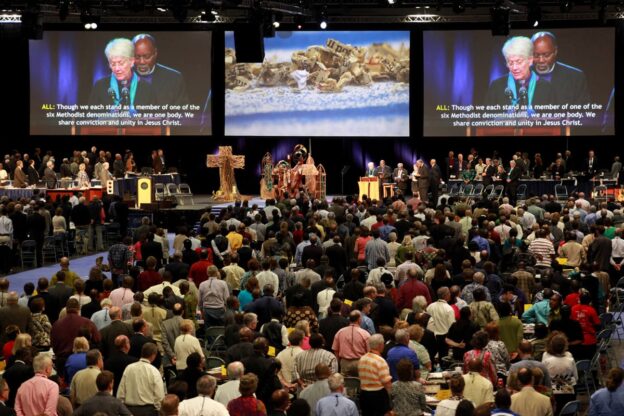
United Methodists and many others followed the 2016 General Conference in Portland with fervent interest. Whether you watched live streaming (a primer in do’s and don’ts of parliamentary procedure), caught a few random comments on social networks or read daily summaries from the United Methodist News Service or the UM Reporter, by now there are a lot of perspectives on what went down – and what didn’t.

Various interest groups immediately went into spin mode, from Reconciling Ministries Network to the Council of Bishops to the Institute on Religion and Democracy. Everyone wanted to attempt to claim a victory for their cause. On the other hand, the problem with grassroots internet communications these days is that hyperbole has become easy currency. Whatever position isn’t mine will immediately cause the End Of The World As We Know It. This isn’t a biblical perspective or even a sensible one, and it can be skinned down to random blanket statements or dressed up in semi-rational pseudo-arguments. Unfortunately General Conference for United Methodists coincides with the U.S. presidential election cycle, every four years. Heaven help us.

While there is context to everything, a few facts can be known about the gathering of United Methodist clergy and lay delegates from around the world, of United Methodist boards, institutions, societies and agencies, of United Methodist caucuses and interest groups, of various religious bodies, activists and news agencies that converged on Portland.

  1. The rules by which the conference will abide must be established at the beginning before business begins. Delegates spent three days at the beginning of the two-week gathering debating one new proposed rule and later lamented how short they were on time.
  2. Hundreds of petitions get voted on in committees for several days at conference. If the committee passes something, it can make it to the floor of General Conference to be voted on by the elected delegates. (Note: Much legislation never makes to discussion on the floor at General Conference because they always run out of time.) 2016 proved to be a year in which the global contingencies made their presence felt in voting. When a committee gathers, not only are elected delegates participating, but observers are present recording votes and communicating them to the groups who have particular interest in whether or not something passes committee. A reliable report from one committee communicated that there was screaming – actual screaming – during one long, strained committee session. (Committee sessions are not livestreamed.)
  3. Hours of plenary time is spent on what could be called diplomatic formalities: special presentations, video reports, a great deal of special music, greetings given and received, guests acknowledged, sermons shared. If anything could be acknowledged, it is that community worship cannot manufacture unity, nor can it “guilt” participants into agreeing with each other.
  4. It is the controversial practice of United Methodist communications to cut livestream during protests.Protests by LGBT groups in the midst of conference business are expected, though not formally scheduled. Sometimes activists also hold press conferences in one location while business continues on the floor. The level and duration of disruption varies.
  5. Everyone – American and international clergy and lay delegates, presiding Bishops, supporting Bishops – everyone needs a short orientation seminar on the basics of Robert’s Rules and on how to track the various stages of a motion.

In the midst of all this, a few things happened. The Judicial Council was voted on and is now an extremely international and diverse body. The United Methodist Church delegates voted to end its relationship with the Religious Coalition for Reproductive Choice. Delegates also voted to double the amount of money put towards theological education in Africa.

However, delegates also voted to ask for leadership from the Council of Bishops before voting on anything related to human sexuality. When this happened, the Council of Bishops spent a night working on a proposal and presented it the next morning. Essentially the proposal suspended any business at conference related to human sexuality and proposed the creation of a commission to study Book of Discipline paragraphs related to the topic. It also proposed a possible specially called gathering in two or three years to meet about the findings of the commission. An alteration of the proposal failed. The original proposal then somehow passed. What was unclear was whether legislation related to reorganization or separation within the denomination was included in the tabling of discussion on human sexuality. Apparently it either was included, or caucuses decided not to pursue the question, because after that vote, no action was taken on proposals for dealing with the controversy in the denomination.

Response was immediate: some people breathed a sigh of relief to again avoid finally addressing the deep theological differences in The United Methodist Church (adoption of the Nicene Creed as a doctrinal standard failed in committee). Activists who have worked long and hard were devastated that votes on LGBT issues would not happen this year. Some traditionalists saw the commission as an opportunity to help form the conversation, while others were gut-wrenchingly frustrated that the conversation that needed to be had was not being had. A rather depressed pall hung over the plenary sessions after delegates voted to create a season of “discernment” or “kicking the can down the road,” depending on who you talked to. Protests were still being held, and votes on whether or not to divest from fossil fuel industries were held around the elephant that remained in the room, whether it was talked about and voted on or not.

Because of course whether or not it was discussed on the floor of General Conference, the theological differences and disagreements on petitions related to human sexuality were everywhere – in hallway chats, on the Twitter live feed, around cafe table discussions, on Facebook, in the news.

About five seconds after General Conference finally ended, not with a bang but with a whimper, Things Started Happening: the Northern Illinois Board of Ministry announced it would not act within the agreement of United Methodist life together (formally called the Book of Discipline), and would welcome candidates of any, all, or no sexual orientation for ministry. Then Bishop Scott Jones from the Great Plains Conference reiterated his position in the follow-up proceedings against a pastor that, while aligned with the Book of Discipline, is a completely different practice from northern Illinois.

A great number of General Conference recaps emerged, post-game analysis from scholars, pastors, and theological pundits dissecting what had – and hadn’t – happened, and why.

Which brings us to today.

In the context of all this, here are several of the best post-mortems of the 2016 General Conference of the [United] Methodist Church. All of them should be read with the awareness that United Methodism is not the only expression of the Wesleyan Methodist movement worldwide: hardly. Over 80 denominations in over 130 countries are Wesleyan Methodist. North Americans tend to be sentimental about the United Methodist branch of the family tree, because architecturally Methodist churches grew along with many Main Streets and downtowns, an expression of Americana, merging with the Evangelical United Brethren in 1968. But Methodism itself grows in a great many iterations, United Methodists being only one.

Here, then, are several recaps that stand out in their insight or the excellence with which their perspective has been put forward (and they cover a range of perspectives)*:

From Asbury Theological Seminary President Dr. Timothy Tennent, “An Open Pastoral Letter to United Methodists”

From scholar Dr. William Abraham, a cerebral analysis of trends, “The Birth Pangs of the UMC as a Unique, Global, and Orthodox Denomination”


*It is acknowledged that many United Methodist-related pastoral or scholarly blogs are written by North Americans, particularly Caucasian men. Many women and people of color may share opinions and viewpoints on Facebook or Twitter but do not necessarily publish their own blog. Consider following pastors on Twitter, like @LisaYebuah, @JenniferMoxley, @KimsNextStep, @joyjmoore, @CarolynCMoore, and @JessicaLaGrone.

A Full Basin: The Purpose Of Orthodoxy by Elizabeth Glass Turner

Orthodoxy gets a bad rap these days. At a time when distinction is seen as an evil – this or that, one or the other – orthodoxy is seen as presumptive, divisive and unwarranted. To say one thing is right or rightful is to deny the right or rightfulness of something else – an inconceivable vanity, a tired, predictable power-play of the literal-minded who have not yet grown beyond certain categories in their faith formation. Passing over the irony that the denial of a creed is, in itself, a creed, what exactly is the purpose of orthodoxy? Too large a question for a short reflection, and one that academics would undoubtedly plumb in detailed excellence. But let’s go for broke and at least sketch a few characteristics. The purpose of orthodoxy is to align followers of Jesus Christ with God and with one another. Yes, this assumes that it’s possible to get out of alignment. But even if we say that judging is a great evil, we practice it regularly in real life because we must: we align our tires, we align scientific instruments, we align our habits with healthy guidelines, we align our behavior with our beliefs. If we neglect realignment, we face the hard reality of entropy – our tires are unaligned, our instruments are unreliable, our health suffers, our behavior harms ourselves and others. “But God is beyond understanding in a way you cannot compare with our comprehension of how to make a car run well. How can you align with someone or something you can’t claim to comprehend?” The purpose of orthodoxy is assert an embodied, knowable reality that is knowable truly even if it can’t be known fully. The Word Made Flesh means that almighty God knew how to make the heartbeat of Trinitarian love known to our well-meaning but tiny minds. Orthodoxy points us again and again to the idea that we can know because the Incarnation reveals that God wants us to know. If we even hesitantly reach for the idea that the Word Became Flesh, that infinite God took on humanity, then we accept the idea that something of God can be known because God made sure of it. So if we out of hand reject the possibility of the Son of God being born in carbon-based, fetal-heartbeat reality, then we immediately make a statement about what we think can be known of God – or not known. The purpose of orthodoxy is to proclaim that God so loved that God so revealed the internal nature of God through Jesus Christ. Jesus Christ is the ultimate revelation of the nature of God, and we treasure Holy Scripture because we trust that the same grace that revealed itself in Christ preserves the redemptive narrative of God’s interaction with humanity in the pages of Holy Scripture. And this is a reality of beauty. Orthodoxy is beautiful because it aligns us with Jesus Christ and with one another. It is beautiful because it asserts an embodied reality that is known truly if not comprehensively. It is beautiful because it proclaims that God loves the world so much that God revealed the divine nature through Jesus Christ. The creeds that house these heirloom beliefs of the Christian faith are beautiful. They are not ugly or divisive or a predictable will to power. If we do not agree about how God has revealed the inner workings of God’s own self, we may still affirm each other’s humanity, each other’s value, each other’s beauty, each other’s worth. We may live in kind regard and friendship. We may live as caring neighbors. We may live in service to each other. We may donate a kidney to each other. We may cheer each other’s kids in sports. We may send emergency relief in tragedy. But we do not share the same heirloom beliefs of the Christian faith, and we probably cannot worship together indefinitely. And that’s alright. The beauty of orthodoxy doesn’t leave room for ill-will: it simply doesn’t. It washes the feet of friend, neighbor, enemy, the same. Common worship is essential for any connected faith body. The Amish and Mennonites and some contemplative Catholics all submit themselves to this reality: with pacifist intent, they order their worship as they best understand and wish others well, ready and active in serving those of other faiths or no faith at all. There is a time to celebrate the Eucharist, and a time to celebrate a service of foot-washing. Maybe the time has come for the latter. That is how we might lovingly pay honor to each other as, with mutual respect, we might depart to order our common worship as we best see fit. So there is a gentle beauty to orthodoxy that sounds a great deal like leather sandals being slid off of calloused feet, like the splash of water being poured from a pitcher into a basin, like a cloth being wrung out, like a towel rubbing against a cracked heel.
It was just before the Passover Festival. Jesus knew that the hour had come for him to leave this world and go to the Father. Having loved his own who were in the world, he loved them to the end. Jesus knew that the Father had put all things under his power, and that he had come from God and was returning to God; so he got up from the meal, took off his outer clothing, and wrapped a towel around his waist. After that, he poured water into a basin and began to wash his disciples’ feet, drying them with the towel that was wrapped around him. When he had finished washing their feet, he put on his clothes and returned to his place. “Do you understand what I have done for you?” he asked them. “You call me ‘Teacher’ and ‘Lord,’ and rightly so, for that is what I am. Now that I, your Lord and Teacher, have washed your feet, you also should wash one another’s feet. I have set you an example that you should do as I have done for you. Very truly I tell you, no servant is greater than his master, nor is a messenger greater than the one who sent him. Now that you know these things, you will be blessed if you do them. – John 13:1-5, 12-17 (NIV)

What A Successful Conference Looks Like by Elizabeth Glass Turner

It is the season of punditry.

So goes life as a U.S. citizen who belongs to The United Methodist Church. General Conference cycles match up with the presidential election cycle: every four years, we encounter heated tempers, technicolor bluster and threats to move to Canada. This year the hype in the United States is reaching near radioactive levels of intensity. Beneath the strident cadence of religious and political talking heads lies a current of fear – not unwarranted: will the radioactivity evaporate our identities, leaving only our shadow imprinted on the wall?

Those who lament that public discourse has gotten out of hand have a point. On the one hand, as the historical hip-hop musical/runaway success “Hamilton” reminds us, our nation’s DNA is laced with potent personalities arguing for the best way forward. As caustic as presidential debates may get, no one has once again died in a duel at the hand of the Vice President (yet). On the other hand, it’s like a splash of cold water to view old footage from 1980’s political debates. The change is astounding. Something is qualitatively different.

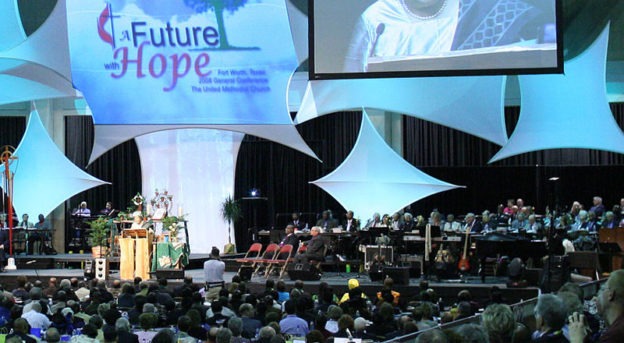
The past few days Twitter has been cluttered by pastors, District Superintendents and Bishops praying for a “successful” General Conference. In 2016, what does a successful General Conference look like? Does it look like one where parliamentary proceedings avoid giving the floor to anyone with a spray tan and blueprints for a giant wall? Does it look like a gathering with international media coverage that manages to avoid protests, riots and arrests? Does it look like a gathering with international media coverage that manages to foster protests, riots and arrests?

Does a successful General Conference look like #itstime, #wearemore, or #faithfulumc? (The #wearemore hashtag is the branding apparatus of Bishops with ulcers who are attempting to remind everyone that this is a long road trip and we are more when we are together, regardless of who is squabbling in the backseat because “he’s looking at me funny!” The question is whether the grave topics under consideration at General Conference are mere backseat squabbling or whether #theyaremore than that.

What does a successful General Conference look like? A lack of blow-up’s, a hopeful kick of the can down the road? A presence of confrontation, an urgent appeal for honesty and resolution?

How do you have a successful conference when participants are wedded – for a variety of reasons – to positions they feel they must hold at all costs?

The problem with pluralism is the evaporation of telos. How can we move toward a common goal successfully together? That telos, that goal, that end-game, means significantly different things to us. The problem isn’t that we can’t work together. It’s that we’re working towards different ends. To minimize those differences disrespects everyone involved.

In the case of human sexuality within The United Methodist Church, for instance, it doesn’t shut down the argument to proclaim that the Supreme Court of the United States has ruled: many religious bodies – significant ones – still practice a mode of spiritual formation that reflects a traditional stance on marriage and sexuality, including the Roman Catholic Church under the popular leadership of Pope Francis, conservative Judaism, and many branches of moderate Islam. And so United Methodists of different convictions may be willing to work together, but underneath that sentiment is the dread often felt in a dead-end relationship: where is this headed? Is it sustainable? I care about this person, but do we have a significant compatibility issue? What if we’re loathe to stop working together but we are working towards different ends?

So rather successful outcomes – because those vary widely depending on who you ask – what are the attributes of a successful 2016 General Conference of The United Methodist Church?

A successful General Conference will be one in which honesty is practiced with humility. The constituents, organizations and movements present need to be extremely honest about their intentions, goals and convictions – no matter what that means for the future of how we live and worship. Fear of divorce can lead to a lack of bluntness, the inability to frankly and simply express oneself. But the honesty must live and breathe in the ecosphere of humility (not that humility means capitulation). Humility doesn’t mean setting aside conviction. It means the willingness to serve another with whom you disagree while you live your conviction with integrity. It means holding the door open for someone who has made your life difficult.

A successful General Conference will be one in which respect is shown in the mode in which business is conducted. If business is interrupted (a great deal of time, energy, money and travel go into planning General Conference) by special interest groups, be they the Green Party, Right to Life, or GLAAD, then it is fair to ask if the behavior embodies respect for the gathering, however much one might agree with the platform of the protesting group. This is particularly pertinent when it comes to non-members of The United Methodist Church demonstrating on the floor during business. This becomes potently illustrated if you conduct a simple thought experiment: would you vote to allow non-United Methodist members to demonstrate on the floor during business if they came to demonstrate on behalf of a certain presumptive presidential nominee? (Or would you vote to allow United Methodists to demonstrate on the floor during business if they came to demonstrate on behalf of a certain presumptive presidential nominee? Here I suggest the convened body should have a say, and not just the presiding chair.)

A successful General Conference will be one in which the worldwide nature of the church will be celebrated as central to the United Methodist identity rather than an appendix to its agenda. If non-English speakers’ perspectives are dismissed, because of the content or because of their place of origin or race, then respect will not have been shown. Eight years ago international delegates to General Conference faced challenges like receiving their preparatory materials months after North Americans did. They sometimes were asked to vote on what in English were oddly worded amendments or proposals after having the content translated twice, such as from English to French and from French to Swahili. Rather than embrace global delegates, some North Americans, seeing their presence as a hassle, promoted the idea of giving them their “own” conference – a gross failure of basic inclusion at best, and reminiscent of the days of American segregationalism at worst. An intentionally “international” opening worship service serves to highlight the global reach of the denomination – but perhaps in a similar way to highlighting diversity at the Oscars.

As the World Methodist Council reminds us, Wesleyan Methodism has deep, historic roots globally. The Council, which includes The United Methodist Church in the denominations it represents, brings together at least 80 denominations from over 130 countries involving over 80 million people. General Conference is not a time to practice geographical hubris with a colonial residue of paternalistic impatience. Simply put, despite all the “ministry of monitoring” that goes in to making General Conference inclusive, how many members of General Boards and Committees are North American? For all the talk of sharing power, North Americans seem particularly loathe to do so.

Finally, a successful General Conference will be one in which decisions are made. What a simple sentence: what a complex proposal. If honesty is practiced with humility, some decisions need to be made. Sometimes the worst outcome is one in which millions of dollars and work hours are spent in order to tread water. The worst case scenario isn’t, as actress Gwyneth Paltrow would put it, a “conscious uncoupling.” The worst case scenario is that blood pressures will skyrocket and mud will be flung all so that nothing changes – a dysfunctional and untenable position.

A failed General Conference has little to do with whether or not The United Methodist Church chooses to continue to exist in its old form or in new iterations. A failed General Conference will be one in which honesty is swallowed by the desire to appease or to protect the status quo; in which humility is swallowed by a sense of entitlement; in which disrespect is shown in the mode in which business is done; in which the worldwide nature of the Body of Christ is re-sketched with North American features; and in which no clear, coherent, time-bound decisions are made in any direction.

Go, therefore, to your committee meetings and plenary gatherings, to the visitors’ gallery and the restroom, to planning sessions and café tables, and consider your conversations, plans and prayers with these questions in mind: if we’re really honest, what do we want this to look like in four years? If we’re really honest, what is it likely to look like in four years? What decisions will help those to be one and the same thing?

…on earth, as it is in heaven.

Blood, Ash, Tears: The Ashiest Of Days by Elizabeth Glass Turner

We are too removed from ash.

Our furnaces soil our hands only as much as a stray clump of dust falls from the filter when we wrinkle our nose and change it with another high-efficiency, allergen-reducing plane of fibers designed to keep our lives clean.

Maybe there’s a stray bonfire, an occasional fireplace mess that dirties our palms or leaves a smudge – extra, chosen warmth for recreational purposes.

If you and I see ash it’s usually on the news, somewhere far away: the 90’s business women with ash around their noses and mouths, the result of breathing in smoke, emerging from the first foreboding basement bombing of the World Trade Center in New York. The dusty, sooty cheeks and noses and foreheads of the bombed and shot-at and chased in Other Parts Of The World as loved ones are pulled limp from rubble. The dazed eyes crinkled in old war photos, peering stark from ash and dirt, smoke-caked faces hiding shellshock.

Lucky us. We get to choose our ash.

Why has ash become #chic? Growing up only the old-school Catholics wore it on their heads and my child eyes tried hard not to stare. “What is Ash Wednesday?” I pointed to the calendar, asking a parent. “A Catholic holiday,” I was told, until our denomination started observing “40 Days of Prayer and Fasting,” and a blink and a few boy bands and technological advances later and there are ashes to go, there are people who never go to church bending and asking for dirty foreheads, what?

What is this impulse for a mark of sorrow, grief, repentance, confession? Why are strangers at train stations asking for ash, in our culture that let black arm bands of mourning drift down to the floor, an old dated practice to be left by the wayside?

Complaint or neuroses or hoarding or entitlement all cover one thing: call it sadness or terror or emptiness or grief, it’s behind the rant at the employee or the compulsive behavior or longing for attention. Mother Teresa spent so much time in dirt and recognized the sadness in North America. She called it a poverty of love.

Oh, God, love – it hurts. It hurts to want to be loved. It hurts to refuse or betray love. It hurts to lose love. And the pastor or priest bending with blackened thumb, murmuring says, I see your pain. It is recognized. Today others will see it too. You have a chance. Love Made Flesh bleeds for you.

Communal grief is necessary. You might stumble on a rare wake among Irish Catholics, or a Jewish family sitting shiva. For the most part, grief has become privatized, something you discuss with a therapist and hide away from the world – unless you sink down into it, let it engulf you, put it in album form and earn a deal with a record label.

Maybe we get to choose our ash. But we don’t get to choose our grief. No President can carry it away, no amount of veganism can remove our guilt, no amount of safe space can really protect us. You play Candy Crush or sew a new quilt or join a fantasy football league or secretly read Fifty Shades of Grey or join a club, anything to distract, but we all close our eyes at night, trying to go to sleep. And whatever you try to numb during waking hours comes to life.

Do not feed after midnight…

I’ve been waiting for this day, ever since two days before Christmas, when weeks of wrapping paper and pain and the Grinch and blood finally contracted into finality, and I avoided looking at my beloved nativity set because Mary had her baby, and mine was lost, the heartbeat ended.

Noel, Noel, Noel, Noel – born is the King of Israel.

My favorite time of year screeching out of control, the beautiful depth of the liturgical calendar and Advent and hang on, little buddy, is it a boy or girl? Then the baby is gone, missing from the manger. Two children up at six on Christmas morning, starry-eyed and bouncing and laughing. I smile and laugh, turn my head, try to hide the grimace of pain, the tears rolling hot.

Chunks of grace, substantive and heavy, held the doors of our souls open. A girl named Micah wrote this, published it just a couple of days after Christmas when I was sure there was nothing in a devotional email pertaining to an Advent miscarriage.

I’ve been waiting for this day, this thundercloud of a day on the horizon of church life, when liturgy would finally match my insides. I do not want a sunny day when I’m sad.

The last enemy to be destroyed is death.

From dust you come, to dust you shall return. Repent and believe the Gospel.

Your body is feeble. Every life involves pain.

Today we acknowledge it.

And we confess not only our frailty but our hope that blood, ash, and tears do not have the last word. In Revelation, blood and smoke and tears can indicate new life.

“And when he had taken it, the four living creatures and the twenty-four elders fell down before the Lamb. Each one had a harp and they were holding golden bowls full of incense, which are the prayers of God’s people. And they sang a new song, saying:

You are worthy to take the scroll
and to open its seals,
because you were slain,
and with your blood you purchased for God
persons from every tribe and language and people and nation.
You have made them to be a kingdom and priests to serve our God,
and they will reign on the earth.

Look! God’s dwelling place is now among the people, and he will dwell with them. They will be his people, and God himself will be with them and be their God. He will wipe every tear from their eyes. There will be no more death or mourning or crying or pain, for the old order of things has passed away.

He who was seated on the throne said, ‘I am making everything new!'”

We are dust without you, God.

Your Kingdom come, your will be done, on earth as it is in heaven…

Make us new creatures. We can’t live this life without you.

Amen.

Leadership Qualities That Can’t Be Faked by Elizabeth Glass Turner

Leadership is a tricky subject.

I had a great college professor who modeled it, taught it, instilled it, and theorized about it (only a rare person can do all of those things). He posed a question: are you born with leadership abilities, or are they learned? (A probable admittedly false dichotomy, to be sure, but a great way to think about how one gains the qualities of leadership.)

Rather late to the party, I watched the painfully exquisite Band of Brothers miniseries (2001), a carefully rendered tribute to a deep slice of modern history. “Band of Brothers” follows American paratroopers who served in Europe in WWII. The men were real, the stories are real, it all really happened – a fact which shakes me. It ought to shake all of us.

I’m in a generation that’s extraordinarily cynical about leaders, largely because of scandal in every sector and at every level of public life. A President misuses power in the Oval Office, Catholic priests are brought up on charges around the world, Congressmen and Governors accidentally Tweet explicit photos or try to sell Senate seats, Bernie Madoff bilks millions, star athletes admit to doping, unarmed Black men are strangled and shot in the back by police officers, 40% of North American pastors surveyed admit to using pornography. The development of the internet means we don’t learn of things slowly – we’re bombarded by information almost as soon as something happens.

Whether or not it’s fair, integrity isn’t assumed. Lack of integrity is.

It is assumed there’s a dichotomy in your life between image and reality – an Instagram filter, if you like. Everyone knows you take 20 selfies to get one good one, right? So the Sunday morning you – why would I assume that’s the real “you”?

There’s good news and bad news. The good news is that the world desperately needs strong leaders. Leaders won’t have to go busking on street corners with their guitars for loose change. Additionally, the good news is that there are still strong leaders in the world.

The bad news is that it costs. Additionally, the bad news is that many strong leaders don’t get much recognition.

Here are a few of the leadership qualities that can’t be faked. The hard part is answering whether you and I are willing to be the real deal, when a Photoshopped head shot is so much faster and easier.

You can’t fake sacrifice.

You can fake generosity, though. But real sacrifice – real sacrifice – isn’t faked. Usually only a few people know about it. When someone talks too readily about themselves and their sacrifices, watch out: often, real sacrifice is learned of from and through others.

To take the battlefield imagery alluded to above, you can fake generosity by offering to do something you were already signed up to do. But you can’t fake the sacrifice of offering to go on a patrol so someone else can rest or sharing the last of your supplies.

If you’re not willing to sacrifice regularly and quietly, don’t be surprised when people follow you when you’re successful but abandon you when the going gets tough.

You can’t fake humility.

False humility is visible a mile away. False humility still finds a way to put other people down privately and publicly. False humility asks followers to do things the leader isn’t willing to do. False humility gets mean at perceived slights. False humility goes hand in hand with a strong self-protective instinct. It sees humility as a social tool rather than a quality of Jesus Christ.

Real humility is comfortable with confidence – in the right things. Real humility doesn’t take potshots at others in order to masquerade as wisdom. Real humility leads from the front and picks up the cleaning rag first, not last. Real humility means a mild response when someone insults you. Real humility puts self-preservation to death.

You can’t fake consistency.

This doesn’t mean glossing over temperamental differences and personality traits. It does mean that whether you discipline yourself to become knowledgeable about property insurance or Greek verbs, the latest studies on PTSD or the life of Bonhoeffer, you see discipline and consistency as qualities that allow you to serve others better when the moment arises.

Or as Major Dick Winters put it (portrayed in “Band of Brothers,” he fought at Normandy, in Holland, and at the Battle of the Bulge), “war exposes the best and worst of those who are called to fight. I know of no man who lacked character in peace and then discovered his character in combat.”

There are very few leadership qualities that can’t be faked. You and I both know that real leadership costs something – and that every newly elected President of the United States who has worked hard to prove him or herself a worthy leader finds out quickly just what it costs to be one of the leaders of the free world.

What leadership qualities are you tempted to skate by on? What leadership qualities are valued by your peers? Do your peers value apparent leadership qualities easier to counterfeit or do they value less-apparent qualities harder to fake?

We want to follow Jesus Christ faithfully – don’t we?

After all – we live in a shell-shocked, battle-weary world.

Are we willing to raise a hand?

“Here am I…

send me.”

Everyday Saints: Faith And Cancer by Elizabeth Glass Turner

“Unified and fearless, we charge ahead into a fun and adventurous life as a family. We are kind-hearted and fervently loving toward each other. We serve others to enrich their lives. Jesus is our strength and our song.” – The Jones Family Mission Statement

A year and a half ago I felt kicked in the gut. A dear friend’s sister-in-law – a young mother, wife of an Air Force pilot – had cancer.

Bad.

I raged at the universe that night. Since entering my thirties, I’ve entered a macabre new stage of life: the mortality of peers stage. A respected college acquaintance dying on an Ohio highway, leaving her husband, five children, and faith community behind; a church planter friend of several of my friends in my small home denomination who came home from the gym to find his pregnant wife dying after their home had been robbed.

My rage sits oddly beside the fact that I really enjoy conducting funerals, even when they’ve been tough. It sits oddly beside my curiosity in the anthropological side of death – burial rituals of southeast Asian tribes or funeral practices of the earliest Christians, martyr’s bones decked out in valuable jewels or the (to me) mysterious folk practice of North Americans who leave balloons and flowers, not at graves, but at sites of death.

It’s the same rage that made me literally stamp my foot when a favorite old cantankerous codger died at the nursing home where I worked for a while.

But this isn’t about my rage.

It’s about Lori Jones’ peace and faith.

Lori has been enrolled in hospice – and un-enrolled. She’s been through multiple kinds of chemo, of drugs that required special special permission to try. And while she uses words like peace and faith, I keep thinking of the word grace.

I think it’s because her peace and faith become grace to the rest of us.

The daughter-in-law of a now-retired United Methodist pastor has, in the middle of treatments for her terminal cancer…launched a website.

A really good one.

And isn’t that part of what a saint does or who a saint is? Someone whose spiritual virtues become grace to us in our trek of faith? Lori’s peace, Lori’s faith, are now a widely available grace to others. As I think of everyday saints in this new year – people who I want to emulate in the best way possible – I look forward to sharing about people like Lori. Recently, reflecting about resolutions, I posed this challenge to Facebook:

Think of one person you admire. Think of one thing they do that sticks out to you. Now think of your average day. How might you do that thing or a version of that thing in the stretch of an average day?

Write that action or quality and post it on your mirror. Honor them this year by beginning to practice your small embodiment of that action or quality.

Resolutions are individualistic. Qualities and virtues are found in community.

We need to mimic the Christlike qualities we experience in other people, whether it’s someone who died 500 years ago or someone down the street. While we hear a lot about brokenness and sin and humility, we damn ourselves to missing out on the promises of God if we don’t highlight and celebrate virtue, fruits of the Spirit, and transformation.

Sometimes it’s easier to understand faith or patience or hope or joy when we see it mid-narrative, embodied by a real person with a real biography and real struggles, not just as an abstract word flourished on an inspirational poster.

Or, in Lori’s own tested and battle-worn words: “I am a 34-year-old mother of three (6,4,2) married to a wonderful husband (Mark) who is an Air Force pilot. I was diagnosed with metastatic Triple Negative Breast Cancer (TNBC) when I was 32 (BRCA1 +). Since then, our family has been through so much together! We have resolved to live life without fear!”

Because just a few days before her diagnosis, the Jones family had come up with the family mission statement above: “Unified and fearless, we charge ahead into a fun and adventurous life as a family. We are kind-hearted and fervently loving toward each other. We serve others to enrich their lives. Jesus is our strength and our song.”

I pray you note something in someone’s life this year, 2016, that you see and recognize as beautiful and worthy of copying. I pray God gives you the grace to, in some small way, introduce it into your own daily rhythm of action and response and being. Whoever that may be for you, whatever their quality – the consistency of a beloved grandparent, the generosity of a friend, the quiet prayer of someone you’re attempting to minister to – I hope it finds a home in your heart.

And maybe you need Lori to be one of those people for you. Maybe you know someone who needs to be sustained by some grace, and Lori’s peace can be a measure of that grace.

She’s put together a practical website designed to help people navigate a tough cancer diagnosis.

It’s also an inspirational website, displaying the timeline of her treatment, diagnoses, ups and downs.

It’s an intensely personal website, updated with current challenges and treatment decisions, yet very much a testimony to the God of heaven and earth.

And it’s a formational website, a place where Lori occasionally writes short devotionals on a variety of topics.

To read a devotional reflection written by someone with terminal cancer – now that is grace indeed. This is not a website – or a story – of platitudes. It’s a site and a story of deliberately chosen adventurous fortitude, by God’s grace.

While the web address is www.peaceincancer.com, the name of the website – without irony or bitterness – is simple: This Ideal Life…

May it be grace for your journey, whatever this year holds.

The Most Underrated New Year’s Prayer by Elizabeth Glass Turner

It’s my (not unkindly meant) guess that tomorrow’s slew of sermons across North America and probably other parts of the world are, in the main, fairly predictable: having grown up as a pastor’s kid, a pastor’s grandkid, pastors’ niece, now pastor’s daughter-in-law, and having preached three years myself, along with having a great number of valued friends in ministry – well, sometimes one can feel along with the famed biblical text that there is nothing new under the sun.

Not that the Word of God doesn’t hold an inspired moment of revelation and transformation for us every time its opened: it does, by the grace of the Triune God, whether or not we feel it or realize it. And by God’s grace, you or I could hear the same sermon every Sunday for a year and grow remarkably through it.

Pastors, parishioners, hear this truth: the Word of God has beauty, truth that is worth hearing, observing, listening to, reading, singing, painting, proclaiming, on its own merit. You don’t have to dress it in a fancy hat, set fireworks off over it or make it go viral. You do have to submit to its terrible, beautiful power: but that’s a very different thing than feeling like Sunday worship is the time of the week you have to market Christianity.

It is in the hard road of following Jesus Christ himself that the Spirit of God sweeps across lands and populations. Actual, painful, weighty life change as we, like Bunyan’s pilgrims, climb, is used by the Spirit in a haunting way – the way that costs.

And so we come to one of the most underrated prayers for the New Year, quietly tucked in a humble corner of the New Testament. “And let us not grow weary while doing good, for in due season we shall reap if we do not lose heart,” wrote the Apostle Paul in a letter to the Galatians.

Let us not grow weary while doing good.

That’s the big New Year fear, isn’t it? That we’ll grow weary of carrying out our resolutions. That we’ll grow weary of driving to the gym in cold wind. That we’ll grow weary of eating lettuce instead of crispy golden potato wedges. That we’ll grow weary of monitoring our spending, going on another blind date, volunteering at the dingy soup kitchen.

Or worse, we think – that we’ll grow weary of extra Bible reading. That we’ll grow weary of an early alarm allowing us 15 extra minutes for prayer. That we’ll grow weary of helping with Vacation Bible School. That we’ll grow weary of singing hymns in a cramped nursing home activity room smelling of stale urine. That we’ll grow weary of bearing with our obnoxious neighbor who we secretly hope never visits our church – our church: our safe haven, our refuge, interrupted by the person we avoid.

Let us not grow weary while doing good.

G.K. Chesterton captured this with stark but hopeful clarity:

Because children have abounding vitality, because they are in spirit fierce and free, therefore they want things repeated and unchanged. They always say, “Do it again”; and the grown-up person does it again until he is nearly dead. For grown-up people are not strong enough to exult in monotony. But perhaps God is strong enough to exult in monotony. It is possible that God says every morning, “Do it again” to the sun; and every evening, “Do it again” to the moon. It may not be automatic necessity that makes all daisies alike; it may be that God makes every daisy separately, but has never got tired of making them. It may be that He has the eternal appetite of infancy; for we have sinned and grown old, and our Father is younger than we.

Let us not grow weary of doing good: no running down the clock here. Lord, let us not grow weary of doing good this year. Our world groans and lurches. We read how we can feel overwhelmed by the sheer scale of suffering, but God calls us to serve one more anyway. In the middle of shootings and terror, Ebola and malaria, cancer and autism, addiction and infertility, let us not grow weary of doing good. In the midst of cruelty and hurt, loss and abuse, panic and depression, anger and pride, let us not grow weary of doing good.

Mother Teresa described it this way:

What we need is to love without getting tired. How does a lamp burn? Through the continuous input of small drops of oil. What are these drops of oil in our lamps? They are the small things of daily life: faithfulness, small words of kindness, a thought for others, our way of being silent, of looking, of speaking, and of acting. Do not look for Jesus away from yourselves. He is not out there; He is in you. Keep your lamp burning, and you will recognize Him.

These words of Jesus, “Even as I have loved you that you also love one another,” should be not only a light to us, but they should also be a flame consuming the selfishness that prevents the growth of holiness. Jesus “loved us to the end,” to the very limit of love: the cross. This love must come from within, from our union with Christ. Loving must be as normal to us as living and breathing, day after day until our death.

When we handle the sick and the needy we touch the suffering body of Christ and this touch will make us heroic; it will make us forget the repugnance and the natural tendencies in us. We need the eyes of deep faith to see Christ in the broken body and dirty clothes under which the most beautiful one among the sons of men hides. We shall need the hands of Christ to touch these bodies wounded by pain and suffering. Intense love does not measure-it just gives.

What indicators in your life light up when you’re getting weary? Do you binge-watch television, finish off the pint of ice cream, overexercise compulsively, shout at loved ones, drink a shot or three of whiskey, gossip on the phone, click on the site you avoid, miss the appointment with the friend who knows you so well?

This year, catch yourself when you’re starting to get weary. Ask why. Look around at your life. Friend, it does not all rest on your shoulders; if it feels like it does, something is awry. But next December, if you’re able to look back and point to moments when you persisted in doing good, persisted in hope, persisted in humor, persisted in grace, persisted in humility – then it will have been a good year.

Let us not grow weary of doing good…Father, Son, Holy Spirit, may it be so.