Gifts We Offer: A South Pacific View by Richard Waugh
What will we be sharing from our Methodist/Wesleyan “waka” (canoe) in whatever region of the world we minister? What treasures and gifts will we share?

What will we be sharing from our Methodist/Wesleyan “waka” (canoe) in whatever region of the world we minister? What treasures and gifts will we share?
Just as in pre-missionary Tonga, the moral sense of the people was identified with the moral sense of the chiefs, now in Christian Tonga, Jesus is the “chief of chiefs” – the ‘eiki ‘o e ngaahi ‘eiki.
So strong is this ideology among many white church leaders, those in theological circles, and some in society, that it rings loudly of “White Liberation!” suggesting that acknowledging ones’ privilege has liberated the individual from the bondage of systems that work on their behalf. I am concerned with the white Christian who wants to do something prophetic like telling other
I think I am drawn so much to poetry these days because over and above anything else poets are themselves. They speak from a raw, sometimes scandalous place that many of us don’t have access to. As a pastor it can be very hard to be yourself, yet it is essential if you want to have anything of value to
Finding and listening to a “Noah” is a reminder that there is a part of our faith that needs to be challenged to understand the profound personal nature of life in the Spirit.
One time as I came down from a platform during a church musical rehearsal, I passed several women and whispered, “I’ll be right back, I have got to go to the bathroom!” I rushed away and couldn’t hear the laughter that erupted behind me; the sound guy had not yet muted my lapel mic. My whisper had been heard throughout the sanctuary.

Most of us are familiar with John 15—it is particularly central to my life and to the life of the local church that I pastor, The Orchard UMC. It is from Jesus’ command there, “to go and bear fruit” that we take our name, vision and mission. Most of us are familiar with the flow: Jesus begins with an eight-verse

Sometimes we need a space where there is new room for the Holy Spirit: space in our lives, in our schedule, in our church building, in our preaching, in our house. For me, luckily enough – except it never seems to do with luck where new room is involved – this has been at the New Room Conference. In an
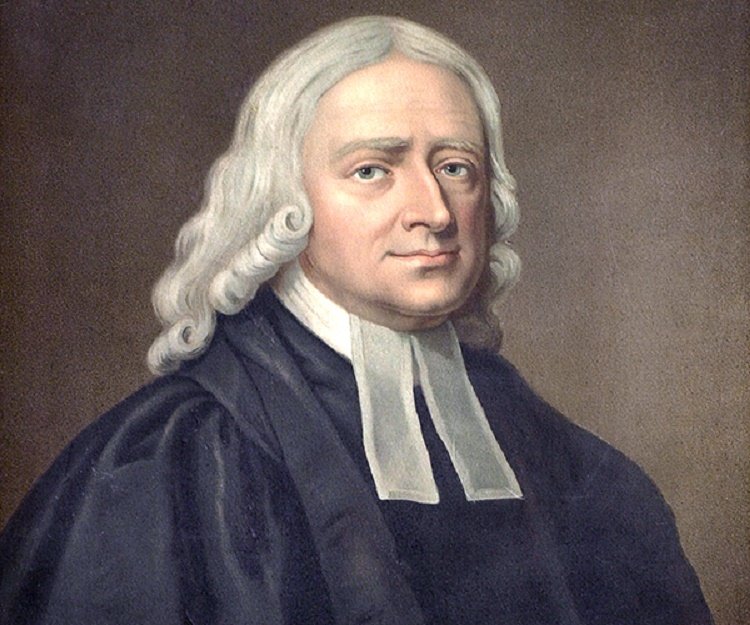
Much is being made these days in my (admittedly very narrow) slice of the world about what it means to be Wesleyan. “Wesleyan” in this case doesn’t refer to a particular denomination but to a broader theological stream birthed through an eighteenth-century movement and largely defined by the commentaries and sermons of John Wesley. Wesley himself once wrote a tract
When the Spirit of the Lord is upon your life you can play your harp because you have been anointed to handle hell, haters, and hypocrites.

I am “old school.” I freely admit it. When it comes to writing, whether it be drafting a letter or revising a doctoral thesis (and I have done both in the last year) I would rather sit down with paper and pencil than a laptop or tablet. Turns out, studies indicate, I am not alone; there is something about the mind-body
And so, among other things I’m giving up for Lent, I’m trying to give up the search to find some other hidden meaning. Perhaps I won’t get anything out of it. We don’t enter into the Lenten season practicing disciplines in order to achieve a particular return. It’s not an investment. Fasting and praying are not disciplines that we engage

I’m supposed to be sitting here writing something brilliant and thought-provoking. You (my audience) are well-versed in theology, social ethics, and various philosophies. You have high expectations, or you wouldn’t be here. Don’t get me wrong, I enjoy a good theological debate and I am passionate about the current social crises, but right now, I’m just really loving the font

“What’s for dinner?” It might be the most dreaded daily question an adult can be asked. If only there was a simple answer that did not hinge on a barrage of underlying questions: Who’s making dinner? What time are we eating? How many for dinner? Will there be any dislikes or allergies represented at the table? What’s in the cupboard?
Every morning I start off with the Morning Office. It’s an online version of the morning and evening prayer service found in the Book of Common Prayer. The service has scripture readings, prayers, and other useful tools for focusing on God. Each day’s reading starts off with a hymn. And while I usually focus on one of the scripture readings,

On a cold winter’s evening, whether to toast marshmallows, chat with friends or curl up and read a book, many of us might enjoy the opportunity to cozy up to a brightly burning fire in the hearth. But how many of us depend upon a fireplace—excepting in dire emergencies—to heat up our homes? The reality is, despite whatever scouting skills
Unless we hold God’s will as Christ held his Father’s, our gifts corrupt. They grow into the most sinister of idols, more powerful than the Baals.
It may just be that we don’t make connections between our experience of being in relationship with Jesus Christ and the experience of the rest of the world through massive efforts and structures. It may just be that it’s about the intimacy of crossing a footbridge to meet another in the middle.
We are called to be “strong but gentle,” called to “strive to make the right prevail,” through the light of God who is with us, who does not abandon us midday, whose purpose will not fail or crumble, who trains us to serve “a higher will.”

For my shield this day A mighty power: The Holy Trinity! Affirming threeness, Confessing oneness, In the making of all Through love… The breastplate of St. Patrick features this refrain at both the beginning and the end of its poem. St. Patrick’s invocation of the Trinitarian Godhead—Father, Son and Holy Spirit—is emblematic of Celtic Christianity. St. Patrick may be famously