
Singing Full Throttle by Kim Reisman
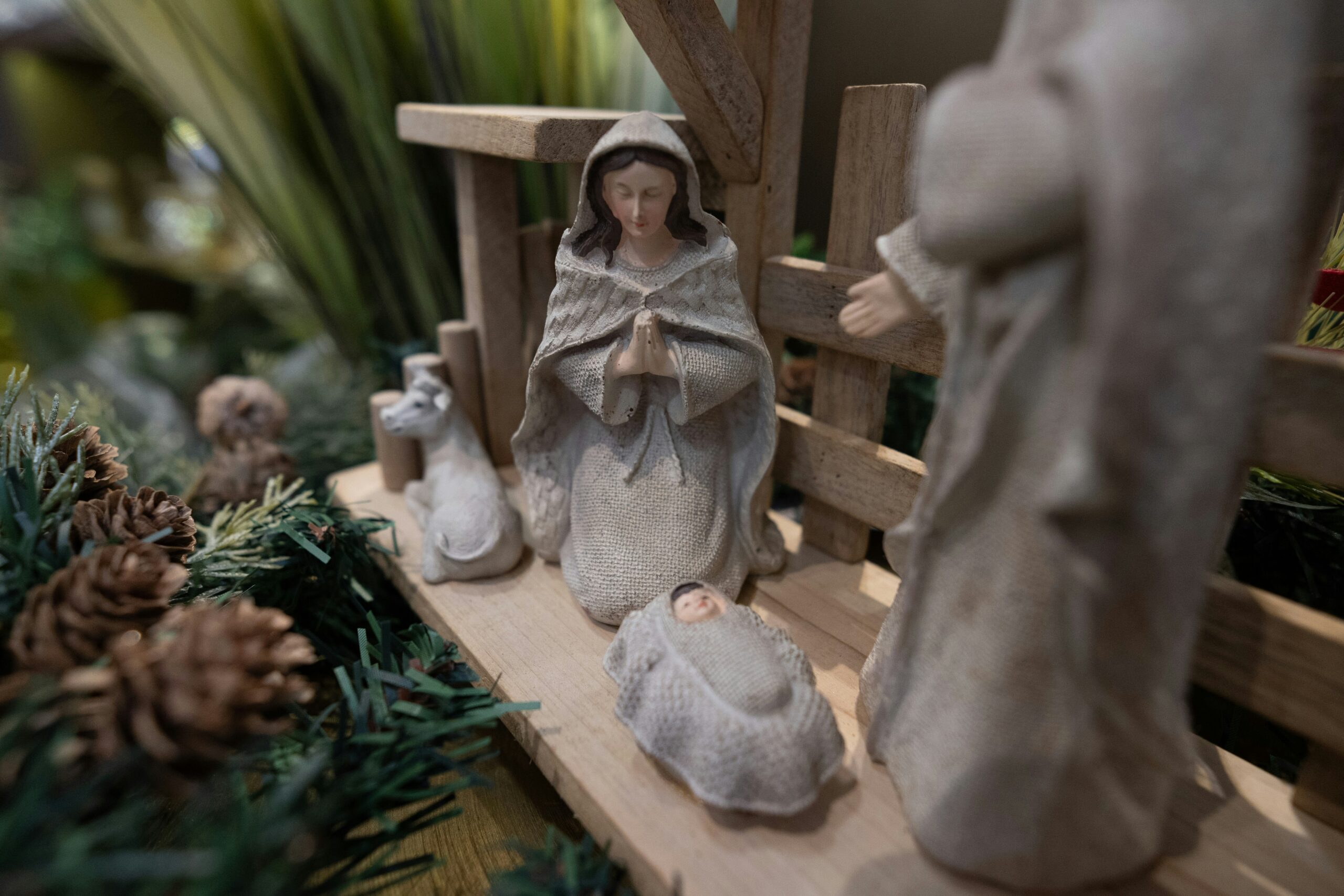
It’s a tradition in my family to have a formal “mother/child” photograph made of each child when they’re between three and six months old. When I was about six months old, my mother posed with me in a remarkable photo which my parents’ still have. It’s remarkable not because it’s of me, but because my mother and I are posed in the style of every classic image of the Madonna and child you can think of – my mother is even wearing a blue robe with a matching veil over her head. I too, posed with my children when each of them was about three months old. I couldn’t quite bring myself to don the robe and veil; but the warm, fuzzy feeling of a Madonna picture is there, nonetheless.
That’s what we’re celebrating these days isn’t it? The warm, fuzzy feeling of mothers and babies, nativity scenes illuminated by starry nights and halos? It makes sense that we get a Hallmark card kind of feeling from it all, because those types of images are rooted in our story of faith. I love the way Luke talks about Jesus’ entrance into our world. And yet it bothers me that it’s so easy to turn the whole thing into nothing but warm, fuzzy feelings.
I think it bothers me because when I think of Christmas, the first thing I think about isn’t nativity scenes or stables or shepherds; not even the baby Jesus. (what?!) Well, not exactly; but when I think about Christmas, before I ever contemplate Jesus, I think about Mary.
More often than not, year after year, Mary is at the heart of my Christmas reflection. Not the Mary of the whole Madonna and child genre, but the Mary who, when given the news that she was miraculously pregnant, boldly responds, “Let it be.” It’s the young woman who in recognizing what God was going to do through her becomes the first to announce God’s good news to the world, the first to proclaim that God’s kingdom of justice would soon be coming near and the first to suggest that God’s new world order would be a radical reversal of the way of the world. It’s Mary who endured the rigors of pregnancy, the disapproving stares of the self-righteous, the complexities of motherhood, the challenges of discipleship and the heartbreak of loss.
Years ago, Scot McKnight described Mary as the Blessed Valorous Mary. His description has stayed with me ever since. The Valorous Mary,
…wears ordinary clothing and exudes hope from a confident face. This Mary utters poetry fit for a political rally, goes toe-to-toe with Herod the Great, musters her motherliness to reprimand her Messiah-son for dallying at the temple, follows her faith to ask him to address a flagging wine supply at a wedding, and then finds the feistiness to take her children to Capernaum to rescue Jesus from death threats. This Mary followed Jesus all the way to the Cross – not just as a mother, but as a disciple, even after his closest followers deserted him. She leads us to a Christmas marked by a yearning for justice and the courage to fight for it. Like other women of her time, she may have worn a robe and a veil, but I suspect her sleeves were rolled up and her veil askew more often than not. [1]
That description resonates with me because it’s Mary’s response to Gabriel’s news that provides the foundation for the meaning she adds to my faith. Soon after the angel leaves, Mary heads to her cousin Elizabeth’s house. When she arrives, they have an intense moment of connectedness. Elizabeth blesses Mary, saying “You’re blessed because you believed that the Lord would do what he said.” (Luke 1:45) Mary’s response is a song about the amazing thing God is doing within her:
Oh, how my soul praises the Lord. How my spirit rejoices in God my Savior! For he took notice of his lowly servant girl, and from now on all generations will call me blessed. For the Mighty One is holy, and he has done great things for me. (Luke 1:46-49)
When I was growing up, I thought Mary’s song – what we often call the Magnificat – was beautiful; she was singing about how wonderful it was to be chosen as a God-bearer. The power of her song didn’t hit me, however, until much later, when I realized that there is a significant downside to being a God-bearer. That’s when Mary’s words became more than the personal rejoicing of a poor, pregnant woman and took on the assertive sound of the proclamation of the coming of God’s kingdom over and against all the kingdoms of this world.
Think about the power of her words. She didn’t just sing it one time to Elizabeth and that was it. Luke knew about her words and included them in his telling of the Jesus story. This tells me Mary’s words were really heard. That’s preaching at its finest.
And what was she preaching?
Mary was preaching about a new Kingdom, and that should give every ruler, every person of privilege or power, reason to worry.
“God shows mercy from generation to generation to all who fear him. His mighty arm has done tremendous things! He has scattered the proud and haughty ones. He has brought down princes from their thrones and exalted the humble. He has filled the hungry with good things and sent the rich away with empty hands. He has helped his servant Israel and remembered to be merciful. For he made this promise to our ancestors, to Abraham and his children forever.” (Luke 1:50-55)
That’s pretty strong stuff coming from a pregnant peasant teenager. That God was going to bring down princes from their thrones couldn’t have been good news to Herod the Great, or even to the Caesars in Rome. That God will ultimately scatter the proud and send the rich away empty-handed ought to make each of us think twice.
Obviously, there’s more to the story. The nature of Jesus’ work on earth had to unfold for Mary just as it does for each of us. That it would ultimately involve a cross I’m sure was as overwhelming a realization as any visit from an angel could ever be.
But the rest of the story will unfold in due time. At Christmas it’s enough for us to remember that there was more to Mary than art can convey. She was subversive; she was dangerous; because she knew who Jesus really was – Gabriel had told her. Mary was the one with the firsthand info – she alone received it from the angel, she alone encountered Elizabeth, she and Joseph alone knew about the shepherds and the magi.
The best part is that Mary didn’t just “quietly treasure those things in her heart.” (Luke 2:19) She took all the details given to her about who Jesus was – Savior, Son of the Most High God – all of what she had seen and heard and experienced, and she passed it all on to us.
As you celebrate the birth of the Son of the Most High God, I pray you will remember Mary, the God-bearer. The one God chose to release the power of the gospel, the power of God’s new world order. And I pray that you won’t just quietly treasure this good news in your heart, but that you would stand with Mary and sing full throttle.
[1] Scot McKnight, The Mary We Never Knew, Christianity Today. https://www.christianitytoday.com/2006/11/mary-we-never-knew/
Subscribe
Get articles about mission, evangelism, leadership, discipleship and prayer delivered directly to your inbox – for free