The Beautiful Gate by Kim Reisman
Why did they leave him at the gate? Why not take him all the way in? Did they not understand that he had spiritual needs as well?

Why did they leave him at the gate? Why not take him all the way in? Did they not understand that he had spiritual needs as well?
Wesley leads us to the heart of Lent and to the heart of every day of seeking the fullness of life in Christ: such a longing to please our Lord that we want the Holy Spirit to check us at the first sense of pride, wrong desire, or the wandering will — anything, that is, that might “quench the kindling

“The mission of the Church is to make disciples of Jesus Christ for the transformation of the world.” The Mission Statement of the United Methodist Church. I am an ordained United Methodist clergy and I have a confession to make. I have a love-hate relationship with the United Methodist mission statement. As a Wesleyan, I love it because it is
On Ash Wednesday, we recall through word and ritual, and even rejoice in, the fact that the Lord our God can bring new life out of the ashes of our brokenness.
A celebration of Easter without a prior descent into the grave is dishonest and naïve, just as observing Lent without the uncompromising proclamation of the Resurrection is hopeless.

Compassion comes from a deliberate identification with another person until we see things as he sees them, and feel things as she feels them. That’s the place to which God seeks to bring all of us.

Around the time the Methodist revival in England completed its first decade, John Wesley penned an essay called A Plain Account of the People Called Methodists. His aim is to explain the Methodist movement to the larger world, which he does by describing the various internal components of the revival that had developed during Methodism’s first ten years. One of

I’m a Yankee. Specifically, I was born in central Michigan, where the air is scented with pine needles and damp sand. I live in northeastern Texas – a region known for its own Piney Woods – but a world away from the cornfields of the Midwest, where I grew up. It may seem like a small question, but how does

I frequently lead workshops on prayer, which I always find kind of odd because I’ve never felt myself to be much of an expert on that kind of thing. Prayer is hard work for me; it’s meaningful, but it’s hard. During my workshops I always focus at some point on intercessory prayer – prayer for needs beyond our own –
Charles Wesley wrote songs for sinners. For those who were lost in sin, his hymns promised salvation, and for those who had come to Christ they were hymns that celebrated the day when it happened… These hymns are as true as ever and it is only our spiritual and doctrinal naivete that keeps us from seeing it.

Acts 17:16-34 contains Paul’s message to the Athenians at the Areopagus. Athens was considered the intellectual capital of the world. It was home to Socrates, Plato and Aristotle. Paul came to Athens during his second mission trip, seeking refuge. Earlier, he had been run out of Thessalonica by the synagogue crowd. He found a more congenial reception in Beroea, until
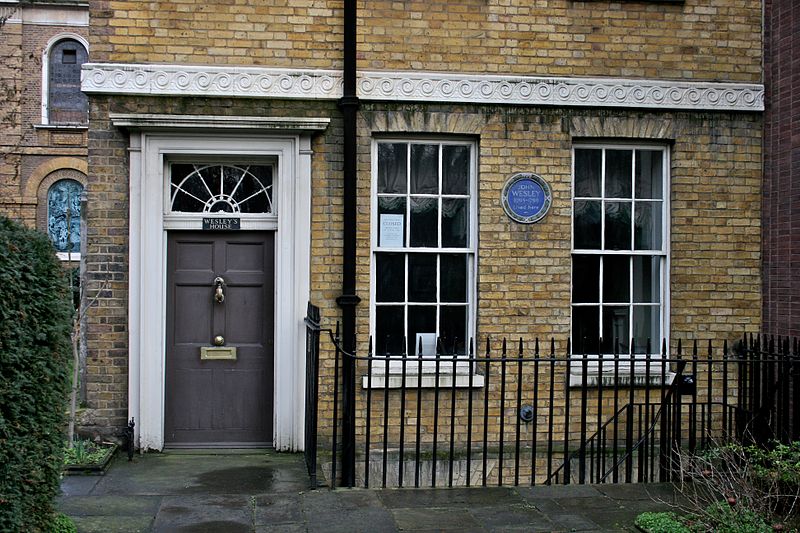
The good news is that we already have a basic blueprint for how to help people embrace faith in Jesus and become his apprentices. Methodist discipline, or the method that gave Methodism its name, was focused on helping people become deeply committed Christians, to become mature followers of Jesus Christ … The biggest challenge contemporary Wesleyans may face is our
This is a portion of the sermon preached on December 27, 2013, at the funeral service for Bishop McAlilly’s nephew Gale Stauffer, who was killed in the line of duty December 23, serving on the Police Force of the city of Tupelo, Mississippi. … little did we know that on this day of days, we would find ourselves moving so

Prevenient grace does not depend on any power or merit in man; no, not in any degree, neither in whole, nor in part. It does not in any wise depend either on the good works or righteousness of the receiver; not on anything he has done or anything he is. It does not depend on his endeavors. It does not

I received an e-mail from a pastor in Tennessee a few days ago posing this question: A church member asked me to recommend a biography on John Wesley, and I didn’t know what to suggest. Wondering if you could suggest something? That’s not an infrequent request to get for a seminary professor who teaches Methodist history. When I get an

I was thirty-two years old when a woman took my advice on how to die. Sitting in her low living room banked with windows that overlooked butterfly-laden bushes, I watched her shallow breaths. She had lost strength and energy: her frame seemed diminished, as if her soul were clinging to her body by mere tendrils. While disease sapped her vitality,
The weight of Christian worship history testifies that the Sunday service is primarily a gathering of, and for, the faithful. This is not to say that we shouldn’t consider how our worship services can best speak in the language of our local contexts. It isn’t to say that we shouldn’t consider if our gatherings are marked with radical hospitality and
Wesley knew how to be abased and how to abound. He intended, as did his brother John, to live all of life under God’s hand, whatever the circumstances of any given day.
Though it may seem to be the most difficult to define of the three, Wesley insists on including spirit with doctrine and discipline because right doctrine (belief) and right discipline (practice) are not enough in themselves.

There is a phrase in Wesleyan theology that holds the key to understanding most everything about present salvation. The phrase is “holiness of heart and life.” This is one of those terms that seems simple at first glance and yet is packed with meaning on multiple levels. It’s also a term worth exploring, and I want to explore it here.
I believe that we will discover the most promising way forward through a deep retrieval of our doctrine and a comprehensive re-reception of it at every level of our church, especially in the local church since that is the most significant arena for making and growing disciples of Jesus Christ. This retrieval project will be a long and difficult one,

Have you ever noticed the similarities between Major League Baseball and the United Methodist Church? Both organizations exist throughout the country and have a brand logo which is recognizable around the world. In the case of the MLB, professional baseball is played on other continents and plenty of MLB players call another country “home.” In a similar vein, the UMC

As a grown-up, I traveled to a hospital once to visit a friend who’d had surgery. A mutual friend accompanied me. I watched his anxiety with amusement. He was anxious about how to find the elevators, anxious about reading the hospital map, anxious about the visit itself. I discovered that this otherwise rational, intelligent adult was uneasy and uncomfortable in

The church today puts a lot of focus on the need to make disciples of Jesus Christ. But do we take seriously what that work requires of us? I’m not so sure. I am very sure, on the other hand, that we’re living in a culture that does us no favors when we even begin to approach the work of
But what we also fail to realize and consistently communicate is that anytime a clergy member has sex with a parishioner who is not their spouse, it is abuse. The emotional, spiritual, and even societal power granted to a pastor is intertwined and inseparable from all their relations within the church. We cannot, therefore, pretend that infidelity between pastors and
To whom shall we go? Ask yourself what’s the alternative BEFORE you leave and see all the options for the empty promises they are. And then fasten yourself to the eternal WHO towering over all the pretending WHATS.
God is in the midst of the normal – not just the fantastic, chocolate and sprinkled covered parts of life. God’s presence is made real when we take simple elements, like bread, and share it. This is why we should stick to what He invites us to do – offer the bread.
We ought to sing it more! Sing it, indeed, until we re-discover the power of this Name. Sing it until, as Charles Wesley urged, “Happy, if with my latest breath/ I may but gasp his name, / preach him to all and cry in death, / ‘Behold, behold the Lamb!’”

For some, it looks like gathering clouds. For others, a black hole. For some, it feels like dread or fear or hopelessness. For others, it feels more like guilt — the kind that won’t go away. It may feel like shame, or like anxiety that never eases up. It can leave one with questions, unable to function, and another unable

I bind unto myself today the strong name of the Trinity, the Three in One and One in Three – the space-maker who is the source of my freedom, the one who empowers me to defy the forces that seek to restrict me to unbending characterizations or rigid roles.
If contemporary Methodists are serious about robust catechesis, we must broaden our concept of the term. We must understand that baptism is a moment that shapes our entire life—a journey in holiness. We must break free from an approach to catechesis that is merely didactic and understand that the process of catechesis is anchored in the worshipping community. And we
I believe that Wesley can help us steer clear of the problem of moralistic therapeutic deism, as well as other barriers to renewal, so we stay on track in providing solid biblical teaching and preaching. He can do this with his robust vision of the Christian life, at once grace-filled and rigorous, communal and personal, leading to the goal of

When you hear the term “discipleship” what comes to mind? An educational program for adults in your church? The reflective/debriefing group sessions during a mission trip? A moment to promote a given ministry or event during the worship service? A particular pastor who serves at a multi-staffed church? Each one of us can probably come up with three or four

When is it time for ______? I googled that question and my search engine finished the question in these ways: When is it time for a divorce? When is it time for a nursing home? When is it time for hospice care? To buy a new car? To break up? To let go? To move on? When is it time
Our Lord’s ascension is, as I like to phrase it, “Easter’s exclamation point.” It tells us that the resurrection of our Lord is not simply a miracle, something to astonish us as with thousands of other miracles; it is a re-shaping of the order of the universe; it is the death of death. It is not simply a lengthening of
Jesus left His disciples. Jesus said, “I am with you always even to the end of the age.” (Matt. 28:20). It wasn’t much long after that He was taken up into the air. He leaves. What is the most common question or statement made by a person in crisis? Where is God in this? Some days I look around and
So, you spend all your time obsessing with others’ expectations of you. The simple truth is this: a life filled with others’ expectations is a life empty of God’s realities. The apostle Paul said it first in Galatians 1:10, “Am I now seeking human approval, or God’s approval? Or am I trying to please people? If I were still pleasing
Most churches have interns at one time or another. This can either be a great experience, or a terrible one (though it will probably be somewhere in between). Done well, an internship program can give you greater levels of effectiveness, train up next-gen leaders, and expand the possibilities for great future ministry in the church. Done poorly, it can eat
Here’s the deal with the whole alarm clock thing – the wake part is God’s work, and God did a pretty good job of it in releasing all that God energy into the world 2000 years ago. But now it’s the get up part. The question is, are we going to sleep right through?

I’ll bet there are roads you could drive blindfolded if you really needed to. Maybe it’s the road from your house to the entrance of your subdivision, or the route you take to work, or the circuitous path you carve in your daily routine – stop, start, turn, pause, start again. The rhythm of acceleration, brake, the swing of the