I’m not what you’d call an outdoorsy person. In fact, the only exercise I typically get is jumping to conclusions. So when I found myself at the bottom of a very steep hill in the Peak District of Derbyshire, legs already burning, lungs already protesting, I had a moment of serious doubt about my life choices.
But I’m getting ahead of myself.
Burnout in Ministry and the Need for a Sabbatical
In the summer of 2024, I was burned out. After ten years pastoring the same congregation — the longest I’d ever been in one place — I was running on fumes. The church had challenges. I had challenges. If you’d asked me to name one area of my life that was going really well, I couldn’t have told you a single thing. As we say in my home state of Tennessee, I felt lower than a snake’s belly.
I needed a sabbatical. More than that, I needed something I couldn’t quite name — a reset, a renewal, a way forward that didn’t involve just grinding harder.
That’s when the Peak Wesley Way appeared on my social media feed.
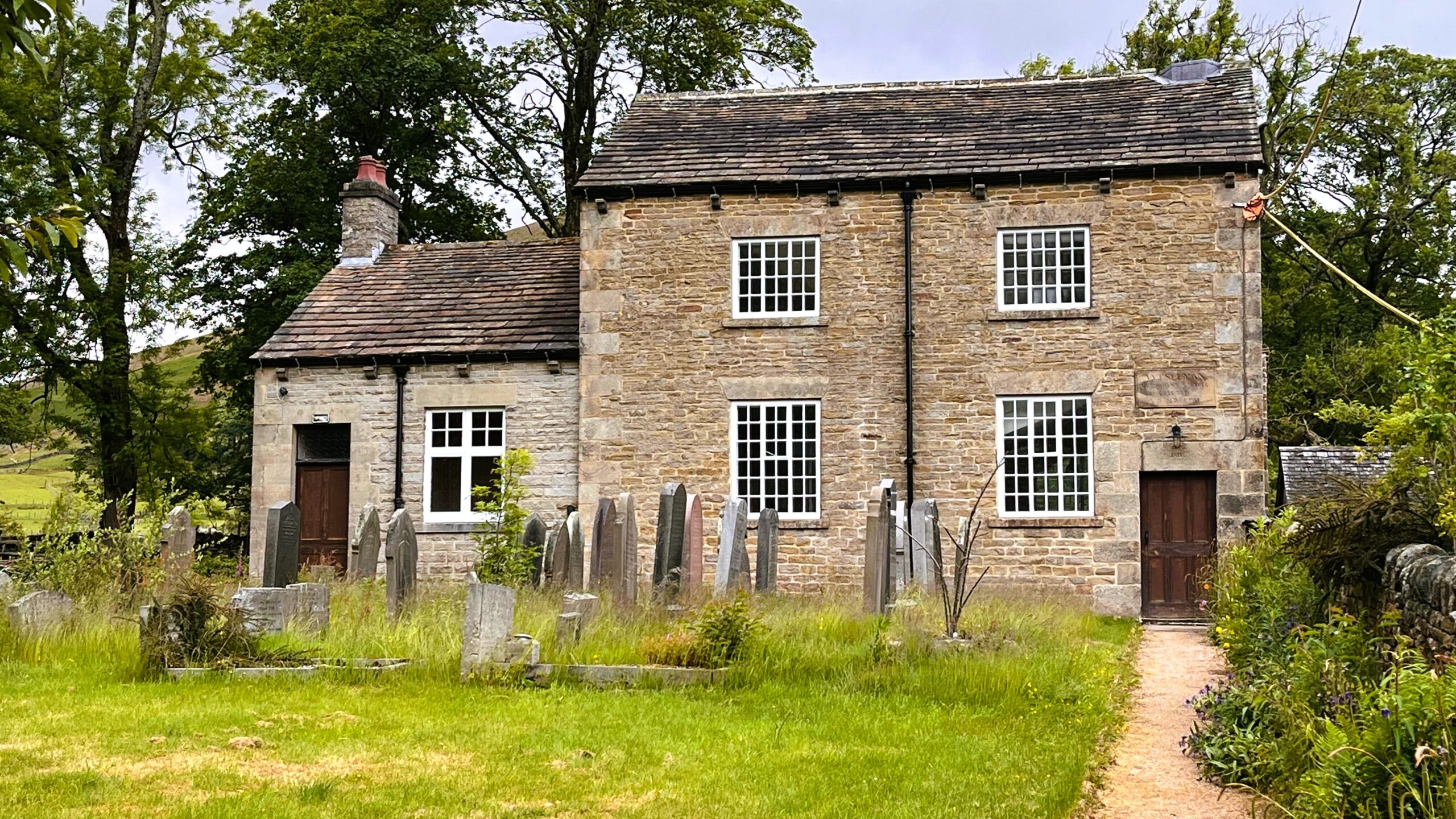
A six-day, 47-mile pilgrimage through the Peak District of England, connecting six Methodist chapels rooted in the early Methodist movement — places where Wesley and his helpers spread scriptural holiness across the Derbyshire hills. Sleep in the chapels. Walk the ancient paths. Follow in their footsteps — literally.
Something stirred in me. “If I ever get a sabbatical,” I thought, “I want to do that!”
In preparing for the journey, I rediscovered a Latin phrase attributed to St. Augustine that I’d heard years before but had nearly forgotten: Solvitur ambulando. It is solved by walking. This time, it stuck.
The early church fathers and mothers understood something we’ve largely forgotten: the rhythm of walking, the steady pace of one foot in front of the other, has a way of untangling the knots in our souls. Problems that seem insurmountable while sitting at a desk become manageable when you’re moving through the world at three miles per hour. Questions that have no answers in the abstract sometimes resolve themselves when you’re watching your feet find the path.
So in late May 2025, my friend and mentor Jorge Acevedo and I began walking. Six days. Forty-seven miles. More hills than I care to remember.
Solvitur Ambulando: Why Walking is the Ultimate Sabbatical Practice
Here’s what I discovered: traditional pilgrimages are journeys to somewhere — Santiago de Compostela, Canterbury, Mecca. The destination is the point. The holy site at the end justifies the journey.
The Peak Wesley Way is different. There’s no cathedral in Edale, the final village. No shrine, no relic. Just a small chapel most people have never heard of.
Because the destination is the pilgrimage.
The six chapels along the way — those are the shrines. The edges and valleys — that’s the sacred space. The act of walking itself, of carrying your weariness and your questions through landscape shaped by early Methodism — that’s what makes it holy.
And here’s the insight that changed something in me: Wesley walked thousands of miles preaching the gospel not because walking was how you got from one place to another, but because walking was the ministry. Movement was the method. The journey was the point.
We’ve forgotten this. We’ve made everything about arriving, achieving, accomplishing. About getting to the destination, taking the photo, checking the box, moving on.
But some things can’t be achieved. They can only be received. And you receive them by walking.
I won’t pretend I came home completely transformed. I still get tired. The church still has its challenges. But something shifted — something quiet that I couldn’t articulate at first but which has become clearer over time.
I’m less afraid of edges now. Less afraid of the steep climbs and uncertain paths. I’ve learned that you can be exhausted and still keep walking. That beauty appears in unexpected places. That the body and soul are connected in ways I’d forgotten.
Most of all, I’ve learned that when you’re stuck, when you’re burned out, when you can’t see a way forward — sometimes the answer isn’t to think harder or pray more or muscle your way through.
Sometimes the answer is simply to start walking.
Solvitur ambulando.
The problems don’t disappear, exactly. But they become bearable. The questions don’t all get answered. But they become less urgent. The darkness doesn’t vanish. But it becomes something you can walk through rather than something that crushes you in place.
If you’re reading this and you’re tired — if you’re standing at a crossroads wondering which way to go — I can’t tell you the answer. I don’t know your path.
But I can tell you this: it is solved by walking.
One step at a time. Along the edges. Through the valleys. Toward home.
The Peak Wesley Way is a six-day pilgrimage through the Peak District of Derbyshire, England, connecting six historic Methodist chapels. For more information, visit www.peakwesleyway.com or contact info@peakwesleyway.com