The Beautiful Gate by Kim Reisman
Why did they leave him at the gate? Why not take him all the way in? Did they not understand that he had spiritual needs as well?

Why did they leave him at the gate? Why not take him all the way in? Did they not understand that he had spiritual needs as well?
Wesley leads us to the heart of Lent and to the heart of every day of seeking the fullness of life in Christ: such a longing to please our Lord that we want the Holy Spirit to check us at the first sense of pride, wrong desire, or the wandering will — anything, that is, that might “quench the kindling

“The mission of the Church is to make disciples of Jesus Christ for the transformation of the world.” The Mission Statement of the United Methodist Church. I am an ordained United Methodist clergy and I have a confession to make. I have a love-hate relationship with the United Methodist mission statement. As a Wesleyan, I love it because it is
On Ash Wednesday, we recall through word and ritual, and even rejoice in, the fact that the Lord our God can bring new life out of the ashes of our brokenness.
A celebration of Easter without a prior descent into the grave is dishonest and naïve, just as observing Lent without the uncompromising proclamation of the Resurrection is hopeless.

Compassion comes from a deliberate identification with another person until we see things as he sees them, and feel things as she feels them. That’s the place to which God seeks to bring all of us.

Around the time the Methodist revival in England completed its first decade, John Wesley penned an essay called A Plain Account of the People Called Methodists. His aim is to explain the Methodist movement to the larger world, which he does by describing the various internal components of the revival that had developed during Methodism’s first ten years. One of

I’m a Yankee. Specifically, I was born in central Michigan, where the air is scented with pine needles and damp sand. I live in northeastern Texas – a region known for its own Piney Woods – but a world away from the cornfields of the Midwest, where I grew up. It may seem like a small question, but how does

I frequently lead workshops on prayer, which I always find kind of odd because I’ve never felt myself to be much of an expert on that kind of thing. Prayer is hard work for me; it’s meaningful, but it’s hard. During my workshops I always focus at some point on intercessory prayer – prayer for needs beyond our own –
Charles Wesley wrote songs for sinners. For those who were lost in sin, his hymns promised salvation, and for those who had come to Christ they were hymns that celebrated the day when it happened… These hymns are as true as ever and it is only our spiritual and doctrinal naivete that keeps us from seeing it.

Acts 17:16-34 contains Paul’s message to the Athenians at the Areopagus. Athens was considered the intellectual capital of the world. It was home to Socrates, Plato and Aristotle. Paul came to Athens during his second mission trip, seeking refuge. Earlier, he had been run out of Thessalonica by the synagogue crowd. He found a more congenial reception in Beroea, until
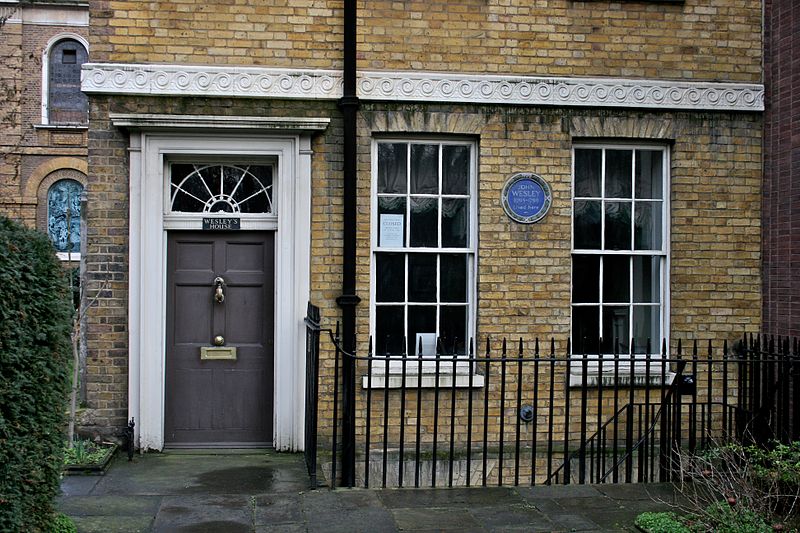
The good news is that we already have a basic blueprint for how to help people embrace faith in Jesus and become his apprentices. Methodist discipline, or the method that gave Methodism its name, was focused on helping people become deeply committed Christians, to become mature followers of Jesus Christ … The biggest challenge contemporary Wesleyans may face is our
This is a portion of the sermon preached on December 27, 2013, at the funeral service for Bishop McAlilly’s nephew Gale Stauffer, who was killed in the line of duty December 23, serving on the Police Force of the city of Tupelo, Mississippi. … little did we know that on this day of days, we would find ourselves moving so

Prevenient grace does not depend on any power or merit in man; no, not in any degree, neither in whole, nor in part. It does not in any wise depend either on the good works or righteousness of the receiver; not on anything he has done or anything he is. It does not depend on his endeavors. It does not

I received an e-mail from a pastor in Tennessee a few days ago posing this question: A church member asked me to recommend a biography on John Wesley, and I didn’t know what to suggest. Wondering if you could suggest something? That’s not an infrequent request to get for a seminary professor who teaches Methodist history. When I get an

I was thirty-two years old when a woman took my advice on how to die. Sitting in her low living room banked with windows that overlooked butterfly-laden bushes, I watched her shallow breaths. She had lost strength and energy: her frame seemed diminished, as if her soul were clinging to her body by mere tendrils. While disease sapped her vitality,
The weight of Christian worship history testifies that the Sunday service is primarily a gathering of, and for, the faithful. This is not to say that we shouldn’t consider how our worship services can best speak in the language of our local contexts. It isn’t to say that we shouldn’t consider if our gatherings are marked with radical hospitality and
Wesley knew how to be abased and how to abound. He intended, as did his brother John, to live all of life under God’s hand, whatever the circumstances of any given day.
Though it may seem to be the most difficult to define of the three, Wesley insists on including spirit with doctrine and discipline because right doctrine (belief) and right discipline (practice) are not enough in themselves.

There is a phrase in Wesleyan theology that holds the key to understanding most everything about present salvation. The phrase is “holiness of heart and life.” This is one of those terms that seems simple at first glance and yet is packed with meaning on multiple levels. It’s also a term worth exploring, and I want to explore it here.
On January 5, Christ followers all over the world will mark what is called Epiphany Sunday. It’s the Sunday we remember the wise men who undertook an arduous journey, following a star without completely understanding what it all meant, but knowing they were part of something larger than themselves. That is what was begun at Christmas really, a journey. The
WME’s launch of the Residency In Mission (RIM) has been a great success. Our first Resident, Eliza Edge, in now in her sixth month of service. Our second Resident, Annie Kate Leinius, arrived in New Zealand just in time for the New Year. Both Eliza and Annie Kate are serving in multi-ethnic congregations in the Wesleyan Methodist Church of New

What is some of the stuff you need to leave behind as you begin the new year? What can you drop off your weary, bending back to make your trek into the New Year a bit easier and far more meaningful?

If you have been a leader for very long, you have heard the question, “Why do we need to change?” In 1967, British Prime Minister Harold Wilson declared, “He who rejects change is the architect of decay. The only human institution which rejects progress is the cemetery.” (1) So we must change if we want to live. Long before the

Fred Rogers was an ordained Presbyterian pastor, but I believe that actually he was a Methodist deep down inside. Why do I say that? From my understanding of how he lived, I don’t know anyone who more fully lived out the concept of “prevenient grace.” Prevenient grace is the grace that goes before us, the grace that calls us into
In the midst of the Advent season, many church leaders are busy preparing for some extra special: Extra and Special worship services. These services generally draw people to church who have not been before or who have not been in a long time. These can be wonderful times of evangelistic energy. Newcomers to the church can be invited into the

“I’m pregnant!” The announcement demands a response. At times the response is easy: There are hugs and cheers, whoops, whirls, and texts—the group kind. At times the response is complicated: There are glances and glares, winces, wails, and tears—not the good kind. When a baby is a dream come true, the announcers set to painting a room, taking vitamins, writing

“The angels filled the sky saying, “Glory to God in the highest, and on earth peace to men.” How does “Emmanuel,” God with us, bring peace into our lives? In what area of your life would you like for God’s peace to come?”

“Ours is an age of noise. We exchange our history for comforting lies of other gods. We exchange our worship for spectacles. We exchange true justice for parodies, imitations, mimicry. We fill our lives with noise. We silence the Word of the Lord.
But the Word comes nevertheless, not in an earthquake or fire or rushing wind, but in

One Sabbath, when Jesus went to eat in the house of a prominent Pharisee, he was being carefully watched. There in front of him was a man suffering from abnormal swelling of his body. Jesus asked the Pharisees and experts in the law, “Is it lawful to heal on the Sabbath or not?” But they remained silent. So taking hold

And so you teach me:
Certainty has become my idol.
Predictability.
Expectations met.
That looks like faith to me:
I ask, knowing that you can.

There are quite a few opinions about a recent celebrity in the spotlight for a high-profile conversion to Christianity. Or an alleged conversion to Christianity, depending on your point of view. Which celebrity it is doesn’t matter as much, because any time a celebrity joins anything, the people who belong to the faith or organization are thrilled. It’s like getting
Let the message about Christ, in all its richness, fill your lives. Teach and counsel each other with all the wisdom he gives. Sing psalms and hymns and spiritual songs to God with thankful hearts. Colossians 3:16 (NLT) In many parts of the world, governments set aside a day dedicated to giving thanks. In the United States that day falls

Why might people who are poor be brokenhearted? God calls our actions and our attitudes to be right toward people with few resources.

“When Christ is squeezed from the Body of Christ by our own priorities and agenda as a congregation or through our busyness as leaders or disciples, what is left is little more than a corpse masquerading as a church.”

God has gently reminded me more than once that the onus for what he has promised is not on me. It is on him.
I was recently visiting my son who is away studying at University, and we attended Sunday worship at a church near his school. After the service, quite a few people stopped us to thank us for showing up to church. The congregation was made up of mostly older members who seemed thankful, relieved, and overjoyed that people from a younger

“Ruth’s life is not living up to her expectations. She is a childless widow, living in a foreign land, dependent on the favor of strangers. Enter the Redeemer – the one who can rewrite the ending of a story gone wrong, buying back tragedy and making way for restoration.”

It is October, which for pastors is Clergy Appreciation Month. Recently I polled clergy on their experiences of Pastor Appreciation in the midst of ministry. The results managed to surprise me. I was curious to know answers to what I thought was a fairly straightforward, simple question: what’s one of the most meaningful gifts or gestures you received for Pastor

As a Mexican, I did not know I was a Hispanic, too. The term “Hispanic” refers to people from Spanish-speaking countries and, in the United States, it is a technical demographic label or distinction used to identify people from a Spanish-speaking origin. Since in Mexico the primary language is Spanish, the term “Hispanic” is not commonly used to identify Spanish-speaking