A Call To Holy Compassion by Maxie Dunnam
We must be honest about our failures and sins. None of us lives up to the standards our faith demands. But this doesn’t mean we cease wrestling with and proclaiming the Word.

We must be honest about our failures and sins. None of us lives up to the standards our faith demands. But this doesn’t mean we cease wrestling with and proclaiming the Word.
Paul, called to be an apostle of Christ Jesus by the will of God, and our brother Sosthenes, To the church of God that is in Corinth, to those who are sanctified in Christ Jesus, called to be saints, together with all those who in every place call on the name of our Lord Jesus Christ, both their Lord and

I confess that I don’t know that much about adoption. I used to tell my little brother that he was adopted—from the animal shelter. I have reaped the consequences of this in my own sons, as the generational dysfunction marches on. I remember lying in bed as an angsty teen, wondering what it would feel like to be chosen, wanted,
What makes us think we can make such an audacious request? The resurrection of Jesus Christ.
Believing in a miracle, a rationally unexplainable occurrence, takes exactly what Tillich describes–a faith that transcends our comprehension without excluding our consciousness. In other words, we should know what we are asking for but not expect the miracle to come in ways we can

A proposed pipeline in my community has caused me to consider the nature of Christian faith and our lives as disciples. I’m not talking about the political, economic or environmental ramifications of pipelines, but the pros and cons of using the analogy of the Christian way of life, our discipleship, as a pipeline. On one hand, the idea of having
The mystery that surrounds us belongs to different modes of perception. That is why he said, “The heart has reasons the mind knows not of.” It is the heart that is able to see into that mystery. And it is why Paul said to the Ephesians, “I pray that God will enlighten the eyes of your heart, so you may
In his latest book, The Death of the Messiah and the Birth of the New Covenant: A (Not So) New Model of the Atonement, Michael Gorman argues that the ultimate purpose of Jesus’ atonement was to “create a transformed people, a (new) people living out a (new) covenant relationship with God together. Moreover, this people will not simply believe in

He described the Christian calendar as being like a spiral staircase: you come to the same point in the circle each year, but you have ascended higher up the stairs each year than you were the year before, or at least that is the purpose of the Christian calendar.

There I was, punching couch cushions, trying to keep my sudden, violent shouts muted so I wouldn’t wake up the kids. If you watched the University of Kentucky vs. Notre Dame college basketball game Saturday night, you know what I’m talking about: a nail-biter, an epic battle. “This is why we love sports,” a headline blazed the following morning. In

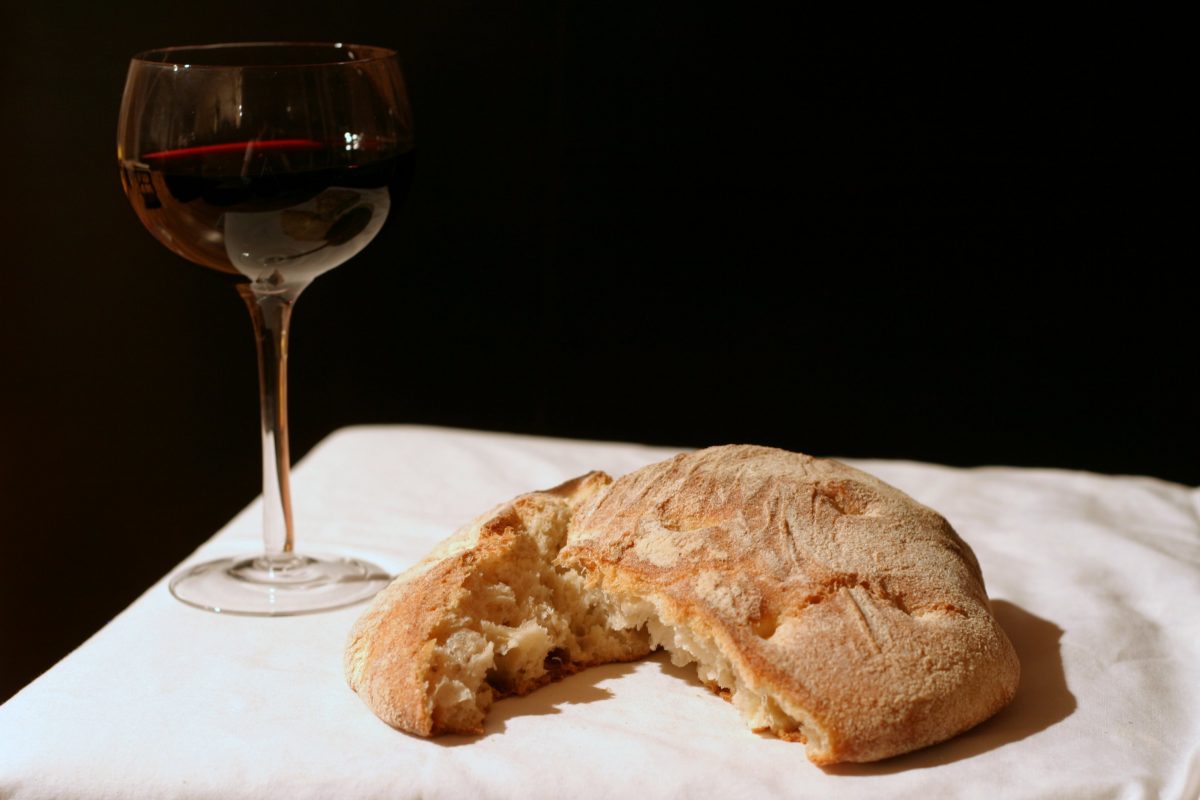
It has been said that the dinner table—that place where we eat, talk, and share life together with others—is an extension of the Eucharist.

Prayer. It is as natural as breathing. Most of us, regardless of faith, will find ourselves praying instinctively at some point in our lives. Typically, the prayer that flows unbidden from our heart is a prayer formed in our soul that expresses our deep distress as a plea of boldness for help or guidance. Or the prayer might be one

How can a loving God send people to hell? The text comes from John 3:16-21: “For God so loved the world that he gave his one and only Son, that whoever believes in him shall not perish but have eternal life. For God did not send his Son into the world to condemn the world, but to save the world through him. Whoever believes in him is not

Intuition is a direct knowledge or awareness of something without conscious attention or reasoning; it is non-intellectual perception. Nothing innately spiritual is either stated or implied in that definition. When a person allows the Holy Spirit to take control of his or her natural intuition, the result is spiritual intuition. Discernment through spiritual intuition provides deeper understanding and expands the
“I was headed in the wrong direction, even though the church was headed in the right direction.”
The sovereignty of God is a vitally important truth Wesleyans badly need to recover. This is not only because it is crucial for understanding the biblical drama, but also because many Wesleyans have tended to neglect it because Calvinists often give the impression that it is one of their distinctive doctrines. But the sovereignty of God is not a Calvinist
Because of a stand he took and a truth he spoke, Elijah is suddenly cut off from his family. From his hometown. From his kosher diet. From everything and everyone. And this is at a time in human history when there was no “you” apart from your group. In his exile the loss of relationships for Elijah was all-encompassing –

How much do you own? If you’re well-established (in whatever cultural context you find yourself), you likely have a general idea of your net worth: the sum total of assets in your possession. If you’re a Sophomore in college, you’d likely have to tally for a while: student debt vs. the worth of a ten-year-old Buick and a dorm room
“The efforts at Methodist liturgical revision that culminated in the 1989 United Methodist Hymnal and 1992 Book of Worship were often disregarded by those seeking to make their worship services more “contemporary.” As “contemporary worship” became an increasingly viable option for Methodists, many completely rejected the hymnal or anything that appeared to be rooted in the past. While Methodist “contemporary”
“Sanctification is not about something that I either have to do to make myself better, or for which I have to feel guilty about not being good enough. It is a ‘work of God’s grace.’ Entire sanctification is really nothing more than
God’s grace freeing us from everything that has kept us chained to sin and death. The Triune

Fasting is more than denying ourselves food. It is choosing to act out, by temporarily denying ourselves food, that we do not live by bread alone. We are completely dependent upon God, and we deliberately choose voluntary weakness. We become identifiably humble in the face of the problems with which we are dealing. We admit to each other, and primarily